






Abstract
Introduction:
With increasing surgical experience, pancreas-conserving surgery is slowly gaining acceptance with the aim to preserve the exocrine and endocrine function of the pancreas. 1 Median pancreatectomy is a parenchyma-sparing resection technique developed for borderline and benign pancreatic tumors localized in the pancreatic neck or proximal body when enucleation is not advisable. 2 This technique avoids distal pancreatectomy or pancreaticoduodenectomy. A laparoscopic approach to this surgery represents a recent advance.
Patients and Methods:
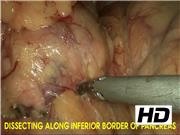
A 15-year-old girl presented with an incidentally detected pancreatic mass on an abdominal ultrasonography. A contrast-enhanced CT scan of the abdomen revealed a 5 × 6 cm hypodense lesion in the body of the pancreas with minimal patchy postcontrast enhancement. Her serum CEA/CA 19.9 levels were normal. An endoscopic ultrasound-guided fine needle aspiration cytology was reported as mucin-secreting papillary neoplasm. The patient was operated in French position with five ports that included a 10-mm umbilical camera port and a 5- and 12-mm left and right working ports, respectively, in the midclavicular line. The gastrocolic ligament was divided to visualize the pancreas along with the tumor. Next, dissection was done along the inferior border of the pancreas to expose the superior mesenteric vein and “tunnel of love” was developed. Furthermore, dissection was done along superior border of the pancreas to identify the splenic and hepatic arteries. Pancreatic neck was divided using a vascular stapler and body of the pancreas along with the tumor was dissected off the splenic vessels. Distal transection was done 1 cm from the tumor margin. The resected specimen was isolated in an endobag. Two stay sutures were taken on a distal pancreatic stump with 2-0 silk. Reconstruction was done by pancreaticogastrostomy. An anterior gastrotomy was done followed by a 2-cm posterior gastrotomy. The silk sutures of the distal stump were grasped through the posterior gastrotomy and the pancreatic stump was manipulated into the stomach lumen. Next, circumferential sutures between stomach and pancreatic stump were taken with 3-0 Prolene ensuring at least 2 cm of pancreatic stump length within the stomach lumen. The anterior gastrotomy was closed with a 2-0 barbed suture, a 28F drain was placed in the lesser sac and the specimen was delivered through a 5-cm Pfannesteil incision. The operative time was 250 minutes and blood loss was <100 mL.
Results:
The patient had a smooth recovery; drain was removed on the 3rd postoperative day and did not have a postoperative pancreatic fistula. She was discharged on the 8th postoperative day. The histopathology was solid pseudopapillary neoplasm of pancreas.
Conclusions:
Laparoscopic median pancreatectomy is a feasible procedure for patients with benign or borderline malignant pancreatic neck tumors. Pancreatic function can be effectively preserved but patient selection is of paramount importance as higher rate of complications may be expected when compared with distal resections.
No competing financial interests exist.
Runtime of video: 11 mins 8 secs
This video was presented at the 13th International Congress of the Association of Minimal Access Surgeon of India, Lucknow, India, in November 2018. This was awarded the gold medal.


Keywords
Get full access to this article
View all access options for this article.