





Abstract
Introduction and Objective:
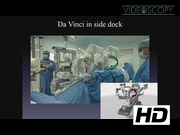
Laparoscopic dismembered Anderson–Hynes pyeloplasty (AHP) has a steep learning curve. Postanastomotic dismembered (PAD) pyeloplasty is a technical modification combining the ease of nondismembered with the excellent outcomes of dismembered pyeloplasty. The addition of dexterity of the robotic endowrist to this technique ensures replication of gold standard open AHP. Herein we present a case of robotic PAD pyeloplasty in a malrotated ectopic pelvic kidney in an adolescent.
Methods:
A 16-year-old male presented with pelviureteral junction obstruction in left ectopic pelvic kidney. A preoperative three-dimensional reconstruction of the complicated vascular supply and pelvic anatomy was created using contrast enhanced CT of kidney, ureter, bladder. Robotic PAD pyeloplasty was performed by initial partial division of the dilated pelvis and ureteral spatulation without dismembering the ureteropelvic junction. Both layers of ureteropelvic anastomosis are completed before dismemberment.
Results:
The estimated blood loss was 50 mL, console time was 60 minutes, and hospital stay was 3 days.
Conclusions:
The PAD technique has several practical advantages such as preserving orientation, providing a tissue handle for traction, and decreasing the operative time. Effective application of robotic PAD to an ectopic pelvic kidney is dependent on familiarity with pelvic anatomy, optimal positioning and port placement, and preprocedure knowledge of the anomalous vascular anatomy.
No competing financial interests exist.
Runtime of video: 7 mins 37 secs


Get full access to this article
View all access options for this article.