





Abstract
Aims and Objectives:
Laparoscopic Anderson Hynes pyeloplasty has a steep learning curve. 1 We present technical recommendations for laparoscopic postanastomotic dismembered (PAD) pyeloplasty and pyelolithotomy, with novel coordination of two screens.
Methods:
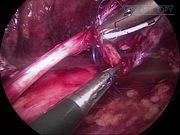
A 10-year-old female with right renal calculi and pelvi-ureteric junction obstruction underwent laparoscopic PAD pyeloplasty. Initial partial division of the dilated pelvis and ureteral spatulation was performed without dismembering the ureteropelvic junction. Two monitors were simultaneously used. One was to show the laparoscopic vision that helped the surgeon guide the flexible nephroscope into the partially divided renal pelvis to retrieve the caliceal calculi through the port under direct vision. A note of caution is to make a reasonable attempt at retrieval respecting the tissue integrity as this is a reconstructive surgery.
Results:
The estimated blood loss was 30 mL, operating time was 150 minutes, and hospital stay was 4 days. Of the total of 179 pyeloplasties done between January 2010 and March 2015 at our institute, 71 were pediatric cases (<18 years). Of these, 3 were open, 26 were laparoscopic, and 42 were robotic pyeloplasties.
Conclusions:
Double screen surgery with good hand-eye coordination between two surgeons may help achieve stone clearance along with reconstructive surgery. 2 Uncleared stones may be subsequently cleared with ultramini PCNL/micro PCNL at time of stent removal.
No competing financial interests exist.
Runtime of video: 6 mins 39 secs


Keywords
Get full access to this article
View all access options for this article.