





Abstract
Introduction:
A Morgagni hernia is a congenital herniation through a retrosternal defect in the diaphragm. They represent 3% of congenital diaphragmatic hernias. 1,2 Morgagni hernias should be repaired based on the risk of complications. 2,3 Laparoscopic repair has been demonstrated to be safe and effective. 1,4 Robotic techniques for repair of a Morgagni hernia has recently been described. 5 This video demonstrates a robot-assisted laparoscopic Morgagni hernia repair.
Materials and Methods:
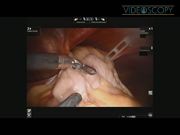
A 21-year-old male presented with intermittent abdominal pain and underwent a computed tomography that diagnosed a Morgagni hernia. An elective, robot-assisted, laparoscopic Morgagni hernia repair was recommended. The patient was positioned supine and three robotic ports (two instrument ports and one camera port) and one assistant port were placed. The contents of the defect were reduced, including omentum, small bowel, and transverse colon. The robotic approach facilitated safe and easy excision of the hernia sac. The defect measured 5 × 3 cm, and the repair was accomplished with polytetrafluoroethylene (PTFE) mesh secured through interrupted sutures. The mesh was secured as a patch.
Results:
The patient had an uneventful recovery and was discharged by postoperative day two tolerating a regular diet with minimal pain. At 12-month follow-up, preoperative symptoms were resolved and the chest x-ray demonstrated no evidence of recurrence.
Conclusions:
A robot-assisted repair of a Morgagni hernia with mesh can provide a tension-free repair. A patch repair was elected in this case in lieu of a primary repair due to the size of the defect and the goal of providing a tension-free repair. Both primary closure and patch repair have been well described for Morgagni hernias with low recurrence rates. 1 However, there is no consensus on the best type of mesh and when to use mesh for a Morgagni hernia. Our group has effectively performed primary repairs using a laparoscopic and a robotic approach for Morgagni defects up to 5 cm. However, a PTFE patch repair is used for larger defects or those defects with undue tension following a primary repair. Although dissection of the hernia sac from the mediastinal and pleural structures may be challenging from a transabdominal approach, the robot-assisted approach made this step of the dissection quite easy. In addition to providing excellent exposure and facilitating dissection, robotic suturing was superior in our opinion relative to laparoscopic suturing techniques. Robot-assisted laparoscopic repair of a Morgagni hernia is a feasible and safe approach that provides a tension-free repair. However, this technique requires advanced surgical skills. Also, larger case series with or without mesh repairs with longer follow-up are needed to compare the robotic approach with other minimally invasive or open techniques.
Runtime of video: 8 mins 16 secs
This video was presented at the AATS Annual Meeting in Baltimore, MD, May 2016.


Get full access to this article
View all access options for this article.