





Abstract
Introduction:
Traditionally, open resection with hepaticojejunostomy reconstruction has been the surgical treatment for cases of choledochal cyst. Our center has recently transitioned from open to laparoscopic and hepaticojejunostomy to hepaticoduodenostomy as our preferred method of excision and biliary reconstruction.
Methods:
This video shows a method adapted at our center to simplify the biliary enteric anastomosis.
Results:
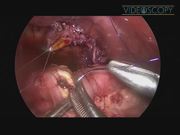
Complete resection of the choledochal cyst is carried out. A duodenotomy is then made at least 2 cm from the end of the pylorus. A lateral corner retraction suture is then placed through both the bile duct and the duodenum to improve exposure. Two long-lasting monofilament sutures are then cut to 8 to 10 cm each and tied extracorporeally. This united suture is then placed intraabdominally and one needle is passed from outside to inside on the bile duct and the process is repeated on the duodenum with the opposite needle. This allows the previously tied knot to be placed on outside the medial corner. The strand intended for the anterior row is then retracted to the patient's left. The posterior row of the anastomosis is then completed in a running fashion. The anterior row is also completed in a running fashion and the two strands are secured intracorporeally at the outside lateral corner. The previously placed traction suture is then tied using an extracorporeal knot pusher.
Conclusion:
Biliary enteric anastomosis after choledochal cyst at our center has been simplified by transitioning to a hepaticoduodenostomy, creating a duodenotomy ≥2 cm from the pylorus and tying the two strands of suture extracorporeally before beginning the anastomosis.
Runtime of video: 3 mins


Keywords
Get full access to this article
View all access options for this article.
Supplementary Material
Please find the following supplemental material available below.
For Open Access articles published under a Creative Commons License, all supplemental material carries the same license as the article it is associated with.
For non-Open Access articles published, all supplemental material carries a non-exclusive license, and permission requests for re-use of supplemental material or any part of supplemental material shall be sent directly to the copyright owner as specified in the copyright notice associated with the article.
