





Abstract
Background:
Chronic pericardial effusions may present with a spectrum of symptoms. When the volume of fluid in the pericardium increases briskly, it may compromise cardiac function. In such cases, urgent pericardiocentesis for short-term management is indicated. A more permanent solution is the creation of a pericardial window. In children, this is mostly performed through a subxiphoid open approach.
Objective:
We describe a thoracoscopic technique for creation of a pericardial window in a toddler.
Case:
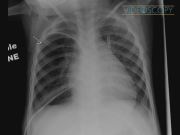
A 2-year-old girl with Down syndrome with acute myeloid leukemia treated with bone marrow transplant developed a large, chronic pericardial effusion as a result of graft-versus-host disease. Several attempts of ultrasound-guided pericardiocentesis were performed, with reaccumulation of the fluid and signs of cardiac tamponade within a few days. After stabilization, she was taken to the operating room where a pericardial window anterior to the right phrenic nerve was created thoracoscopically using ultrasound shears. An 8F Jackson–Pratt drain was placed as a chest tube.
Results:
The procedure was well tolerated by the patient, and hemodynamics improved immediately. The operative time was 36 minutes and the blood loss was minimal. The chest tube was removed on postoperative day 8, at which time the cardiac silhouette had normalized. A chest CT performed 1 month later for worsening pulmonary status showed no recurrent pericardial or pleural effusion.
Conclusions:
Pericardial windows can be performed safely via a thoracoscopic approach in children with symptomatic chronic pericardial effusions. The procedure is simple and quick and normalizes cardiac function immediately. The surface area of the pleura seems to be adequate for resorption of the pericardial fluid in this case.
No competing financial interests exist
.
Runtime of video: 3 mins


Get full access to this article
View all access options for this article.
Supplementary Material
Please find the following supplemental material available below.
For Open Access articles published under a Creative Commons License, all supplemental material carries the same license as the article it is associated with.
For non-Open Access articles published, all supplemental material carries a non-exclusive license, and permission requests for re-use of supplemental material or any part of supplemental material shall be sent directly to the copyright owner as specified in the copyright notice associated with the article.
