





Abstract
Introduction:
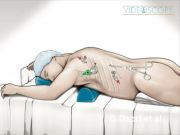
Boerhaave's syndrome is an emergency disease related to high risk of mortality and morbidity. 1 Surgical treatment is usually performed by thoracotomy or thoracoscopy with the patient in lateral position. 2 The author reports a patient with a distal esophageal perforation repaired by left thoracoscopy in prone position.
Materials and Methods:
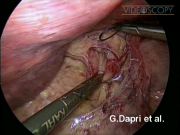
A 44-year-old man was admitted to emergency room after 14 hours of an episode of vomiting and hematemesis. Preoperative work-up evidenced a perforation of the distal esophagus on the left side, associated to a pneumomediastinum. The patient underwent left thoracoscopy in prone position, after induction of general anesthesia using the Carlens double-lumen tube. Three trocars (5, 10, and 5 mm) were placed in the 5th, 7th, and 10th intercostal spaces, respectively. The exploration of the chest cavity showed the presence of free liquid and fibrin, without evident esophageal perforation. The latter was, however, demonstrated after the dissection of the mediastinal pleura and appeared to be 2 cm in length. A nasogastric tube was advanced into the stomach under view, and a supplementary trocarless grasper was placed in the 10th space to improve field exposure. The esophagus perforation was closed using 2/0 silk interrupted sutures, with a reinforcement patch using the inferior pulmonary ligament. The cavity was cleaned and a chest tube replaced the 5-mm trocar in the 10th intercostal space, with its tip close to the suture.
Results:
The operative time was 90 minutes, and no significant operative bleeding was noted. The patient was hospitalized in the intensive care unit and extubated after 24 hours. A chest tube was placed in the right chest after 10 days for a pleural effusion, and a pericardic drain was placed after 16 days for pericardic tamponade. The gastrograffin swallow at 10 days showed a residual sinus at the site of the perforation, and a repeat gastrograffin swallow at 20 days was negative for leak. The patient was allowed to be discharged after 32 days.
Conclusions:
Esophageal perforation can be treated by thoracoscopy in prone position because the access is advantageous, thanks to the effect of gravity force on the cardiopulmonary organs. Success of the primary suture depends on the timing between the incidence of the disease and the treatment; however, the morbidity remains high.
No competing financial interest exist.
Runtime of video: 6 mins 48 secs

Keywords
Get full access to this article
View all access options for this article.
References
Supplementary Material
Please find the following supplemental material available below.
For Open Access articles published under a Creative Commons License, all supplemental material carries the same license as the article it is associated with.
For non-Open Access articles published, all supplemental material carries a non-exclusive license, and permission requests for re-use of supplemental material or any part of supplemental material shall be sent directly to the copyright owner as specified in the copyright notice associated with the article.
