





Abstract
Dynamic training and real-time movements of the laparoscope using the postural mechatronics assistance for solo surgery (PMASS).
Introduction:
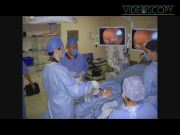
Currently available robotic assistants have proven to be useful in the operating room, 1 but do not provide real-time assistance, lack portability, and are technologically complex to set up. During surgery, the handle of the laparoscope is dynamic and requires continuous manipulation in real time. An easy-to-use, fit-for-purpose, real-time laparoscopic assistant would be highly beneficial to the laparoscopic surgeon and facilitate solo surgery. The ideal laparoscopic assistant should be intuitive and allow location of the surgical target in real time so that the surgeon can adequately control the surgery. We therefore designed the PMASS, which consists of a harness placed on the surgeon's chest and a mechanical arm connected to the harness. PMASS facilitates solo surgery through simple postural control and foot pedals. In this video, we introduce PMASS, test its function using a set of tasks, and discuss its strengths and limitations.
Materials and Methods:
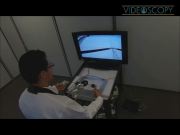
PMASS, Box trainer, and Commercial TV monitors. PMASS was designed using desktop engineering design software (Autodesk AutoCAD Mechanical) and the simulated dynamics of the movements were evaluated and visualized using the Nastram software package. The functionality of PMASS was tested using three tasks from the MISTELS training program (knotting, cutting, and transferring) on the Laparoscopic Home Trainer. 2,3 Each required a wide range of manipulations of the laparoscope, from almost static to totally dynamic, to fully test the system.
Video Description:
00.57 PMASS description; 03.28 Execution of tasks; 05.20 Results.
Results and Conclusions:
PMASS consists of a harness and a mechanical arm. The up-down position is controlled by pedals that move the laparoscope, which is attached to the end of the arm, thus modifying the angle of view at the point of entry. The postural movements of the surgeon move the laparoscope in and out of the work area, while rotation of the torso controls left to right (horizontal) viewing. All tasks were performed easily and allowed the surgeon to assist himself and handle the laparoscope and other instruments. PMASS is intuitive and allows navigation in three degrees of freedom of movement (in-out, left-right, and up-down). Camera motion on its own axis is also available, but currently needs to be performed manually. PMASS does not adversely affect patient safety, which is ensured by carefully controlling movements, preventing abrupt changes, maintaining sterility in the operating room, and directly viewing the instruments at all times. 4 –7 The main advantages of PMASS are hands-free self-assistance of the optics in real time, tremor is not perceived in the visual feedback, and intuitive handling. The current design is suitable for situations in which the surgeon, monitor, and target are all in a straight line, although users have noted that continuous and sustained use tires the shoulder and neck. However, PMASS allows the surgeon to control the surgical scenery and provide hands-free self-assistance in real time.
The authors have no conflicts of interest to disclose.
Runtime of video: 7 mins 08 secs

Get full access to this article
View all access options for this article.
References
Supplementary Material
Please find the following supplemental material available below.
For Open Access articles published under a Creative Commons License, all supplemental material carries the same license as the article it is associated with.
For non-Open Access articles published, all supplemental material carries a non-exclusive license, and permission requests for re-use of supplemental material or any part of supplemental material shall be sent directly to the copyright owner as specified in the copyright notice associated with the article.
