





Abstract
Introduction:
We report a pure Natural Orifice Translumenal Endoscopic Surgery (NOTES) rectosigmoidectomy in animal models using transgastric endoscopic inferior mesenteric artery (IMA) dissection and transanal rectal mobilization.
Methods:
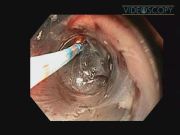
NOTES rectosigmoidectomy was performed on ten live animals (two pigs weighing 35–40 kg each, and eight dogs weighing 25–30 kg each) and the video showed a procedure on a dog. Under general anesthesia, a gastroscope (Olympus, Tokyo, Japan) was introduced perorally into the stomach. After incision of the gastric submucosal cushion, a transparent hood was added. A gastrotomy was made following the creation of a submucosal tunnel. After the passage of the endoscope into the peritoneal cavity, a circular stapler shaft was transanally inserted up to the sigmoid colon for spatial orientation and traction of the mesocolon. 1 The IMA was endoscopically dissected using coagrasper (FD-410LR; Olympus), and then clipped using endoscopic clips (hx-600–90; Olympus), two proximal and one distal. Endoscopic division of the sigmoid mesocolon was conducted laterally toward the marginal artery, which was divided with the coagrasper. The rectal mucosa was incised circumferentially 2 cm proximal to the dentate line using the monopolar and Harmonic Scalpel® (Ethicon Endo-Surgery, Cincinnati, OH). Transanal full-thickness circumferential rectal and mesorectal dissection was performed. Mobilized rectosigmoid and sigmoid mesentery were exteriorized transanally and transected. A colorectal anastomosis was performed using a circular stapler with a single stapling technique. The anastomosis was inspected using a colonoscope. During the transanal approach, gastrotomy was closed using four endoscopic clips. After finishing the operation, laparotomy was performed to inspect the gastrotomy closure site, and confirm air-tightness with over-insufflation of the stomach.
Results:
Endoscopic dissection of the IMA was successful in all cases, but minor bleedings occurred in three cases. The mean time from dissection and clipping to division of the IMA was 36.7 minutes (range, 25–45 minutes). The mean operation time was 180.5 minutes (range, 145–210 minutes). There were no intraoperative complications or hemodynamic instability. The mean length of the resected specimen was 11.2 cm (range, 9–17 cm).
Conclusions:
A pure NOTES approach to rectosigmoid resection using transgastric endoscopic IMA dissection is technically feasible in animal models.
The authors have no potential conflicts of interest to be disclosed
.
Financial Disclosure: This research was supported by the Kyung Hee University Research Fund in 2011 (KHU-20110930).
Runtime of video: 4 mins 30 secs


Keywords
Get full access to this article
View all access options for this article.
References
Supplementary Material
Please find the following supplemental material available below.
For Open Access articles published under a Creative Commons License, all supplemental material carries the same license as the article it is associated with.
For non-Open Access articles published, all supplemental material carries a non-exclusive license, and permission requests for re-use of supplemental material or any part of supplemental material shall be sent directly to the copyright owner as specified in the copyright notice associated with the article.
