





Abstract
Introduction:
Anterior diaphragmatic hernias of the Morgagni type are the least common type of congenital diaphragmatic hernia and account for about 6% of all cases. Morgagni hernias often present as an incidental finding on a chest radiograph. Most pediatric surgeons would advocate for elective repair in asymptomatic patients. Laparoscopic repair of Morgagni hernia in children has been previously described. 1 –3 As the hernia itself produces minimal symptoms, postoperative cosmesis is often of great concern to the parents of the affected child. Percutaneous suturing techniques have been previously described for single-incision laparoscopic surgery. We present our technique of virtually scarless single-incision pediatric endosurgical (SIPES) repair of a Morgagni hernia.
Case:
The patient was a 20-month-old female child who presented to our hospital with fever and persistent cough. A chest radiograph was obtained, showing an anterior diaphragmatic hernia. The finding was confirmed on computed tomography. The patient recovered from her acute illness and after discussion with the parents, she was scheduled for an elective SIPES repair. A 2-cm longitudinal incision was made in the umbilicus, and a proprietary laparoendoscopic single-site trocar was introduced. A 5-mm 70-degree endoscope was used for visualization, providing an anteriorly angulated view of the operating field. The herniated bowel was easily reduced into the abdomen using two straight bowel graspers. The posterior diaphragmatic rim was clearly visualized. The fundus of the hernia sack was grasped and the entire sack was inverted into the abdomen. The sac was ligated at the base with an endoscopic loop tie, and excised using hook electrocautery. The defect was repaired primarily using 2-0 braided polyester percutaneous sutures. The first stitch was placed intracorporeally to approximate the medial portion of the diaphragm to the anterior abdominal wall. The muscular lip of the diaphragm was then sutured to the xiphoid process and the periostium of the right and left lower costal angle using percutaneous sutures. The last suture detached from the needle, and we used a Berci fascial closure device to complete the stich.
Results:
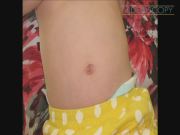
The total operative time was 198 minutes. The patient recovered uneventfully and was discharged home on postoperative day 3. Follow-up at 9 months was unremarkable and the scar was well hidden in the navel.
Discussion:
Morgagni hernias in children are rare and are generally asymptomatic. Traditional repair involves open or laparoscopic techniques. Single-incisional pediatric endosurgical techniques have been developed to address many common pediatric conditions. 4 –7 Single-incisional techniques allow for improved cosmesis, which may be particularly important for parents with children affected with elective surgical conditions. SIPES Morgagni diaphragmatic hernia repair is a reasonable alternative to traditional open or conventional laparoscopic techniques. Percutaneous suturing technique allowed us to anchor the rim of the diaphragm securely to the cartilaginous portion of the xiphoid and the costal periostium, which may prevent recurrence.
The authors have nothing to disclose.
Run time of video: 4 mins 32 secs
Presented at International Pediatric Endosurgery Group: 21st Annual Congress, San Diego, California. March 6–10, 2012.


Keywords
Get full access to this article
View all access options for this article.
References
Supplementary Material
Please find the following supplemental material available below.
For Open Access articles published under a Creative Commons License, all supplemental material carries the same license as the article it is associated with.
For non-Open Access articles published, all supplemental material carries a non-exclusive license, and permission requests for re-use of supplemental material or any part of supplemental material shall be sent directly to the copyright owner as specified in the copyright notice associated with the article.
