





Abstract
Introduction:
Total extraperitoneal repair (TEP) has become a popular technique for inguinal hernia repair. 1,2 The minimal invasive technique has multiple benefits such as less postoperative pain and reduced length of hospital stay. 3 –5 We present a case of a TEP inguinal hernia repair with one reusable 7-mm port assisted by a (Veress) needle.
Materials and Methods:
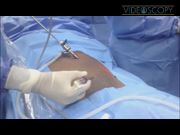
We selected a patient with a small medial inguinal hernia of the left side and a low body–mass index (BMI; 20.15 kg/m2); previous history only showed an open Lichtenstein inguinal repair of the right side. We used one reusable 7-mm port and a Veress needle as a dissecting tool. We present a video of the procedure describing every detailed aspect, from an inside and outside view. The run time of the video is 4 minutes and 47 seconds. The video is accompanied by English narration.
Results:
The procedure was performed safely, swiftly, and uneventfully with the 7-mm port and a blunt Veress needle (24 minutes operating time). Postoperative evaluation and follow-up visits were uneventful.
Discussion:
Although a surgeon with vast experience in minimal invasive surgery performed the procedure, because of the relative ease of this first case, we think this procedure could also be possible in patients with a higher BMI or a more complex hernia.
Conclusion:
We present the case of a novel technique of an inguinal hernia repair using only a conventional reusable 7-mm port and a needle. To our knowledge, this technique has never been described before. The procedure was performed safely and swiftly with an uneventful postoperative recovery and 3-month follow-up. This novel procedure warrants further study through consecutive series and controlled trials to determine its validity.
No competing financial interests exist.
Runtime of video: 4 mins 47 secs


Keywords
Get full access to this article
View all access options for this article.
References
Supplementary Material
Please find the following supplemental material available below.
For Open Access articles published under a Creative Commons License, all supplemental material carries the same license as the article it is associated with.
For non-Open Access articles published, all supplemental material carries a non-exclusive license, and permission requests for re-use of supplemental material or any part of supplemental material shall be sent directly to the copyright owner as specified in the copyright notice associated with the article.
