





Abstract
Introduction:
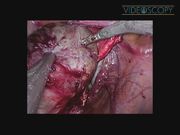
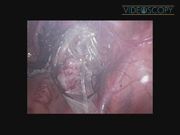
With the advent of laparoendoscopic single-site surgery (LESS) techniques emerging as viable, feasible, and widely applicable minimally invasive procedures, 1 –8 it is likely that its role in gynecologic surgery will be increasingly recognized. Numerous studies 9 –14 have shown that LESS can help to improve cosmesis and potentially reduce postoperative pain. We aim to describe our surgical technique to carry out the LESS approach through transumbilical access to remove a large dermoid cyst of the ovary in a patient who had subsequent melanoma excision and skin grafting at the interscapular region. The video run time is 6 minutes 34 seconds. The video includes the surgical procedure using our modified technique, the postoperative surgical scar, and the comparison of our surgical technique with the conventional cystectomy surgical technique.
Materials and Methods:
The patient is a 35-year-old Caucasian lady who underwent a two-step surgery to remove (1) a large 100×77×90mm right-sided dermoid cyst of the ovary and (2) a 25 mm superficial spreading malignant melanoma located at her interscapular region followed by skin grafting, in the same operative setting. Written feedback was obtained from the patient. Institutional Review Board (IRB) approval is not required in our institution for case reports. The histopathology report of patient's dermoid cyst of the ovary is included in the video.
Results and Conclusions:
No conversion to multiaccess standard laparoscopic technique and no intraoperative or postoperative complications were observed. The duration of the LESS for large dermoid cyst of the ovary was ∼1.5 hours. Total operative time was 5 hours. The patient was discharged home on postoperation day 2. The incision site had mild bruising over the umbilical region at 7 days postsurgery, which subsided significantly at 9 days postsurgery. The patient reported that within a week, the surgical scar was well healed such that she was able to resume her usual daily activities. This also facilitated the recovery of her back wound. The single surgical scar is well hidden in the umbilicus and the patient reported high-satisfaction level with the postoperative cosmesis. There have been no other complications in the 6 months after surgery. Therefore, we postulate that LESS is feasible and safe, even for masses such as a large dermoid cyst. The modification in surgical techniques and vaginal retrieval of specimen allows for the use of the LESS approach in ovarian cystectomy. Benefits of this surgical technique include quick recovery and minimal pain, especially important for this patient who needed a subsequent back surgery in the same operative setting. The minimal postoperative scar is cosmetically more favorable, particularly for younger patients. All in all, LESS facilitates a truly minimally invasive surgical approach.
Acknowledgment:
The authors thank the patient presented in this video for providing her written informed consent, photographs of her surgical scars, and written feedback.
Authors' Contributions:
All authors have full access to all of the published data in the study and take responsibility for the content and integrity of this article. Drafting of the Word file and video: All authors. Critical revision of the Word file and video: All authors.
No competing financial interests exists.
Runtime of video: 6 mins 34 secs

Keywords
Get full access to this article
View all access options for this article.
References
Supplementary Material
Please find the following supplemental material available below.
For Open Access articles published under a Creative Commons License, all supplemental material carries the same license as the article it is associated with.
For non-Open Access articles published, all supplemental material carries a non-exclusive license, and permission requests for re-use of supplemental material or any part of supplemental material shall be sent directly to the copyright owner as specified in the copyright notice associated with the article.
