





Abstract
Introduction:
Transurethral resection of the prostate (TURP) has been considered the standard treatment for decades. 1,2 During the past 20 years, laser technology played an increasing role in transurethral prostate surgery due to reduced perioperative morbidity compared to TURP. 1 –23 Data about laser treatment of the prostate after previous surgical treatment for benign prostatic hyperplasia (BPH) are rare. In this video, we demonstrate the feasibility of ThuVEP after prior prostate surgery for BPH.
Material and Methods:
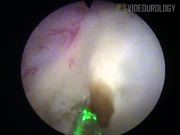
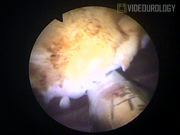
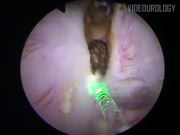
Three patients with previous surgical treatment for BPH (180 W Greenlight™ XPS prostatectomy 2013, TURP 1998, TURP 2013) were treated by ThuVEP. All patients had recurrent prostatic tissue after prior surgical treatment. The crucial steps of the procedure are presented in the video as follows: circumferential incision of the verumontanum, 5 and 7 o'clock incisions at the middle lobe, retrograde removal of the median lobe, apical incision of the lateral lobes, retrograde removal of the lateral lobes, and removal of prostatic tissue by mechanical morcellation. The surgical technique was modified according to the changed anatomy in each case. The thulium laser was applied at a power level of 90 W. A 550 nm bare-ended laser fiber and a 26F resectoscope were used. 3,9
Results:
All surgeries were completed effectively without complications. Resected specimens weighted 100 g (180 W XPS prostatectomy 2013), 20 g (TURP 1998), and 8 g (TURP 2013) each. All postoperative courses were uneventful. Urinary catheters could be removed after 2 days; the length of hospitalization was 2 or 3 days.
Conclusions:
The technique of ThuVEP is feasible after previous prostate surgery for BPH. The same principles of ThuVEP, used in untreated prostates, can be applied in a treated one, although it is more challenging to find the surgical planes.
No competing financial interests exist.
Runtime of video: 9 minutes 46 secs
Keywords
Get full access to this article
View all access options for this article.