





Abstract
Introduction:
Ganglioneuroma is a rare, primitive, benign neurogenic tumor arising from the primordial neural crest cells that form the sympathetic nervous system. They are often located in the retroperitoneum and encase the major vessels and ureter. The primary treatment of these tumors is surgical. The use of robotic technology in urology has spread far beyond prostatectomy in recent years, with the emergence of many applications to retroperitoneal surgery. We have performed two cases of robot-assisted excision of retroperitoneal ganglioneuroma, and herein describe our technique with primary repair of iatrogenic ureteral injury that occurred in one case.
Materials and Methods:
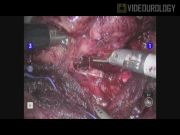
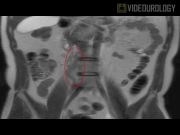
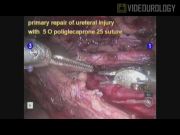
A 28-year-old man presented to us with progressively worsening right flank pain for several months. He had consulted multiple doctors, including a neurologist. Physical examination was normal, and magnetic resonance imaging of the abdomen demonstrated a 6 × 2.8 × 1.2 cm right retroperitoneal mass encasing the vena cava and laterally deviating the ureter. We excised this mass using robotic assistance, and repaired an iatrogenic intraoperative ureteral injury. The steps of the procedure demonstrated in our video include (1) cystoscopy, retrograde pyelography, and stent placement. (2) Port placement (four robotic ports and two assistant ports). (3) Dissection of the mass off the vena cava, ureter, and retroperitoneum. (4) Recognition of ureteral injury. (5) Ureteroureterostomy with 5-0 polyglecaprone 25 suture.
Results:
Total operative time from cystoscopy to the closure of skin incisions and including robot docking and undocking was 224 min. The estimated blood loss was 75 mL. The Jackson-Pratt drain was removed, and the patient was discharged on postoperative day 2. The ureteral stent was removed after 4 weeks, and a renogram 6 weeks later demonstrated symmetric function without evidence of any obstruction. At 3 months follow-up, the patient had complete resolution of his pain and computed tomography imaging revealed no residual or recurrent mass. Pathologic analysis of the mass was consistent with a ganglioneuroma.
Conclusions:
Complex retroperitoneal masses encasing the vena cava and ureter can be excised using robot-assisted technology. To our knowledge, this is the first described case of robotic excision of a retroperitoneal ganglioneuroma. These rare cases require an advanced robotic surgeon along with an experienced surgical team. Over the last 3 years, we have performed over 1000 robotic urologic surgical procedures at our center and have begun to expand the applications of this technology to cases such as this. Moreover, iatrogenic ureteral injuries during such cases can be safely and efficaciously repaired utilizing robotic assistance.
The authors have nothing to disclose.
Runtime of video: 4 mins 44 secs
Get full access to this article
View all access options for this article.