





Abstract
Objective:
The Roth-Net retrieval device (US Endoscopy, Mentor OH) has been utilized for gastrointestinal endoscopy since 1993 for tissue retrieval and foreign body retrieval. Our objective was to evaluate its utility in stone retrieval for percutaneous nephrolithotomy.
Methods:
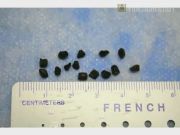
A 30F Amplatz sheath was placed into an ex vivo porcine kidney. Fifteen calculi ranging from 2 to 3 mm were placed percutaneously through the sheath and positioned in a dependent calyx. A Storz rigid nephroscope was utilized to observe the calculi. The 5.4F Pediatric Roth-Net retriever (US Endoscopy Model 00711057, Mentor OH) was deployed through the working channel. The device consists of a custom-woven nylon mesh with a 1-mm open spacing. The wire frame is a 0.018-inch 3×3 stainless steel braided cable of medium stiffness. The net size is 2 cm wide ×4 cm long. A total of five trials were performed with the Cook Perc-N-Circle stone basket and five trials were performed with the Roth-Net.
Results:
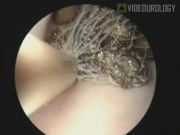
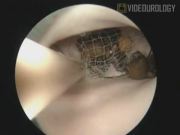
Multiple stone fragments were successfully retrieved with the Roth-Net device, whether free-floating, or lying dependent in a calyceal fornix. On the basis of the five trials performed on each device, the average number of stones retrieved with the Cook Perc-N-Circle was 1.5 per attempt, whereas the average number with the Roth-Net was 8. The calculi could be easily released by opening the Roth-Net device, and no endoscopic evidence of trauma to the urothelium was noted.
Conclusion:
The Roth-Net offers an effective alternative for percutaneous extraction of multiple small calculi.
No competing financial interests exist.
Runtime of video: 3 mins 2 secs
Keywords
Get full access to this article
View all access options for this article.