





Abstract
Introduction:
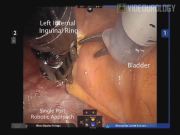
Chronic groin pain can be debilitating for patients. 1 –3 Microsurgical subinguinal denervation of the spermatic cord (MDSC) is a treatment option. For patients who fail this treatment or who have phantom pain after orchiectomy, there are limited further options. 4 –6 Our goal was to develop a single-port and abdominal robotic microsurgical neurolysis technique to ligate the genitofemoral and inferior hypogastric nerve fibers within the abdomen above the internal inguinal ring. Neurolysis has been shown to be an effective therapy for chronic orchialgia. 1,2,7 –9 For patients with inguinodynia and orchialgia after hernia repair with mesh, abdominal ligation of the ilioinguinal, iliohypogastric, and genital nerves in one series showed significant resolution or improvement in pain. 4 In another study, transperitoneal laparoscopic testicular denervation after failure of other nonsurgical modalities showed a 71% pain reduction. 5 Although the robot may not be necessary for gross dissection, the robot does allow for microsurgical fine dissection of the vessels, which is more difficult with standard laparoscopy. 7 This video presents a novel technique for the treatment of persistent orchialgia.
Materials and Methods:
This was a prospective study of patients with chronic groin pain who had phantom pain after orchiectomy. Primary endpoint was impact of pain on quality of life (PIQ-6 pain impact questionnaire from RAND Corporation) and secondary endpoint was operative robotic duration. PIQ-6 scores were collected preoperatively and at 1, 3, 6, and 12 months postoperatively.
Results:
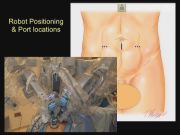
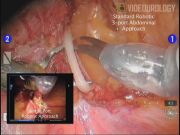
We completed 18 cases (five single port) from June 2009 to April 2010. These initial cases were all patients who had persistent pain after orchiectomy done for pain. Although not presented here, this technique has been used for a few patients who had groin pain after a failed subinguinal microsurgical denervation of the spermatic cord. The original cause for the testicular or groin pain in these patients was a third from before vasectomy, a third from previous hernia repair, and a third idiopathic (no identifiable cause). Significant reduction in pain (PIQ-6 <50: pain with no impact on quality of life) occurred in 78% (14/18) within 1 month after operation. Two of these failures where patients that had pain elimination for 6 months, but then pain returned thereafter. One of these patients had a redo procedure with elimination of pain again. Median operating room duration was 10 minutes (5–30) of console time. The average robotic incision is 2.5 cm, which is quite small since not much lateral movement of the robotic arms for the microsurgical dissection of the vessels is not need. This factor allowed positioning of the arms next to each other, and most of the manipulation was just at the endowrist of the robotic instrumentation. Initially, a peri-umbilical site was chosen based on surgeon comfort, but more recent cases have been performed using an umbilical incision. In this series there was one complication: postoperative scrotal hematoma that resolved with conservative measures.
Conclusions:
Single-port and abdominal robotic microsurgical neurolysis appears to be effective and feasible with minimal short-term complications and improved immediate pain relief, but longer-term follow-up is required.
No competing financial interests exist.
Runtime of video: 5 mins 4 secs
Get full access to this article
View all access options for this article.