





Abstract
Introduction:
Laparoscopy and robot-assisted surgery have been proven to be efficacious and beneficial in the management of ureteral injuries. 1,2 From 2003 to 2010 we have performed 35 laparoscopic ureteral re-implantation, 4 of them bi-lateral. In this video we present our first approach to a robot-assisted extra-vesical bilateral ureteroneocystostomy in regard to ergonomic advantages offered by the DaVinci® system, feasibility, safety, and short-term results.
Materials and Methods:
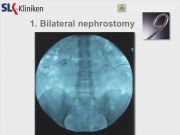
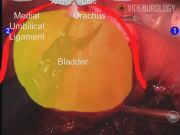
A 55-year-old woman with a bilateral ureteric transection after a radical hysterectomy came to our vision. The day after the gynecological surgery, urine collection from the drain and subsequent intravenous urography confirmed an iatrogenic bilateral injury. We proceeded to the placement of bilateral nephrostomy; 6 weeks later, we performed a robot-assisted bilateral ureteroneocystostomy according to an extra vesical Lich-Gregoir technique. The camera is placed superior to the umbilicus and a similar port arrangement as for radical prostatectomy was used. We proceeded to the placement of bilateral nephrostomy; 6 weeks later we performed a robot-assisted bilateral ureteroneocystostomy according to an extra vesical Lich-Gregoir technique. Patient is supine, with a Trendelenburg position of 20°. The trocars are positioned as follows: robotic camera port, 5 cm above the umbilicus in the median line; two 8-mm robot ports, 8 cm laterally and caudally; and two 10-mm trocars for assistant, at level of the right iliac crest. An accessory 5-mm working port is placed in suprabuc area. We performed a bilateral vesico psoas-hitch and tension-free ureteral reimplantations on the bladder dome using running sutures. Pigtail catheters are placed retrogradely and the detrusor is closed over the ureters to create a submucosal tunnel.
Results:
The console time was 176 min. No intraoperative or postoperative complications were noticed and the estimate blood loss was 110 mL. The urethral catheter was removed after a cystogram showing no evidence of an anastomotic leakage on day 7, and the patient was discharged uneventfully from the hospital on day 9. The pigtails were removed after 3 weeks and the patients was asymptomatic after 2 months of follow-up.
Conclusions:
Laparoscopic reconstructive procedures may be performed for the management of mid and distal ureteric strictures, but difficulty with intra corporeal suturing and prolonged operative times remain distinct disadvantages. A bilateral ureteral reimplantation is more complex for anatomical and ergonomic reasons. 3,4 With the added benefits of reduced hospital stay and improved patient quality of life, associated with minimally invasive surgery, the robot assistance is particularly well suited with superior visibility and ergonomics for the management of complex reconstructive procedures where a precise dissection and stitching is needed. 5,6 The Endowrist® technology, and the Clutch function, will overcome the difficulties encountered in a pure laparoscopic approach. Bilateral robotic ureteroneocystostomy is a safe and effective treatment for the management of distal ureteric disease.
We assure that we did not have any commercial associations during the last 2 years that might create a conflict of interest in connection with the published video. The authors have nothing to disclose.
Runtime of video: 7 mins 02 secs

Get full access to this article
View all access options for this article.