






Abstract
Abstract
Introduction:
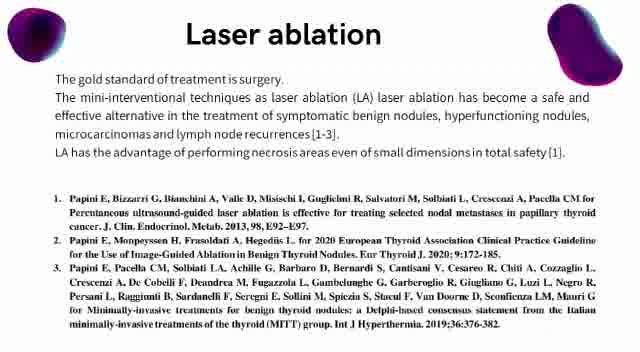
The gold standard of treating benign and malignant thyroid disease is surgery, but since the early 2000s, mini-interventional methods and laser ablation (LA) have been a safe alternative to surgery. Surgery has a higher complication rate. LA can be used to treat symptomatic benign nodules, hyperfunctioning nodules, microcarcinomas, and lymph node recurrences [1–3]. LA has the advantage of performing necrosis areas even of small dimensions in total safety [3]. In addition, it makes use of the “pullback” technique that allows to treat lesions with a major axis >2 cm. The aim of our video is to provide a short introductory guide to laser treatment and to present the case of a woman with Plummer's adenoma.
Materials and Methods:
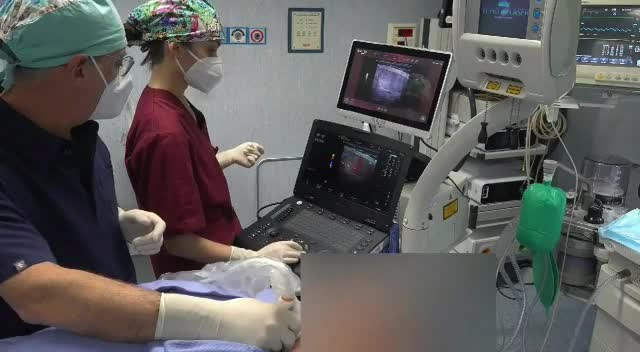
This is a case report of a 53-year-old woman with Plummer's adenoma. The patient presents mild exophthalmos, tachycardia, night sweats, and poor control with medical therapy. The patient underwent ablative treatment with a laser fiber: 4 W, 3600 J, and 0.5 cm pullback. The patient does not have major complications.
Results:
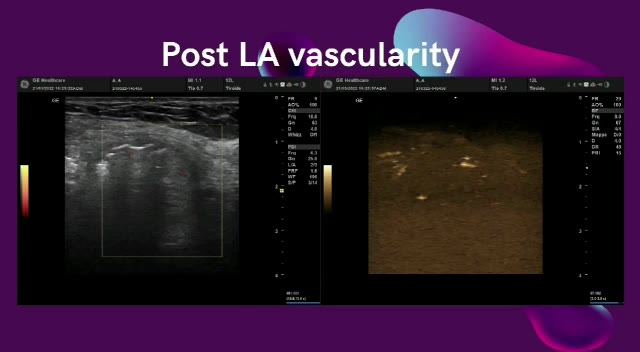
At 1 month of follow-up, we recorded a volumetric reduction of ~20%. The biohumoral tests have normalized.
Conclusions:
LA represents a safe, an effective, and a minimally invasive alternative to surgery in the treatment of autonomous thyroid nodule. This technique allows a necrosis with a low complication rate compared with surgical treatment.
No competing financial interests exist.
Runtime of video: 8 mins
Get full access to this article
View all access options for this article.