






Abstract
Abstract
Background:
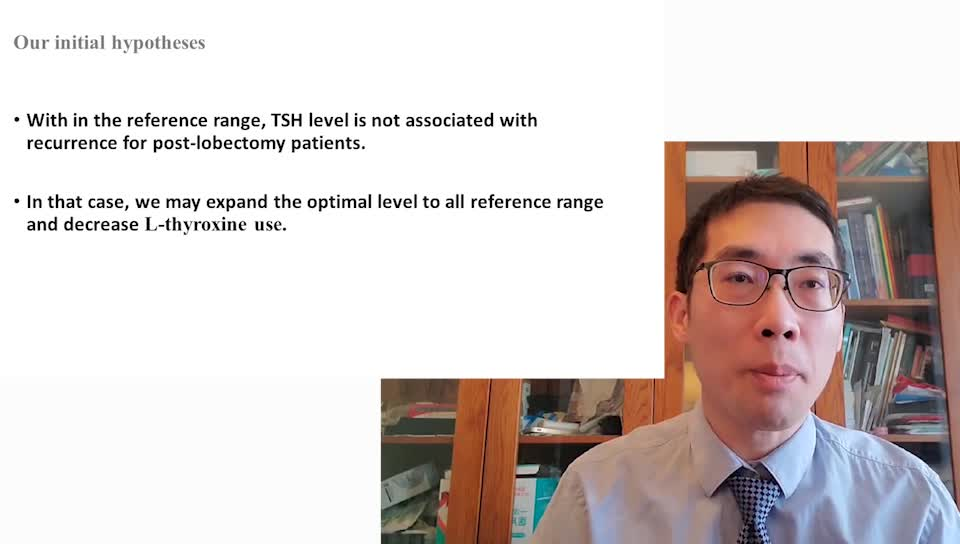
The optimal serum thyroid-stimulating hormone (TSH) level for postlobectomy papillary thyroid carcinoma (PTC) patients is unclear. The objective of this study was to examine the association of TSH and recurrence in postlobectomy patients.
Methods:
Patients who underwent lobectomy for PTC in a single tertiary hospital from January 2000 to December 2014 were enrolled. The mean TSH level of a patient was calculated based on each serum TSH value during follow-up. The reference range of serum TSH was 0.5–4.0 mU/L. Univariate and multivariable analyses were performed with Cox proportional hazards models. Restricted cubic spline (RCS) functions were used to model relationships between mean TSH and recurrence-free survival (RFS).
Results:
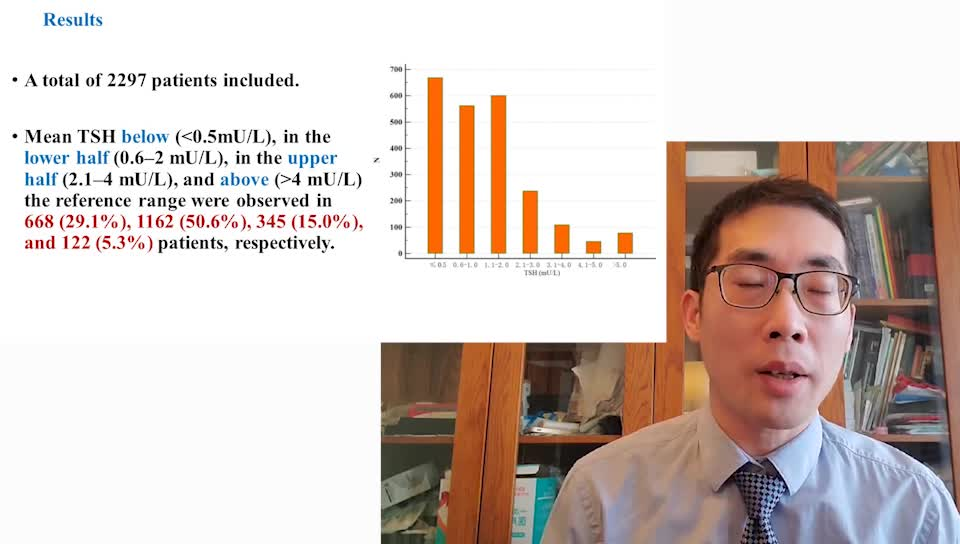
A total of 2297 patients [median age, 42 years; 1750 (76.2%) female] were analyzed. Mean TSH level below (≤0.5 mU/L), in the lower half (0.6–2 mU/L), in the upper half (2.1–4 mU/L), and above (>4 mU/L) the reference range was observed in 668 (29.1%), 1162 (50.6%), 345 (15.0%), and 122 (5.3%) patients, respectively. According to the Cox model and RCS, no association was observed between mean TSH and RFS in the whole cohort, low-risk group, and intermediate- to high-risk groups (adjusted p = 0.4737, 0.9314, and 0.1859, adjusted P for nonlinear = 0.4589, 0.8622, and 0.3010). The only RFS difference observed in the stratified univariate analysis was between patients with mean TSH in the lower half (0.6–2 mU/L, n = 659) and those with above the reference range (>4 mU/L, n = 68) in the intermediate- to high-risk group (10-year RFS by Kaplan–Meier 84.4% vs. 69.4%, log rank p = 0.011).
Conclusions:
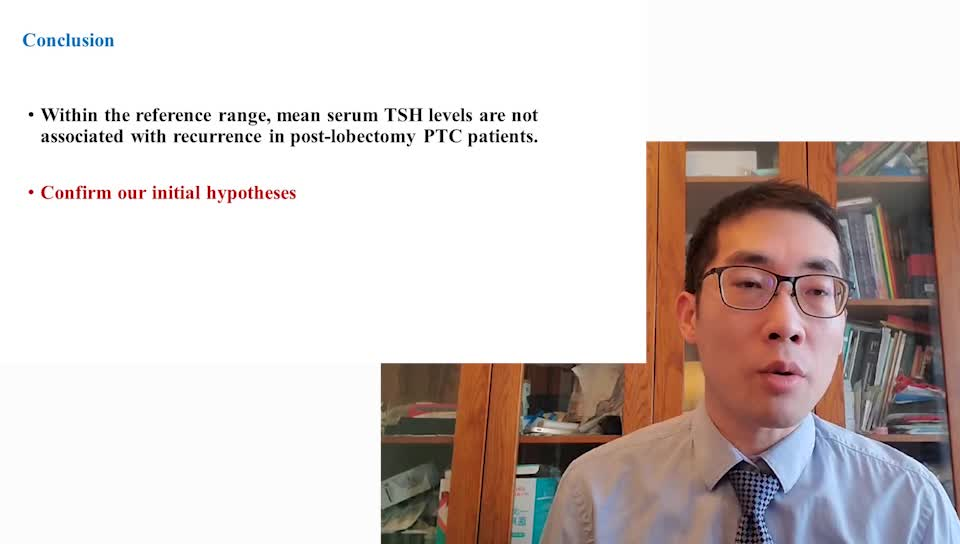
Mean serum TSH levels are not associated with recurrence. A normal TSH reference range is recommended for postlobectomy PTC patients.
No competing financial interests exist
.
Runtime of video: 8 mins 00 secs
Get full access to this article
View all access options for this article.