






Abstract
Abstract
Introduction:
Metastasis to the sellar region occurs in 1%–3.6% of cancer patients, most commonly caused by lung cancer in men and breast cancer in women. Thyroid cancer accounts for only 2% of pituitary metastases.
Case:
A 69-year-old woman presented to endocrinology for evaluation of a left 3.1 cm irregular isoechoic thyroid nodule with microcalcifications. Biopsy revealed papillary thyroid carcinoma (PTC). She underwent a total thyroidectomy with central compartment dissection by a high-volume endocrine surgeon. Pathology analysis revealed a 4.1 cm classical PTC with tall cell features and 5 out of 13 positive paratracheal lymph nodes (largest 3 mm). She received 178.1 mCi I-131. She had an elevated nonstimulated thyroglobulin of 400 ng/mL at 6 months after I-I31. Neck ultrasonography revealed new suspicious bilateral lymph nodes; positron emission tomography/computed tomography (CT) showed marked nodal flurodeoxyglucose F 18-avidity but no distant disease. The patient underwent bilateral modified radical neck dissections and multiple revision surgeries for persistent locoregional structurally incomplete response; she was eventually deemed to be unresectable and radioactive iodine refractory. External beam radiotherapy was planned but her disease entered a quiescent phase appropriate for active surveillance with minimal biochemical or radiographic change. Two years later, she developed subacute fatigue, nausea, and a weight loss of 23 kg of unclear etiology. Repeat CT neck imaging showed stable neck disease with a new incidental 2.1 × 1.3 × 1.3 cm sellar mass. Hormonal work-up showed panhypopituitarism; a morning cortisol was 3.4 μg/dL: (6–18.4 μg/dL) and adrenocorticotropic hormone of 13 pg/mL (7–63 pg/mL). Patient was started on prednisone 5 mg daily with symptom resolution. Pituitary mass biopsy/resection showed metastatic PTC; she underwent external beam radiation for an unresectable infundibular tumor remnant. Genetic testing was positive for B-Raf V600E with human telomerase reverse transcriptase (TERT) promoter mutation.
Conclusion:
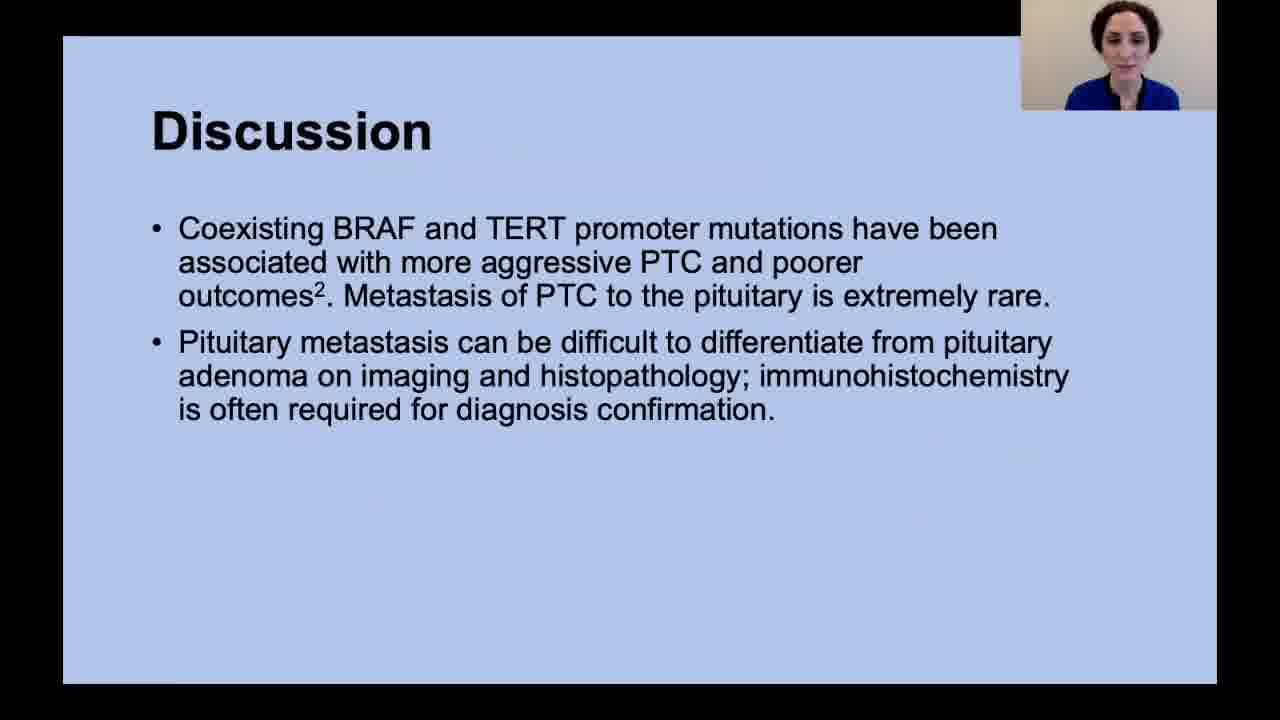
Coexisting B-Raf and TERT promoter mutations have been associated with more aggressive PTC and poorer outcomes. Metastasis of PTC to the pituitary is extremely rare Pituitary metastasis can be difficult to differentiate from pituitary adenoma on imaging and histopathology; immunohistochemistry is often required for diagnosis confirmation. Presentation may include headache, visual field defects, cranial nerve palsy, and/or symptoms of pituitary insufficiency. Treatment options include surgery, radiotherapy, iodotherapy, and chemotherapy.
No competing financial interests exist.
Runtime of video: 4 mins


Get full access to this article
View all access options for this article.