






Abstract
Abstract
Introduction:
Augmented reality (AR) allows the user to see the real world, with virtual objects superimposed upon or composited with the real world. 1 Incorporation of AR in laparoscopic or robotic surgery aids the surgeon to more easily perceive anatomical structures intuitively, which helps to identify structures covered or hidden by surrounding tissue. 2 Recurrent laryngeal nerve (RLN) injury is one of the most serious complications after thyroid surgery, which results in vocal cord palsy. 3 Compared with the open thyroid surgery, identifying the RLN in the robotic thyroid surgery is more challenging because surgeons cannot use the tactile sense. In this study, we adopted AR to help surgeons to localize the RLN during the robotic thyroid surgery.
Materials and Methods:
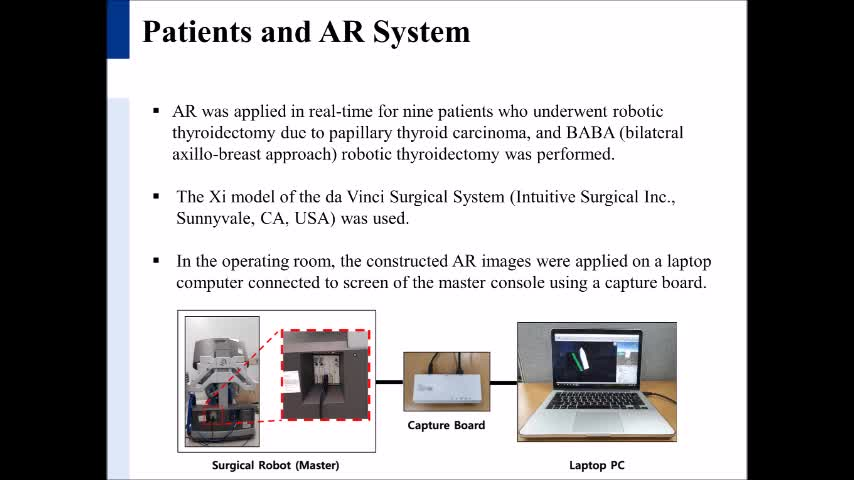
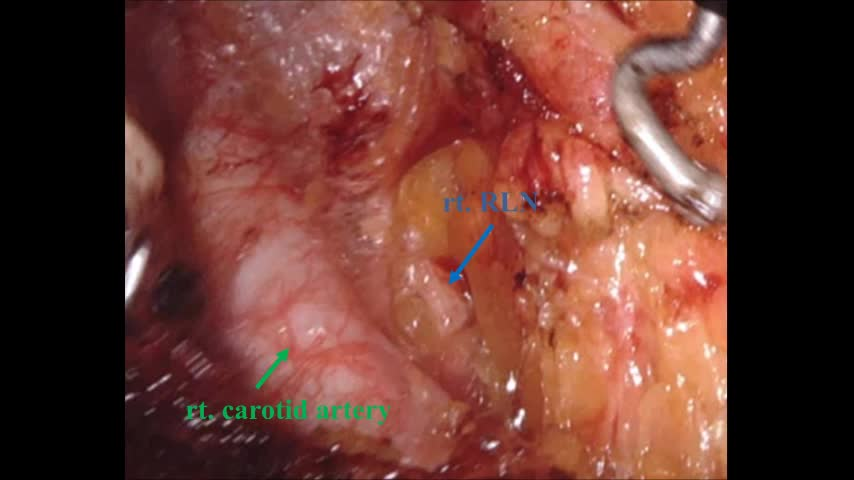
AR was applied in real time for nine patients who underwent robotic thyroidectomy because of papillary thyroid carcinoma, and bilateral axillo-breast approach robotic thyroidectomy was performed. We constructed the AR images of the common carotid artery and the trachea using the computed tomography images. Based on the DICOM files from patients, AR images of the structures of interest segmented, and then 3D volume rendering was performed through segmented section images using open source software Seg3D (v 2.4.3). 4 Before overlay, we applied simultaneous localization and mapping technique, 5 which enables surgical map construction and vision-based tracking using MAXST AR SDK (v 4.1.4). The AR image of the RLN was positioned to the side of the trachea with 8 mm distance, which was determined in the pilot study. The actual trachea and right common carotid artery were overlaid with AR images of the trachea and right common artery using a mouse controller.
Results:
AR was applied in real time for two patients who underwent robotic thyroidectomy because of thyroid cancer. The patient had no vocal cord paralysis on the postoperative laryngoscopic examination.
Conclusions:
In this prospective study, AR was effectively applied to robotic thyroid surgery. AR that overlaps on the actual organs may be helpful for surgeons to identify hidden anatomical structures during the robotic surgery.
No competing financial interests exist.
Runtime of video: 5 mins 17 secs
Get full access to this article
View all access options for this article.