





Abstract
Abstract
Background:
Endoscopic adrenalectomy is currently performed using multiple ports placed either transabdominally or retroperitoneally. Single-access laparoscopic adrenalectomy has been described, but has yet to be widely adopted. 1 We report our technique of single-incision retroperitoneoscopic adrenalectomy (SIRA). 2
Methods and Materials:
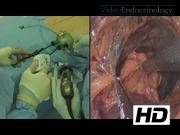
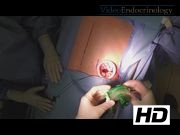
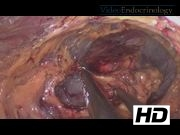
We present a case of a 53-year-old male with an incidentally found 4.5 cm right adrenal mass on CT scan performed after a motor vehicle accident. Biochemical evaluation revealed that this was a nonfunctioning nodule. Surgery was recommended given the size of the mass. A right SIRA was performed by first placing the patient in a prone position. Noncompressive bolsters were used to allow the abdominal contents to fall forward and expand the retroperitoneal working space. The retroperitoneal space was entered through a direct cut down through a 2 cm skin incision made just below the inferior border of the 12th rib. A mini GelPoint device equipped with three 5 mm ports was then placed through the single 2 cm incision. The retroperitoneal space was insufflated with up to 30 mm Hg. A 5 mm 30° camera and two additional instruments, a blunt dissector and a LigaSure device, were inserted through the mini GelPoint. We bluntly entered Gerota's fascia and took down the filmy attachments of the periadrenal and perirenal fat pads. An adrenal nodule with no evidence of gross invasion was noted. The superior pole of the right kidney was then mobilized and detached from the inferior border of the adrenal gland. The adrenal arteries overlying the inferior vena cava (IVC) were divided with the LigaSure. The medial border of the IVC was dissected to identify the adrenal vein, which was ligated with the LigaSure. The remaining attachments at the anterior and lateral surfaces of the adrenal gland were dissected free. The specimen was placed within an Endocatch bag and morcellated before removal. The retroperitoneum was re-examined to ensure hemostasis as the insufflation pressure was brought down. The mini GelPoint was removed and the incision was closed with a 2-0 Vicryl fascial stitch and a running subcuticular suture.
Results:
The patient underwent an uncomplicated SIRA through a single 2 cm incision. The length of operation was 50 minutes and blood loss was minimal. The patient spent the night in the hospital for observation and was discharged home on the morning of postoperative day 1.
Conclusions:
SIRA is safe and feasible to implement as a refinement of conventional retroperitoneoscopic adrenalectomy. Use of three ports allows for two-handed dissection, which may shorten the learning curve for many surgeons.
No competing financial interests exist.
Runtime of video: 5 mins 22 secs
Keywords
Get full access to this article
View all access options for this article.
References
Supplementary Material
Please find the following supplemental material available below.
For Open Access articles published under a Creative Commons License, all supplemental material carries the same license as the article it is associated with.
For non-Open Access articles published, all supplemental material carries a non-exclusive license, and permission requests for re-use of supplemental material or any part of supplemental material shall be sent directly to the copyright owner as specified in the copyright notice associated with the article.
