






Abstract
Introduction:
Giant adrenal cysts are a rare pathology and limited evidence exists regarding the appropriate management. We describe three cases of giant adrenal cysts that were successfully resected via posterior retroperitoneoscopic adrenalectomy.
Materials & Methods:
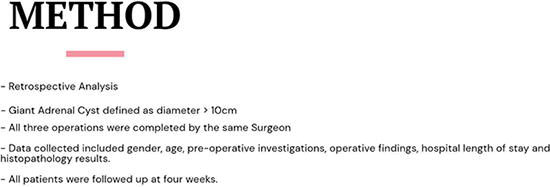
A retrospective analysis was conducted on three patients who underwent posterior retroperitoneoscopic adrenalectomy for treatment of giant adrenal cysts. These operations were all completed by the same surgeon. Data collected included gender, age, preoperative investigations, operative findings, hospital length of stay, and histopathology results. All patients were followed up at 4 weeks.
Results:
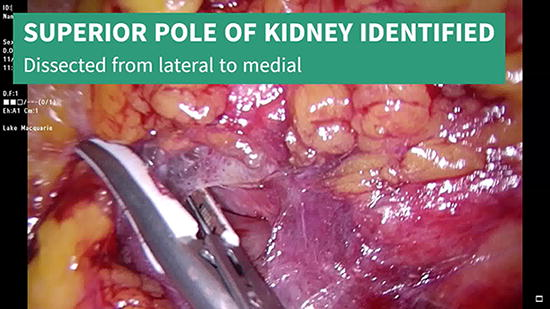
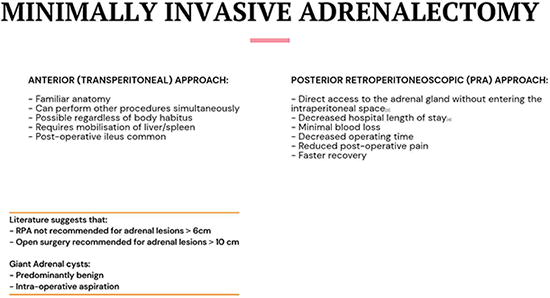
Patients were aged 39, 39, and 62; two were female and two had left sided adrenal cysts. All cysts were found incidentally on imaging, and all cases reported mild symptoms of mass effect. The size of adrenal cyst ranged from 11.1 cm to 17.5 cm. All three patients had normal preoperative functional testing, including plasma metanephrines and 1 mg Dexamethasone suppression test. During posterior retroperitoneoscopic adrenalectomy, needle decompression of the giant adrenal cyst was performed, and the remaining hole was secured with an endoloop. This technique allowed for the removal of the entire cyst capsule via a posterior retroperitoneoscopic approach with formal ligation of the adrenal vein. In all cases, the postoperative period was uneventful, with discharge within 24 hours of the operation (one same day discharge). There were no postoperative complications, and all patients were well at the postoperative visit (4 weeks postoperatively). Histology results were all benign, with two pseudocysts and one endothelial cyst. Minimally invasive adrenalectomy has become the gold standard for removal of adrenal lesions. The posterior retroperitoneoscopic approach provides direct access to the adrenal gland without entering the intraperitoneal space, in doing so decreasing the risk of incidental trauma to abdominal viscera. 1 This technique has also been associated with a decreased hospital length of stay, minimal blood loss, decreased operating time, reduced postoperative pain, and faster recovery. 2 There are very limited studies on the use of posterior retroperitoneoscopic approach for giant adrenal cysts, which because of their size can be difficult to resect via a posterior approach, but as they are predominantly benign, can be aspirated to facilitate removal. The author has only found one other case of giant adrenal cyst removed via posterior retroperitoneoscopic approach in the literature. 3
Conclusion:
Three cases of successful resection of giant adrenal cysts via posterior retroperitoneoscopic approach are presented. All were completed without complication and with good postoperative recovery. In patients with mass effect symptoms from giant adrenal cysts, we would recommend minimally invasive adrenalectomy, facilitated by aspiration.
Author Disclosure Statement:
The authors have no disclosures.
Funding Information:
No funding was received for this article.
Runtime of video: 08 min 51 sec.
Get full access to this article
View all access options for this article.