





Abstract
Abstract
Introduction:
Patients with thyroid tumor especially those having thyroid cancer with lymph nodes metastasis may benefit thyroidectomy with lymph nodes dissection. The surgery requires exactly distinguishing parathyroid glands from lymph nodes. The technique used applies to stain the lymph nodes in black and differentiate them from parathyroid glands with the purpose of removing additional metastatic lymph nodes while retaining the parathyroid glands. The carbon nanoparticles (CNPs, Carbon Nanoparticles Suspension Injection; Chongqing LUMMY Pharmaceutical Co., Ltd.), consisting of nano-sized carbon particles with an average diameter of 150 nm, are a new class of lymph node tracers approved and certificated by the State Food and Drug Administration in China in 2004. Being immediately able to enter the lymphatic capillaries (diameters of 500 nm) rather than blood vessel capillaries (diameters of 30–50 nm), the CNPs are rapidly engulfed by macrophages upon injection into the tissues around the tumor and have played important roles in lymph node dissections for breast cancer and gastrointestinal carcinoma.1,2 For central compartment lymph nodes dissection, the CNPs approach might facilitate the surgery by exposing the lymph nodes clearly and distinguishing the parathyroid glands to better preserve them. The aim of this video is to show the use of CNPs applied in lymphatic dissection.
Methods and Materials:
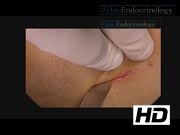
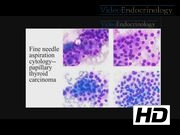
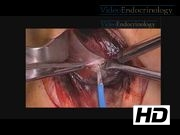
A 31-year-old female patient was found to have thyroid nodule in the right lobe. She underwent fine needle aspiration biopsy that showed papillary thyroid carcinoma. The MRI showed ipsilateral central lymph nodes metastasis. She had no abnormalities in thyroid function and clinical symptoms, so lobectomy was necessary and we presented her thyroid lobectomy with ipsilateral central lymph node dissection considering her disease and obeying the 2015 American Thyroid Association (ATA) guideline. The patient was intubated supine on the operating room table. We made a 6 cm arcuate incision in the neck about 3 cm above the Angulus Ludovici. The dissociation of the anterior capsule and exposure of the abnormal lobe should be done cautiously to prevent separation of the tissue dorsal to the thyroid to reduce destruction of the surrounding thyroid lymphatic network. 3 A small amount of CNPs is injected in two sites around the tumor using skin test needle. We present the thyroid lobectomy using the Wu Gaosong's procedure. 4 When the right lobe was done, the lymph nodes were stained in black while the inferior parathyroid glands were hidden in the area that remained unstained. Central compartment is defined 5 as an area that is bounded superiorly by the hypoid bone, inferiorly by the upper part of the horn of the thymus, and on either side by the carotid arteries; in this case, the tumor was in the right lobe with potential metastasis in the ipsilateral area. Then the right-side central compartment neck dissection was performed with prelaryngeal Delphian node region.
Results:
Pathology analysis showed papillary thyroid carcinoma with only one lymph node metastasis in the ipsilateral central compartment lymph nodes. The patient was discharged home on postoperative day 3 uneventfully.
Conclusion:
This video illustrates the technical details of thyroidectomy with central compartment lymph nodes dissection using the technique of CNPs. The CNPs method can improve the extent and accuracy of neck central lymph nodes dissection and can preserve the normal anatomic structure and physiologic function of the parathyroid glands and thus facilitate the procedure.
This work was supported by the National Science Foundation of Hubei Province through contract Grant Nos. 2008CDB179, WJ2015MA003, and 2004ABA246.
No competing financial interests exist.
Runtime of video: 8 mins 30 secs
Keywords
Get full access to this article
View all access options for this article.
References
Supplementary Material
Please find the following supplemental material available below.
For Open Access articles published under a Creative Commons License, all supplemental material carries the same license as the article it is associated with.
For non-Open Access articles published, all supplemental material carries a non-exclusive license, and permission requests for re-use of supplemental material or any part of supplemental material shall be sent directly to the copyright owner as specified in the copyright notice associated with the article.
