





Abstract
Abstract
Introduction:
The nonrecurrent laryngeal nerve occurs in less than 1% of cases and is associated with a right subclavian artery takeoff from the distal aortic arch. The nonrecurrent laryngeal nerve develops from the vagus nerve as a direct medial branch in the neck and extends downward from behind the carotid artery to the laryngeal entry point.
Case:
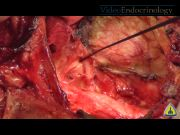
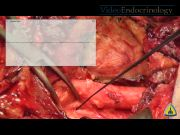
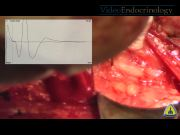
A 53-year-old man, who had previously undergone a total thyroidectomy, was referred to our institution for surgical management of metastatic papillary thyroid carcinoma and underwent a central compartment neck reoperation with excision of the prelaryngeal, pretracheal, and right paratracheal nodal basins. A right lateral compartment neck dissection of levels 2a, 3, 4, and 5b was also performed. Preoperative fiber-optic laryngoscopy revealed a completely mobile right true vocal fold and a left true vocal fold that had motion impairment. Intraoperative diagnosis of a nonrecurrent right laryngeal nerve was achieved with intraoperative nerve monitoring and vagal nerve stimulation.
Conclusion:
This video illustrates the role of intraoperative nerve monitoring in the detection of the nonrecurrent laryngeal nerve. During the surgery, routine stimulation of the vagus nerve below the inferior thyroid artery is part of the standard neural stimulation algorithms during intraoperative nerve monitoring. If on the right-hand side this focus of vagal nerve stimulation is negative, then the stimulation should be performed at a higher level of the vagus nerve. If this higher vagal nerve stimulation results in laryngeal electromyography activity, a nonrecurrent right laryngeal nerve is electrically diagnosed.
Running time of video: 3 mins, 12 secs
Keywords
Get full access to this article
View all access options for this article.
Supplementary Material
Please find the following supplemental material available below.
For Open Access articles published under a Creative Commons License, all supplemental material carries the same license as the article it is associated with.
For non-Open Access articles published, all supplemental material carries a non-exclusive license, and permission requests for re-use of supplemental material or any part of supplemental material shall be sent directly to the copyright owner as specified in the copyright notice associated with the article.
