





Abstract
Abstract
Introduction:
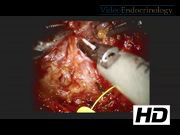
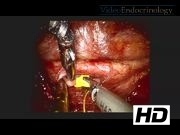
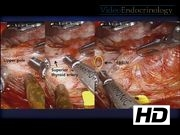
Continuous intraoperative neuromonitoring (C-IONM) by stimulation of the vagus nerve (VN) has been used in conventional and endoscopic thyroid surgery. To the best of our knowledge, the use of the standardized C-IONM technique during transaxillary robotic thyroidectomy (RT) has not yet been described. This video presentation provides the details of the C-IONM technique with the automatic periodic stimulating (APS) accessory for transaxillary RT.
Materials and Methods:
The standard technique of the C-IONM consists of localizing and monitoring VN, external branch of superior laryngeal nerve (EBSLN), and recurrent laryngeal nerve (RLN) as the surgeon dissects and removes the thyroid gland. The surgical maneuvers for the APS placement of contralateral side in total thyroidectomy through the transaxillary approach must be accurate with cautious dissection to avoid a potential iatrogenic morbidity on the contralateral VN function.
Results:
All procedures of C-IONM during transaxillary RT were performed safely and effectively. Moreover, C-IONM application was also performed safely on the contralateral side even for total thyroidectomy. C-IONM has utility in identifying real-time adverse concordant amplitude and latency changes, which can prompt modification of the associated surgical maneuver and may prevent nerve injury during thyroidectomy.
Conclusions:
C-IONM in transaxillary RT is a safe and feasible technique to test the functional integrity of the EBSLN and RLN. C-IONM might be helpful for advanced training in RT.
Presented at the First World Congress of Neural Monitoring in Thyroid and Parathyroid Surgery, 17–19 September 2015, Krakow, Poland.
No competing financial interests exist.
Runtime of video: 9 mins 16 secs
Get full access to this article
View all access options for this article.
Supplementary Material
Please find the following supplemental material available below.
For Open Access articles published under a Creative Commons License, all supplemental material carries the same license as the article it is associated with.
For non-Open Access articles published, all supplemental material carries a non-exclusive license, and permission requests for re-use of supplemental material or any part of supplemental material shall be sent directly to the copyright owner as specified in the copyright notice associated with the article.
