






Abstract
Introduction:
Transoral thyroidectomy has recently gained popularity owing to its superior cosmetic outcomes and low morbidity.1–3 The transoral endoscopic vestibular approach is more commonly adopted than the transoral robotic approach. However, the transoral robotic procedure has several advantages, such as a three-dimensional magnified view, innovative instrumentation, and the ability to perform counter-traction using a third robotic instrument through the axillary port. During thyroidectomy, intraoperative neural monitoring (IONM) is widely performed for identifying the recurrent laryngeal nerve (RLN) and verifying its function. Particularly, IONM is useful for identifying and confirming the RLN in the limited surgical view during transoral thyroidectomy. 4 In addition to RLN, the IONM technique is also used for identifying the external branch of the superior laryngeal nerve (EBSLN). This video presentation aimed to demonstrate the operative procedure of transoral robotic thyroidectomy with IONM of the RLN and EBSLN.
Methods:
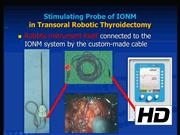
Incidentally detected subcentimeter papillary thyroid carcinoma of the left thyroid lobe was diagnosed in a 24-year-old woman. She underwent transoral robotic left lobectomy under IONM. A C2 NerveMonitor with laryngeal select electrode (Inomed Medizintechnik GmbH, Germany) was used for IONM. The appropriate position of the laryngeal electrode was routinely checked after intubation and neck extension using laryngofiberscopy. The standardized intermittent IONM protocol recommended by the International Neural Monitoring Study Group was performed together with additional neural monitoring of the EBSLN to obtain the V1-S1-S2-R1-R2-V2 signals. 5 The robotic instrument itself was used as a stimulating probe by connecting it to the interface-connector box using the custom-made cable. 4
Results:
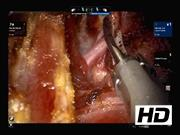
The operation was completed without conversion to the conventional transcervical approach while obtaining all V1-S1-S2-R1-R2-V2 signals. The working space and surgical view were sufficient to perform thyroid lobectomy and identify the vagus nerve, RLN and EBSLN. There were no major postoperative complications, such as RLN palsy, hypoparathyroidism, hematoma, seroma, mental nerve injury, CO2 embolism, or surgical site infection. The total operative time was 155 minutes. The patient was satisfied with postoperative cosmesis.
Conclusion:
Transoral robotic thyroidectomy with IONM of the RLN and EBSLN is feasible and useful for identifying and preserving the nerves and predicting the nerve function.
Runtime of video: 8 mins 32 secs
Keywords
Get full access to this article
View all access options for this article.