





Abstract
Abstract
Introduction:
Recently, the general population has taken interest of their postoperative quality of appearance,1,2 and the transverse cervical scar after conventional open thyroid surgery has risen as one of the endocrine surgeon's concern and the surgical skill of approximating the skin layer has become an important factor in scar formation. 3 This video is to present the advance in transverse cervical scar after conventional thyroid surgery.
Materials and Methods:
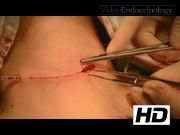
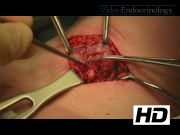
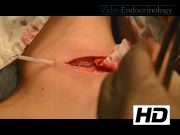
When performing thyroid surgery, excessive skin traction should be avoided to prevent the injury on the skin edge. The surgical field does not have to be always pulled in every direction to show the full operation field. When performing parathyroid preservation procedure, the skin has to be pulled only to show the appropriate field to preserve the parathyroid. When closing the midline, the upper and lower skin flap does not have to be pulled in both directions. Only the skin flap around the suturing field should be involved in traction. We use monofilament synthetic absorbable suture 5-0 with cutting needle to close the skin layer and the procedure is performed in interrupted subcuticular suture technique. During the procedure, we try to minimize the damage on the skin edge by not placing direct forceps pressure on the edge. During the surgery, we try to keep the surgical field in moist condition by applying wet gauze when the skin edge looks dry.
Results:
The postoperative scar at the end of thyroid surgery remains with no skin damage and is well approximated with only a linear incision line.
Conclusion:
Endocrine surgeons are to perform oncologically and functionally safe surgery when performing thyroidectomy, but the quality of scar should be in concern in these days. The postoperative transverse cervical scar after thyroid surgery can be improved and advance during the surgery and at the end of surgery by minimizing the direct injury to the skin edge.
Runtime of video: 3 mins 55 secs
Keywords
Get full access to this article
View all access options for this article.
References
Supplementary Material
Please find the following supplemental material available below.
For Open Access articles published under a Creative Commons License, all supplemental material carries the same license as the article it is associated with.
For non-Open Access articles published, all supplemental material carries a non-exclusive license, and permission requests for re-use of supplemental material or any part of supplemental material shall be sent directly to the copyright owner as specified in the copyright notice associated with the article.
