






Abstract
Introduction
Surgical site infections (SSIs) are one of the most frequent healthcare-associated infections. 1 The SSI rates are 2–20 times higher in low- and middle-income countries compared with high-income countries. 1 However, there is a scarcity of studies done in low- and middle-income countries. 2 Inability to set up a surveillance system for SSI can, to a large extent, explain the scarcity of studies in resource-constrained settings. For completing the surveillance for SSI, a patient is required to be followed up for 30 days postoperatively. 3 Most patients in resource-constrained settings like those in India come to a surgical facility from widely dispersed geographical areas, as facilities for surgery are not easily available. Follow-up studies are therefore difficult to perform, as a majority of patients do not return. This incomplete follow-up is the main hindrance to SSI surveillance.
Because India has one of the largest expanding networks of mobile phones in the world, we decided to assess the feasibility of using mobile communication technology for completion of follow-up for SSI surveillance in a rural hospital in India.
Subjects and Methods
Study Setting
This prospective, exploratory study was conducted in the 90-bed general surgery ward of Chandrikaben Rashmikant Gardi Hospital, a 600-bed teaching hospital associated with Ruxmaniben Deepchand Gardi Medical College (RDGMC), Ujjain, Madhya Pradesh, India. The time period of the study was from October 2010 to June 2011. Chandrikaben Rashmikant Gardi Hospital is located 6 km outside Ujjain City and caters predominantly to the rural population. The patients included in the study traveled an average distance of 31 km (range, 0.4–440 km) to the hospital. Most (70%) patient visits were unscheduled; however, most surgeries (90%) were planned. Four surgery clinical units managed the admitted patients. Each unit consists of at least one professor or associate professor, one assistant professor, and three to four residents. There were four operating theaters available during the study period.
Data Collection Procedure
For SSI surveillance a trained study-assistant filled a predesigned form containing SSI risk factors. Details of methods and risk factors for SSI in a larger cohort have been published elsewhere. 4 Table 1 shows the template of the data collection form. The study-assistant also collected phone numbers either of self-owned or of a shared mobile number at the time of discharge. For postdischarge SSI surveillance, patients were asked to return for follow-up within 1 week of completing the 30-day postsurgery period. Those patients who did not return for follow-up within the stipulated time were contacted on their mobile phones for an interview regarding the patient's surgical site to complete the SSI surveillance.
Summary of the Data Collection Form Filled in for All Patients Undergoing Surgery at the Rural Hospital in Ujjain, India
American Society of Anesthesiologists (ASA) classification: class I–II, a normal healthy patient or a patient with mild systematic disease; class III–V, a patient with severe systematic disease, a patient with severe systematic disease that is a constant threat to life, or a moribund patient who is not expected to survive without the operation.
SSI, surgical site infection.
To operationalize the actual phone calls, we made a diary of the calendar year with the patient's name in the case of self-owned mobile phones or the name of the patient's relative or friend having the shared mobile phone. The mobile phone numbers were noted at the time of discharge from the hospital. The patients were reached on their mobile phones within 1 week after the 30-day period postsurgery, so as to give the patients a chance to complete the physical follow-up. During the mobile phone contact, the study-assistant asked questions regarding the general well-being of the patient, including the current condition of the wound, in the local language, Hindi. Specific questions were asked regarding wound dehiscence and purulent discharge from the wound. If wound infection was suspected, the patient was requested to visit the surgery outpatient clinic for a review. All patients who were approached agreed to participate in the study.
Ethical Statement and Data Management
The Ethical Committee of Ruxmaniben Deepchand Gardi Medical College approved the study (approval number 114/2010). Informed verbal consent was obtained from all study participants prior to enrollment.
EpiData version 3.1 software (EpiData Association, Odense, Denmark) was used for data entry, and STATA version 12.0 software (StataCorp, College Station, TX) was used for data processing and analysis. Descriptive statistics were calculated. The SSI rate was calculated with 95% confidence intervals (CIs), and a value of p<0.05 was considered significant.
Results
In total, 536 patients were operated on during the study period; among them, 397 (75%) were male. The mean age of the operated-on patients was 40 years (95% CI, 38–41 years). The mean duration of hospital stay was 10.7 days (95% CI, 9.9–11.6 days). Most (81%) operated-on patients were from rural areas. The most common surgical procedures included herniotomy or herniorraphy (50%), lower gastrointestinal surgeries (30%), and urogenital surgeries (20%).
Among the surgical patients, ownership of mobile phones was 75% (95% CI, 73–78%). The remaining 25% patients (n=133) used a shared mobile phone. All patients had an ordinary mobile phone. No patient had a self-owned or shared smartphone. For 380 patients (74.5%), the follow-up was completed by mobile phone, as they did not return for follow-up to outpatient clinics. Among the patients who did not return for follow-up within 1 week of completing the 30-day postsurgery period (n=380), most (n=289, 76%) could be contacted during the first mobile phone call. An additional 80 patients (21%) could be reached by a second call, and the remaining 11 (3%) required three or more calls to be reached. If we had considered the follow-up in surgical outpatients only, the SSI rate would have been 15.3% (24/156). But, because SSI surveillance was completed in all 536 patients and an additional 10 cases with SSI were detected over the mobile phone, the corrected SSI rate at the end of follow-up was 6.3% (n=34). Out of these 10 SSI cases detected over mobile phones, 4 cases had shared mobile phones, and the remaining had self-owned mobile phones. All 10 patients had physical follow-up within the next 7 days on an outpatient basis. The distribution of the SSIs according to type of surgeries was four herniorraphies, three exploratory laparotomies for intestinal obstruction, two exploratory laparotomies for intestinal perforation, and one for urogenital surgery.
All patients who were suspected to have an SSI based on the mobile phone call were physically followed up in the surgical outpatient clinic where the wound infection was verified by trained surgeons: Figure 1 shows the healed surgical wound from right-sided hernioplasty of a 45-year-old male patient, taken at 30 days of follow-up postsurgery, and Figure 2 shows the superficial SSI of an incised wound of a 22-year old male patient taken at 30 days of follow-up postsurgery.

Healed surgical wound from right-sided hernioplasty of a 45-year-old male patient, taken at 30 days of follow-up postsurgery.
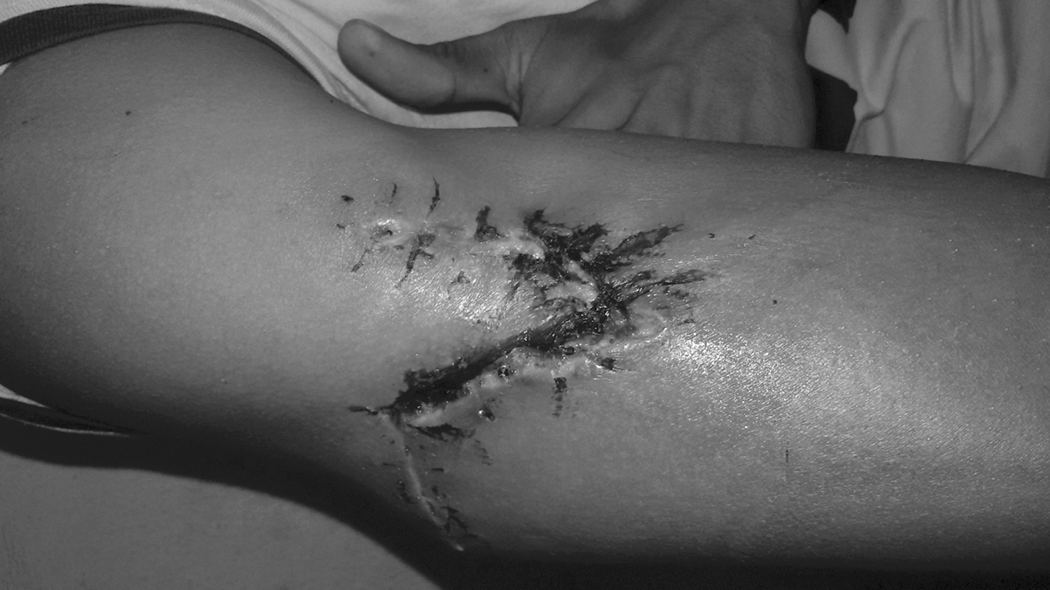
Superficial surgical site infection of an incised wound of a 22-year-old male patient, taken at 30 days of follow-up postsurgery.
Discussion
The present study found that a high percentage (75%) of patients do not return for the follow-up visit postsurgery in our set-up in a rural Indian hospital. Surveillance for SSI is difficult to complete in remote rural areas, as by definition SSI surveillance requires a 30-day follow-up visit postsurgery. 3 This gap in surveillance could be filled by mobile-based surveillance. In the future, as increasing numbers of rural residents own a mobile phone or have a shared mobile phone, SSI follow-up can be achieved in other similar settings.
A study from Cambodia significantly increased the follow-up of patients after cleft palate surgery for speech and language therapy (23% pre-intervention to 73% postintervention) by using mobile phone communication. 5 A study from Nigeria reported significantly higher numbers of follow-up appointments for postcancer care (19% pre-intervention to 98% postintervention). 6 Another study from China found short message service provided significantly higher (relative risk=1.5) follow-up adherence in a pediatric cataract treatment program. 7 India has the second largest subscriber base for mobile phone connections in the world, with nearly 950 million mobile phone connections, of which 41% (384 million) are in rural areas. 8 Mobile phones have been used for delivering disease control intervention in the field of human immunodeficiency virus infection. 9 However, the use of mobile technology in the field of surveillance of SSI has remained largely untapped.
Limitations
Because none of our patient had smartphones, we did not use patient wound photographs sent through mobile phones in our study. Pictorial messages or images using multimedia messaging service could not be used for the same reason. Short messaging service could not be used as the study was done in a rural area with a poor literacy rate, and most (>75%) of the users were unaware how to open or send a text message.
Conclusions
The follow-up of two-thirds of all the operated-on patients for SSI surveillance was completed using mobile phones, and one-third of SSIs were detected over the mobile phone. Patients should also be asked for a shared mobile number in case they do not have a mobile phone of their own. As India has one of the fastest growing mobile networks in the world, this communication technology is feasible to be used in rural settings to complete case follow-up for SSIs.
Footnotes
Disclosure Statement
No competing financial interests exist.