






Abstract
Polyclonal and monoclonal antibodies were raised to protein carrier molecules haptenized with RDX, a major component of many plastic explosives including Semtex. Sera from immunized mice detected RDX protein conjugates in standard ELISA. Clonally purified monoclonal antibodies had detection limits in the sub-ng/mL range for underivatized RDX in competition ELISA. The monoclonal antibodies are not dependent on the presence of taggants added during the manufacturing process, and are likely to have utility in the detection of any explosive containing RDX, or RDX contamination of environmental sites.
Introduction
RDX
Before the hapten can be conjugated to a protein it must be chemically derivatized to enable it to bind covalently to the protein molecule.(3,4) This process alters the structure of the hapten, raising the possibility that an antibody that recognizes the derivatized hapten may not in fact recognize underivatized pure RDX. In addition, some derivatives possess a relatively long side chain that is not found in the underivatized hapten. Because of the small size of the hapten itself, antibodies raised to the derivative may include portions of the derivative side chain as recognition features, leading to a failure to recognize the hapten with sufficiently high affinity in the absence of the side chain.
Materials and Methods
To avoid the above scenarios, two different derivatives of RDX were used in this project, RDX12, which has a relatively long derivative side chain, and RDX14, which has a very short derivative side chain (Fig. 1). RDX14 conjugates were used for immunizations of 5- to 8-week-old female BALB/c mice, and an RDX12 conjugate was used for screening of sera and hybridoma supernatants. The rationale for this is that only antibodies reactive with both derivatives will be selected, and the only features in common between the derivatives are those that are also shared by underivatized RDX. To further optimize the protocol, the derivatized haptens were conjugated to different carrier proteins, keyhole limpet hemocyanin (KLH) and bovine serum albumin (BSA), to ensure that carrier protein determinants were not part of the epitopes recognized by expanded antibodies. KLH-RDX14 conjugate emulsified in complete Freund's adjuvant (CFA) was used for all primary immunizations; but the mice were also simultaneously immunized with unconjugated BSA, emulsified in CFA, from a separate syringe at a separate site. Booster immunizations used a BSA-RDX14 conjugate emulsified in incomplete Freund's adjuvant. Hybridomas were generated by standard techniques using the X63-AG8 plasmacytoma fusion partner.(2,5)
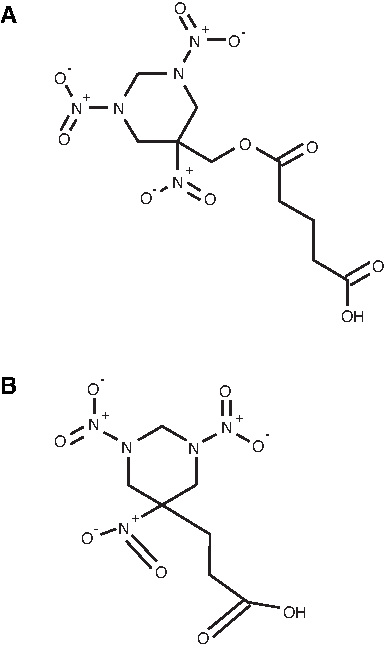
Structure of RDX12 (
Results and Discussion
Initial screens of sera and hybridoma supernatants were undertaken by direct ELISA against RDX12 conjugated to chicken gamma globulin (CGG). CGG was used as a carrier protein as a further precaution against selection of antibodies for which the carrier protein contributed to the recognized epitope. Serum from immunized animals was able to recognize CGG-RDX12 in direct ELISA at dilutions in excess of 1:1000 (Fig. 2A), indicating that the immunization was successful and hybridoma fusions could be undertaken with a high probability of success. After selection and expansion of hybridomas reactive with CGG-RDX12, further screening was undertaken using competition ELISA where recognition of CGG-RDX12 was competed with underivatized, unconjugated RDX. RDX efficiently competed with CGG-RDX12 for antibody binding, demonstrating specificity for RDX rather than a fortuitous epitope involving carrier protein or derivatization side chain moieties. The limit of detection for RDX was as low as 0.3 ng/mL for the best performing antibodies (Fig. 2B).
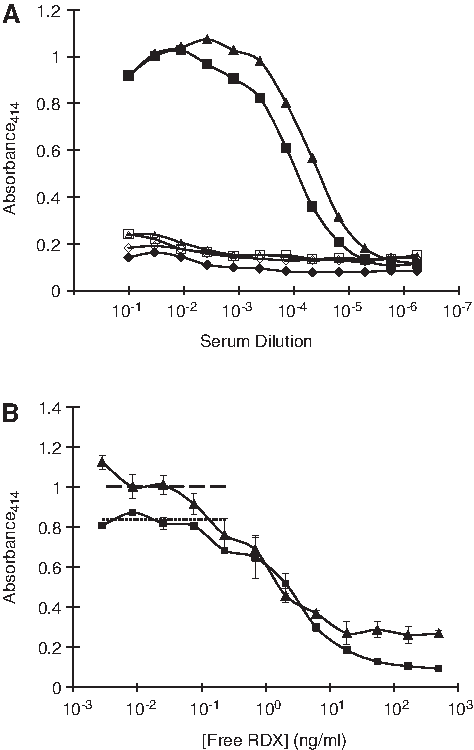
(
Since the early 1990s, it has been an international requirement for explosives to include a volatile taggant that is added during manufacturing.(6) These make a major contribution to detection of bombs, landmines, and explosive caches by sniffer dogs and machine-based detection systems. The antibodies we describe here provide a useful complementary tool to the use of taggants, because they are able to directly and specifically bind RDX, irrespective of the presence of taggant. This has the potential to allow detection and identification of trace amounts of RDX-containing explosives for screening, forensic, or environmental analysis. Several technologies are available for the incorporation of antibodies into optical- and/or resonance-based sensors, which can import the sensitivity and specificity of the antibodies into extant and future sensor and detection technology.
Footnotes
Author Disclosure Statement
The authors have no financial conflicts to disclose.