





Abstract
‘I hear the alarms at dead of night, I hear the bells – shouts! I pass the crowd – I run! The sight of flames maddens me with pleasure.’
Poems of joy, Walt Whitman (1860) ‘It is with our passions as it is with fire and water, they are good servants, but bad masters.’ Aesop's fables, Sir Roger L'Estrange, 1616–7104.
Fire is destructive; bushfires are a part of Australian life. Bushfires are dependent on available fuel and if this is great, fires can rapidly get out of control. Aboriginal Australians managed their environment by reducing fuel supplies in a process termed ‘fire-stick farming’ [1]. Fire has caused massive destruction in Australia: Black Friday, Victoria 1939, killing 71; Black Tuesday, Tasmania 1967, killing 61; Ash Wednesday, South Australia and Victoria 1983, killing 75 and the Childers backpackers’ disaster. An increasing number of fires are deliberately lit [2]. This paper reviews the literature on arson (deliberate firesetting) and focuses on the ‘dangerousness’ of these offenders.
Arson has significant economic and social implications. It has been estimated that in Western Australia in the late '90s, that the annual value of damage from all fires was about $50 million [3]. It has been estimated that deliberately lit fires account for 30% of damage (e.g. $15 million per year). No dollar figure can accurately reflect the loss of life and injuries that result from deliberately lit fires. This loss includes social trauma, family disruption and both medical and mental health sequelae [3].
Arson, as a crime, does not lend itself easily to empirical research. It is an unusual crime as it is easy to perform but difficult to detect. The initial intent of the firesetter does not always equate to the outcome and it is an adage among firefighters that a big fire is just a small fire that hasn't been controlled. In America only 3% of suspected arson fires lead to conviction [2], [4]. The victim of the firesetter does not have to be faced and it has been hypothesized that some firesetters are unassertive individuals who are unable to express anger toward their victims in more acceptable ways [5]. As a group, firesetters are heterogenous and there have been many different classifications proposed [6–8]. There have been no large studies comparing firesetters from different subgroups and there are also inherent biases within the groups.
Early literature on firesetters was dominated by case reports of interesting subjects employing descriptive, psychodynamic formulations [5],[9–11]. A body of literature developed, which was based on these early case reports. They appear to have helped model the belief that firesetters are dangerous. Is this ‘kindling theory’ of dangerousness supported by the empirical research? This theory is that the early individual case reports have had an undue influence on modern beliefs and thus like a bushfire these beliefs have spread.
This paper will briefly describe the early literature. The empirical literature will then be reviewed, focusing on those papers which have examined recidivism. Any risk factors for deliberate firesetting or recidivism will be explored.
Background
Psychiatry has focused on the so-called pathological firesetters, those who light fires for motives other than monetary gain or other, more rational reasons. Interest started in the late 18th century when German writers considered that pathological firesetting was a phenomenon perpetrated by physically disabled or mentally retarded, pubescent girls who had abnormal psychosexual development (Platner, 1797; Henke, 1812, quoted in [7]). In France in 1833, Marc described the condition of ‘pyromania’ or ‘monomanie incendiare’ and stated that it usually occurred in sexually frustrated teenage girls (and also in older men) where it was related to the attainment of sexual satisfaction [9]. Isaac Ray, an American, went on to describe pyromania as ‘a distinct form of insanity, annulling responsibility for the acts to which it leads’ [6]. Esquirol described ‘incendiary monomania’ in his Mental maladies – a treatize on insanity, 1845 [10]. He described some cases and concluded that, ‘mental alienation, whatever may be the character of the delirium, leads some insane persons to the commission of incendiary acts’ and ‘that there is a variety of monomania without delirium, characterized by an instinctive desire to burn’.
Further psychodynamic formulated case reports have emphasized the sexual root of firesetting (Stekel, 1924; Schmid, 1914, quoted in [5]). Freud (1932) believed the act of firesetting was a symbolic and archetypical outlet for sexual impulses [11]. Psychiatrists however, see a biased sample of firesetters and tend to write up the more bizarre or interesting cases. Case reports often tend to cite previous case reports to give support to their own formulations [5], thus kindling the predominant theories on pathological firesetters.
The psychodynamic literature also emphasizes the dangerousness of firesetters [12], [13]. Treatment is rarely discussed and prognosis has been deemed to be poor. Is the dangerousness of firesetters supported by the empirical literature?
Firesetters have more recently been compared with violent and property offenders [14], [15]. They were found to have a greater similarity to property offenders in personality, offending history and sexual behaviour [15]. Some similarities were found with the violent group [15], which was discussed as being related to the ‘displaced aggression hypothesis of arson’ [14]. The sexual arousal of firesetters has been re-examined using penile responses to audio-taped narratives [16]. They found no data that supported sexual motivation being commonly involved in arson.
Method
A comprehensive review of the literature was undertaken using PubMed and MEDLINE. Key words used were: arson; pyromania; firesetting; firesetter; fire-raisers; arsonist; fire; pyromaniacs; incendiarism; set fires; and fire play. Those articles that had any reference to recidivism were studied in greater detail. Initially this research considered using a methodology similar to that described by Furby et al. (1989) in their review of sex offender recidivism [17]. However, by using their strict criteria, most of the firesetting papers would be excluded. The methodological guidelines suggested by Furby et al. include:
Sample selection and description. It is essential that the samples used are similar in order that the results can be generalized to firesetters not in the study.
(A) Study design. There are very few prospective studies of firesetters, with the notable exception of Soothill and Pope [18]. Retrospective studies are useful as they can process large numbers quickly; they are inexpensive and can help in the design of prospective studies. Information used in retrospective studies has not always been collected for research purposes and the validity of the information can be questionable. (B) Treatment effectiveness is an important consideration in recidivism studies in order to predict and reduce risk. There are very few studies containing treatment outcomes in the literature, the numbers are small and the follow-up period is short [12], [19]. (C) Studies should be of sufficient sample size in order to obtain statistically significant results.
Criterion measures. The most important measure is the definition of recidivism. The literature on firesetters uses varying definitions and this makes comparisons difficult. Differences include any criminal recidivism versus firesetting recidivism, and a previous history of firesetting versus a subsequent episode of firesetting. The latter is important in that interventions may affect the risk of re-offending. Unfortunately the main intervention quoted in most of the literature is imprisonment. When comparing data from different recidivism studies, the follow-up period should be the same. It is also essential to review sources of information. Most firesetting literature is based on official records. Given the poor arrest and conviction rates of firesetting, comparisons of official records with self-reports are difficult.
Results
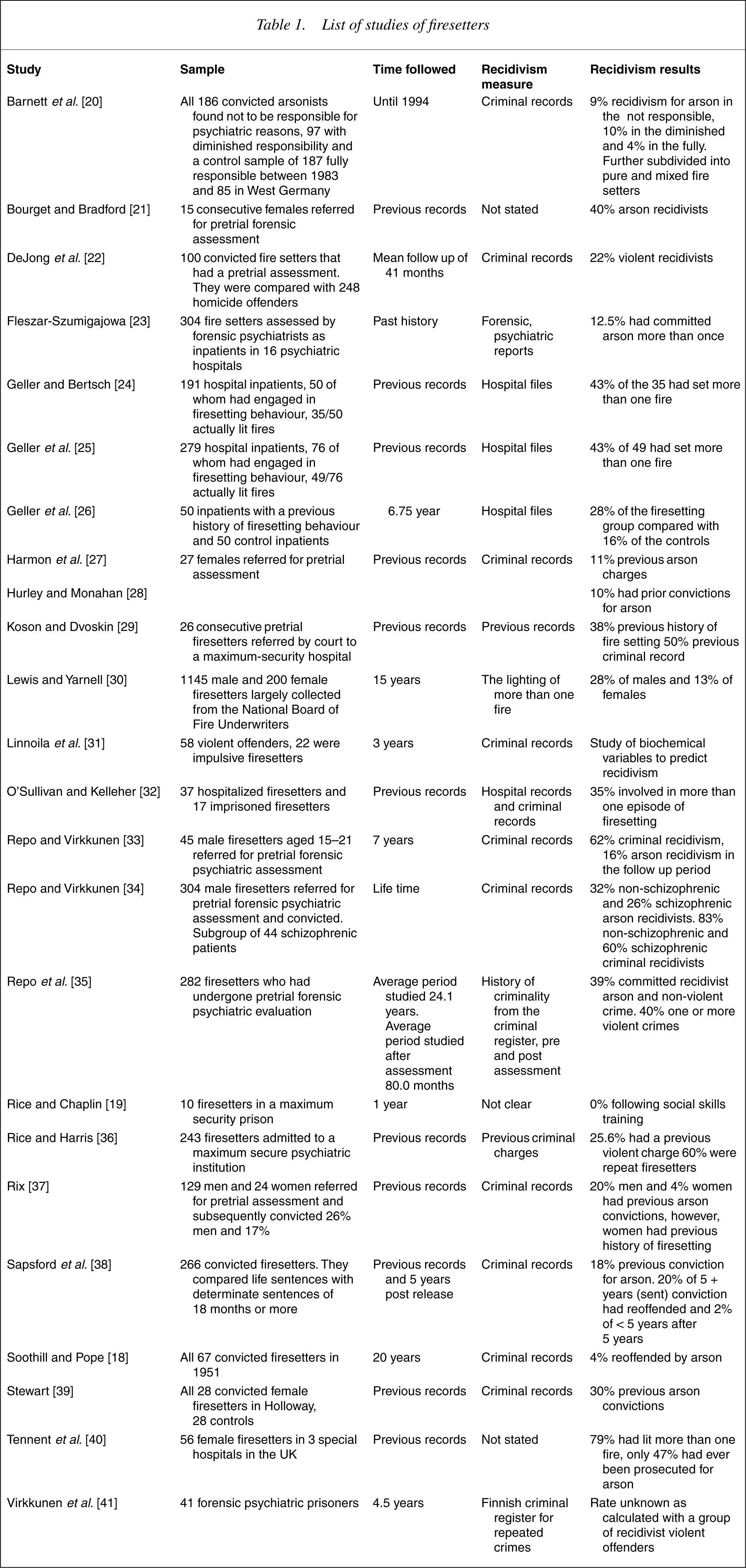
Results of the literature review are listed in Table 1.
List of studies of firesetters
Commentary
The classic paper to date is by Lewis and Yarnell in 1951. They reported on 1145 male and 200 female pathological firesetters [30] of whom 28% of male and 13% of female firesetters had set more that one fire. This is the biggest study to date and the large numbers involved probably override some of its methodological shortfalls. Problems in the study include the sample being neither random nor complete, there is no comparison group, no reliability data are reported and there are few details of the methodology used.
The studies fall into three broad groups: (i) those in forensic psychiatric settings; (ii) those in the criminal justice system; and (iii) those in general and psychiatric hospitals. As the sample is different in each population, they are discussed separately.
Forensic psychiatric settings
This population has significant bias. To be admitted into a forensic psychiatric setting, the criteria are often having a serious mental illness and being a significant risk to others. Different institutions will have different admission criteria, which may be modelled by local legislation. Therefore, comparing groups from different settings is difficult.
Repo et al. examined the medical and criminal records of 282 firesetters [35]. They compared first-time and repeat offenders on a range of diagnostic, demographic and biological variables. Only 21% (59) of firesetters had made only one arson attempt. Thirty-nine percent (110) had committed recidivist arson and non-violent crimes; 40% (113) had committed one or more violent crimes. They found that antisocial personality disorder and alcohol dependence were strongly associated with criminal recidivism. Firesetters diagnosed with schizophrenia committed fewer recidivist criminal offences. Recidivist offenders often had a history of long-lasting enuresis, were younger at the time of the first offence and were more often intoxicated at the time of the arson attempt.
Rice and Harris compared 243 firesetters admitted to a large, maximum secure psychiatric institution with 100 patients admitted at the same facility [36]. In their group, 60% (145) of firesetters were recidivist offenders. The repeat offenders were compared with the onetime offenders. The recidivist offenders were more likely to have a personality disorder, be younger at the index offence and had more extensive criminal histories. The first-time offenders were more likely to have victimized a person they knew and for reasons that were psychotic.
Virkkunen et al. (1996) investigated biochemical and family variables to predict recidivism in alcoholic patients who had committed violent offences or who set fires [41]. There were 41 firesetters examined; these were mixed with 73 violent offenders in the analysis of the risk factors. It is unclear why the two different groups were not separated and why only alcoholic offenders were examined. However, in this group they found that low cerebrospinal fluid 5-hydroxy indole acetic acid (5-HIAA) and 3-methoxy-4-hydroxy phenyl glycol (MHPG) concentrations and a developmental history positive for early paternal absence and the presence of a brother in the family of origin predicted recidivism.
Smaller studies have reported five out of 50 with prior convictions for arson [28] and 10 out of 26 had prior histories of firesetting [29].
Problems with forensic samples
Only a small proportion of deliberate firesetters are apprehended. Of these individuals only a small proportion undergo a psychiatric evaluation. In a Finnish study [42] only 10% of suspected arsonists undergo assessment. Most forensic samples reviewed are thus skewed and not a true representation of arsonists in general. Recidivism is generally measured by self-report or criminal records and both have their limitations. Self-reporters may have bias, as reporting an antisocial activity will not always be accurate. Arson is a costly problem to society [3] and yet it is a poorly solved offence. In America in 1989 [2], [4] only 3% of suspected arson fires led to convictions. Hence the criminal records will not be representative of all arsonists.
Many studies have had small numbers with obvious problems in methodology. There have been only two studies with large numbers, which were discussed above [35], [36]. These used different methodologies and were set in different countries and so it is difficult to compare the studies. Some studies reported general recidivism whereas others looked specifically at arson recidivism.
Criminal justice system
This group includes research based on court records and prison samples. The most comprehensive research on court records was performed in Germany [20]. They examined all records of convicted firesetters between 1983 and 1985, who had been found not to be responsible for psychiatric reasons (n = 97). They compared these with a random sample of all firesetters who had been found fully responsible for their actions (n = 187). They then examined the criminal records of the groups, dividing them into ‘pure’ firesetters and ‘mixed’ firesetters (those who re-offended in any other manner). They found that within these groups, the individuals who had been found to have diminished responsibility were significantly more likely to re-offend by arson. They have found that in previous studies personality disorder was the most common diagnosis in this group [43], [44].
Over the three-year study period, 844 people were convicted of arson. Twenty-two percent were found not to be responsible and 9% were found to have diminished responsibility for psychiatric reasons. Within the following 10 years, seven (4%) of those who were fully responsible, 16 (9%) who were not responsible and 10 (10%) of those with diminished responsibility were reconvicted of arson.
The research was a comprehensive study of recidivism in arson; however, there were some methodological problems. The research was based on criminal records alone and was retrospective. No diagnostic interview was performed and access to medical files was not obtained. Therefore, it is difficult to make predictions as to who the at-risk individuals of recidivism are. Individual risk factors in the diminished responsibility group could be examined to study whether the at-risk population of recidivism can be predicted. It would also be beneficial to study whether there are ‘protective’ factors in the low-risk group. For this to happen, a more detailed research study would need to be devised.
Sapsford et al. compared firesetters in prison serving life sentences (n = 23) with two other samples of firesetters who were serving or had served determinate sentences of 18 months or more (n = 96/147) [38]. They examined many variables including previous offending behaviour. They found that a previous conviction for arson occurred in 47 out of the total sample (226). The best single predictor of recidivism for arson was the number of previous convictions for arson. Similarly, looking at criminal offending, the best single predictor of future conviction was the number of previous convictions. They found a strong association between previous arson offending and ever being diagnosed as ‘sexually abnormal’. The life sentence group had little in common with the short-term offenders but were had more similarities to the offenders serving 5 years or more. Seventy-eight (29%) had previous ‘mental treatment’ but a diagnostic study was not performed.
This sample excluded offenders with a determinate sentence of less than 18 months and obviously included only prisoners. The main thrust of the research appeared to be comparing life sentence with fixed term offenders. The diagnoses of psychopathy and sexual abnormality were more common among the life sentence group. They did not appear to be more likely as a group to be reconvicted.
A much-quoted paper is Soothill and Pope's 2 year cohort study of firesetters [18]. They followed up 67 people who had been convicted of arson in 1951. Using criminal records to detect recidivism, over the next 20 years, only three were reconvicted of arson. The long-term follow-up was vindicated, as two recidivists did not re-offend until 13 and 15 years later. The deficit of this paper is that there was no psychiatric assessment of these offenders and that it relied on official reconviction rates.
General and psychiatric hospitals
The largest sample from this group was from Poland [23]; 304 cases were reported over a 10-year period. In this sample of firesetters 12.5% (38) had offended more than once. They found an association of recidivism with offenders suffering from epilepsy, mental retardation and personality disorders.
Geller examined the frequency of firesetting behaviour in the hospital records of two state hospitals [24], [26]. In one hospital 15 out of 31 subjects had set more than one fire and in the other, 21 out of 49. They went on to follow up one group over a 6.75-year period. They compared this group of firesetters with a matched group of non-firesetters. Fourteen of 40 firesetters were involved in subsequent firesetting behaviour. This compared with 8 out of 50 from the control group. There were some methodological problems in this research related to small numbers, reliance on hospital records and possible problems in the selection of the matched group. This research, although interesting to hospital psychiatrists, does not aid the overall picture of firesetters.
This group cannot be easily compared with the forensic and criminal record populations as the hospital group had not been convicted or charged with an arson offence. The court or prison process may also have an impact on subsequent behaviours and serve as a deterrent to future offending. The research is of interest in that firesetting in hospitals is not restricted to those with a previous history of firesetting. The firesetting appeared to involve a diagnostic spectrum in both repeaters and first-time offenders. Unfortunately it does not add much to the literature about predictive models as to who may offend in such a manner.
Discussion
The empirical literature on firesetters does not support or refute the early literature on the dangerousness of firesetters. There is a vast difference in recidivism rates in different populations, from 4% to 60%; these figures are not helpful when seeing an individual patient. Given the different study designs within different samples and the biases of the samples, the research does not help guide us in the assessment of the dangerousness of firesetters. Firesetters are a heterogenous group and most of the literature does not examine different groups of firesetters but different places where firesetters are held.
There have been many classifications of firesetters [6–8],[45]. Some of these classify firesetters based on motivation, others on multiaxial factors and one on person-orientated versus object-orientated motivation [45]. It is important that an agreed classification can be used and subgroups of offenders can be examined. A communicative firesetter is likely to have very different characteristics to a revenge firesetter. Once a better understanding of the different types of firesetter has been reached, treatment approaches can be developed.
Literature on treatment for firesetters is limited. Social skills training has been suggested due to the poor interpersonal skills of firesetters [19]. In the small group of adults this has been practised in that there was significant improvement in behavioural assessments [19], but the numbers were small and the follow-up period was short. Stewart [39] examined adult female firesetters and suggested behavioural and psychological antecedents to offending should be targeted for treatment. She found these to be low self-esteem, depression, communication skills and anger management. There have been many more programs for juvenile firesetters, which have used a variety of approaches including fire safety education, behavioural programs, psychodynamic approaches and satiation [9], [46], [47].
Clinical common sense tells us that those with a previous history of firesetting, substance abuse and antisocial personality disorder are more likely to re-offend in a similar manner in the future. If their offending behaviour was related to psychotic phenomena, vigorous treatment of the underlying disorder is likely to reduce their risk.
More research is needed in this area; this should address a classification of firesetting and study of the different subtypes. Given the poor detection rate of firesetters and the relatively low incidence of pathological firesetters, a multicentre, collaborative study design will probably produce the best results. In Western Australia we are setting up a database of firesetters who have been assessed by the State Forensic Mental Health Service. This will include data on risk factors cited in the literature, including enuresis and sexual motivation. It is hoped that treatments can be developed to reduce risk in these adult offenders, as has been done for their juvenile counterparts.
In summary, firesetting remains a poorly understood offence. The early literature, based on case reports, appears to have kindled an interest in firesetters and also portrayed them as dangerous recidivists. There is insufficient empirical data to support this. Forensic psychiatry needs to learn more about mentally ill firesetters in order to answer the question: how dangerous is this individual fire setter?