



Abstract
Hormesis is a dose-response phenomenon that has received little recognition, credibility and acceptance as evidenced by its absence from major toxicological/risk assessment texts, governmental regulatory dose-response modeling for risk assessment, and non-visibility in major professional toxicological society national meetings. This paper traces the historical evolution of the hormetic dose-response hypothesis, why this model is not only credible but also more common than the widely accepted threshold model in direct comparative evaluation, and how the toxicological community made a critical error in rejecting hormesis, a rejection sustained over 70 years.
INTRODUCTION
The central pillar of toxicology is that of the dose-response relationship. The nature of the dose response has long been assumed to follow a threshold model (Bliss, 1935a, 1935b, 1935c; Clarke, 1937; Finney, 1952; Gaddum, 1953). This has been especially the situation for non-carcinogens. In the case of carcinogens, regulatory agencies such as the EPA and FDA have assumed that the shape of the dose response is linear at low doses based principally on a conservative precautionary-type philosophy. Advocates for either a threshold or linear model perspective have engaged in a long-term debate over the biological plausibility of their respective models, especially in the contentious area of carcinogen risk assessment/regulation. While the threshold vs linearity at low-dose debate has cast a dominant shadow over the field of risk assessment for nearly three decades, in this paper we propose that the most fundamental shape of the dose-response relationship is neither threshold nor linear but U-shaped. This challenge for the primacy of dose-response model dominance in toxicology and, in fact, the vast array of biological disciplines by the U-shaped perspective cuts to the core beliefs of the field with extremely significant evolutionary, ecological, biomedical, clinical, economic and social implications (Calabrese and Baldwin, 2001a). The present paper will establish that the hormetic dose response is the most dominant dose-response model in toxicology based on objective, head-to-head comparison with the threshold model; it will demonstrate how the toxicological community missed this basic feature of the dose response, a mistake of historical proportions and implications; it will also provide a mechanistic framework that can account for quantitative features of the hormetic dose response. This evaluation will be placed within an historical context to enhance a balanced understanding of the unfolding of toxicological thought concerning the dose-response throughout the past century. The paper argues that the hormetic dose response is the central dose-response model in toxicology and needs to be included in all leading texts and taught as a routine feature of toxicological instruction dealing with the dose response and principles of risk assessment.
DEFINITION
The U-shaped dose response model is commonly referred to as hormesis, a dose response phenomenon characterized by a low-dose stimulation and a high dose inhibition. This dose response may take the shape of either the inverted U or a J-shaped dose response depending on the endpoint that is measured (Figure 1). In the case of the inverted U-shaped dose response, this may be observed when endpoints such as growth, fecundity and longevity are measured. In the case of J-shaped dose response relationships, this may be observed when endpoints such as disease incidence are measured.

(A) The most common form of the hormetic dose-response curve depicting low-dose stimulatory and high-dose inhibitory responses, the β- or inverted U-shaped curve. Endpoints displaying this curve include growth, fecundity and longevity. (B) The hormetic dose-response curve depicting low-dose reduction and high-dose enhancement of adverse effects. Endpoints displaying this curve include carcinogenesis, mutagenesis and disease incidence.
While the hormetic dose response is often described as either an inverted U- or J-shaped dose response, it is best described as a dose-time-response, in which there is an initial disruption of homeostasis (i.e., toxicity) followed by a modest overcompensation response which eventually leads to a re-establishment of homeostasis. It is this modest overcompensation response which is seen as the hormetic low-dose stimulation (Figure 2) (Calabrese and Baldwin, 2001c, 2002a).

(A) The general form of hormetic dose-response relationships; (B) the temporal sequence of hormetic dose-response relationships.
HISTORICAL PERSPECTIVES
The phenomenon of hormesis has had a long, but spotty history. For the most part it has been a marginalized dose-response theory with occasional vocal advocates over the past century. Once toxicology became a reasonably well organized and professional discipline this dose-response theory found itself excluded from the principal textbooks, developments of professional societies and the activities of an ever dominant governmental toxicological/risk assessment influence. Despite this shunned perspective by the dominant influences in the field of toxicology over the past 70 to 80 years, there has been a continuous flow of articles published that provides support to this hypothesis across the broad spectrum of biological sub-disciplines.
The term hormesis entered the scientific literature in 1943 when Southam and Ehrlich reported that extracts from the red cedar tree enhanced the metabolism of fungi at low concentrations but inhibited it at higher concentrations. These investigators were apparently unaware of a substantial body of literature that described similar dose responses in plants, microorganisms, insects, and mammalian models from a variety of chemical agents, including most of the well-studied inorganic contaminants as well as various forms of radioactivity (Calabrese and Baldwin, 2000a–e). The primacy of the concept of hormesis is generally credited to Hugo Schulz, a pharmacologist at the University of Greifswald in northern Germany who based experiments dealing with the effects of disinfectants on the metabolism of yeasts in the mid 1880s (Schulz, 1887). The terminology that grew up around the concept of hormesis reflected the culture of the time, which had a tendency to name phenomena after their discoverers and to quickly conclude that they reflected some type of biological “Law.” Thus, the initial observations of Schulz along with his attempts to generalize the concept resulted in this phenomenon being called the Arndt-Schulz Law or Hueppe's Rule, after the bacteriologist who extended the findings to bacteria (Hueppe, 1896). However, these terms are rarely used today, giving way to hormesis or other terms such as U- or J-shaped, biphasic dose response, dual effects, bidirectional responses and several others.
The early history of what are now called hormetic effects was surprisingly impressive. This phenomenon attracted a number of well-known researchers who published their findings in the leading journals of the day. A detailed assessment of the historical foundations of chemical and radiation hormesis has been published by Calabrese and Baldwin (2000a–e). Even more impressive was the fact that several of the early leading hormetic researchers were direct descendants from Nobel Prize winners' laboratories such as Ferdinand Hueppe (see Hueppe, 1896) from Robert Koch's lab, Louis Kahlenberg (University of Wisconsin) (see Kahlenberg and True, 1896a, b) from Willhem Ostwald's lab, and Charles Richet (1905,1906–1907), a Nobel Prize winner for the discovery of anaphylaxsis. Other early leaders in hormetic research with outstanding scientific reputations were Charles Edward Winslow (see Winslow and Dolloff, 1928; Winslow and Haywood, 1931; Falk, 1923) at Yale University, Benjamin Duggar (1901, 1936) of Cornell University/University of Wisconsin, and Jensen (1907) at Stanford University. Due to the fact that X-rays and radionuclides were discovered about a decade after the initial research of Schulz, the association of radioactivity and hormesis was delayed relative to chemical findings. Nonetheless, substantial evidence emerged by the early 1920s that radiation-induced biphasic dose-response relationships were considered common, reproducible and independent of biological model (Calabrese and Baldwin, 2000c–d). In fact, the hormetic dose response was commonly reported and diagrammed in leading texts on botany and microbiology into the middle decades of the twentieth century (Marshall and Hrenoff, 1937).
Despite the initial decades of successful hormetic research it became the object of opponents who successfully linked it with the medical practice of homeopathy (Clark, 1937). This was an easy thing to do since the creator of the concept of hormesis, Hugo Schulz, was a very strong proponent of homeopathy and in fact interpreted his findings as providing the scientific foundations of the medical practice of homeopathy. In fact, the Arndt-Schulz Law was named, in part, after Rudolph Arndt, a homeopathic physician. As a result of the very close association between the Arndt-Schulz Law and homeopathy it became targeted by enemies of homeopathy in the long-running confrontation with what is today called traditional medicine. Even today, the proponents of homeopathy still point to the work of Schulz as providing important historical foundations of the biological basis of homeopathy (Bellevite et al., 1997). However, in the early decades of the twentieth century the homeopathy movement had major setbacks with numerous homeopathic medical schools in the U.S. being forced to close due to poor academic standards. How these actions affected the Arndt-Schulz Law has never been studied but it is likely that it negatively impacted its general recognition and acceptance. In fact, as early as 1896 Hueppe argued that the findings of Schulz were reproducible and needed to be judged on their own merits, not coupled with homeopathy, even though this was how Schulz himself framed the question.
The downfall of the Arndt-Schulz Law, however, cannot be solely laid at the feet of its close association with homeopathy. It had a number of other limitations of notable importance that combined to make this theory play scientific catch-up throughout the remainder of the century. For example, the proponents of the Arndt-Schultz Law attempted to transform this dose-response theory into a range of profitable businesses, claiming, for example, that low doses of radium could be used not only as a human elixir but also as a fertilizer for plants at low doses. In both cases it had major public relations failures. In the case of the elixir, its greatest proponent, Eben Evers, died a very public and painful death from radium-induced bone cancer. In the case of radium as a fertilizer, the findings were consistently equivocal; most notably was the 1948 13-site USDA study although it had important study design weaknesses (Alexander, 1950). In addition, the emphasis on the nature of the dose response during the 1920s and 1930s was not on low-dose effects; in fact, just the opposite. Issues that received greatest attention were the effects of disinfectants on microbes, the effects of pesticides on a wide range of organisms, as well as protection of workers from toxic substances. These cases involved instances of high-dose effects. Furthermore, it was evident that the investigations of that era did not address the quantitative features of the hormetic dose response, which in fact are rather modest, at least as far as the low-dose stimulation is concerned.
By the 1930s, the collective criticisms of the Arndt-Schulz Law had significantly eroded many of the earlier gains it had made in both the chemical and radiation domains. Despite the legitimacy of many of these criticisms, this was unfortunate since the data underlying the hormetic hypothesis were generally sound and substantial. However, as is common in such debates, commercial claims were often proven wrong while scientific limitations were often exaggerated. This fall from centrality within the scientific community during the early 1930s and subsequent decades occurred as major consolidations were taking place in the U.S. and elsewhere with respect to health and safety issues, statistical foundations of dose-response relationships and governmental decisions of how to estimate risks from radiological and chemical hazards. At this point, the Arndt-Schulz Law became generally ignored and has continued to be so.
This brief assessment of the historical foundations of hormesis reveals that it was a theory without either a financial sponsor or a core of leading scientific proponents. In addition, U.S. science in the twentieth century became one that was nearly entirely dependent upon government agency funding and responsive to its intellectual agenda, often supported by influential bodies such as the National Academy of Sciences. Lacking these crucial elements, hormesis was an hypothesis that failed to thrive.
NEW OPPORTUNITIES AND INTEREST
Major developments in environmental regulation over the past 40 years have provided the necessary incentive for the reexamination of the hormesis hypothesis. While this may not seem obvious, it is directly linked to the extraordinary conservative protectionist philosophy of governmental agencies such as the U.S. EPA in their risk-assessment procedures for carcinogens, which assume linearity at low doses. Such governmental actions have led to very high costs being imposed on affected industries and organizations such as the U.S. DOD and DOE. This led to interest not only in exploring the biological foundations of low-dose extrapolation but also alternative models of low-dose responses. It became very evident to those leading the affected organizations that if hormesis was right then linearity at low doses was wrong. At that point, the 1981 book by Luckey dealing with hormesis and ionizing radiation became potentially significant. Ironically, Luckey did not even mention any relationship between hormesis and carcinogenicity. Nonetheless, it sparked interest in the concept of radiation hormesis, especially in light of reports in the 1950s and 1960s suggesting that low doses of radiation may reduce the risks of certain cancers in natural high background radiation settings (Luckey, 1991), as well as reports suggesting enhanced longevity in survivors of the atomic bomb blast (Kondo, 1993) and numerous animal model validation experiments during the 1970s and 1980s (see Calabrese and Baldwin, 2002b for review).
This combination of factors and the leadership of the Electric Power Research Institute (EPRI) led to the first-ever conference on Radiation Hormesis in 1985 in Oakland, California. Of particular note was that the proceedings were published two years later in the prestigious journal Health Physics, adding not only enhanced visibility to the topic but that elusive credibility that hormesis lacked. Several years later, Leonard Sagan (1989), who directed the 1985 EPRI conference, and Sheldon Wolff (1989) of the University of California at San Francisco debated the viability of hormesis as a credible biological hypothesis in the journal Science. Following the publication of the Science articles a meeting was held in May 1990 at the University of Massachusetts, Amherst to devise a plan to provide balanced leadership for assessing how biological systems respond to low levels of chemical and physical stressors. Based on this meeting, the BELLE (Biological Effects of Low Level Exposures) organization was created that has played a significant role in assessing the hormesis concept (see commentary by Rodricks, 2003).
OBJECTIVE EVALUATION
By the mid-1990s the assessment of hormesis seemed to fall into groups that either thought it was a concept based on reproducible data or were unconvinced, generally concluding that the low-dose stimulation was most likely that of normal variation. These critics contended that the evidence in support of the hormesis hypothesis had simply been overinterpreted.
In order to move beyond this impasse concerning hormesis, we developed a priori evaluative criteria to assess whether a dose-response displayed features consistent with the hormetic/biphasic dose-response. These criteria were based on study design characteristics, such as whether the experiment displayed a NOAEL (No Observed Adverse Effect Level) and the number of doses less than the NOAEL, the magnitude of the low-dose stimulation, the presence or absence of statistical significance for the stimulatory effects, and the reproducibility of the findings. Each factor considered received a numerical ranking, which provided a basis for a mathematical algorithm to estimate the likelihood that each dose-response yielded evidence consistent with the hormetic hypothesis. We also developed a relational retrieval database into which information from numerous different content fields from each study could be entered. With these two tools, evidence from about 5000 experiments was accumulated that provided positive evidence of hormesis. An assessment of the findings indicates that hormetic dose-response relationships are very generalizable, being independent of biological model, endpoint measured and chemical class/physical stressor (Calabrese and Baldwin, 1997; Calabrese et al., 1999). Figure 3 provides a diverse set of examples of dose-response relationships that are consistent with the hormetic hypothesis. They were selected to demonstrate the range of biological models and endpoints in which hormetic responses may occur.

Representative examples of U-shaped dose-response curves. The asterisks indicate statistically significant data.
The creation of this hormesis database using objective criteria was an important first step in the assessment of hormesis as a credible biological hypothesis. Of importance was that the evaluative criteria were sufficiently specific and objective that they led to negligible variation among those evaluating dose responses for the presence or absence of evidence concerning hormesis. It was this type of consistency that was sought in order to overcome the disparity of the conclusions that proponents and opponents had expressed on the topic.
An assessment of this database revealed important characteristics of hormetic dose-response relationships. Most notably, the magnitude of the low-dose stimulation was generally quite modest. In most cases the maximum stimulation did not exceed two-fold greater than the concurrent control group. The maximum response was generally about 30–60% greater than the control group response. The width of the stimulatory response was more variable than that of the magnitude of the low-dose stimulation. Typically the range of the stimulatory responses was within a factor of 10–20 of the NOAEL dosage. In a small proportion of the cases the dosage range of the stimulation would exceed a factor of 100-fold. In addition, there were occasions when the stimulatory dosage range would reproducibly exceed 1000-fold.
Of importance was that the hormetic stimulation was graphically contiguous with and ended at the traditional toxicological NOAEL (Figure 4). This allowed risk assessors the opportunity to place hormetic responses within a risk assessment dose-response context. This would prove to be the case not only for testing purposes within a hazard assessment framework but also for modeling of low-dose responses. The second reason is that the hormetic response was closely linked to the occurrence of the initiation of toxicity. In fact, since 1896 (Townsend, 1896) the low-dose stimulation had been reported to occur as a result of an overcompensation to a disruption in homeostasis. In fact, this observation, which has been repeatedly reported (Calabrese, 2001), provides the foundation for why the hormetic response is invariably adjacent to the toxicological NOAEL.

Dose-response curve depicting the quantitative features of hormesis.
That hormesis may occur as a result of an overcompensation to low-level toxic insult accounts for why the stimulation is modest, based on the assumption that the disrupted biological process/system will re-establish homeostasis. Under such circumstances it would be expected that the biological processes would use sufficient resources to ensure that homeostasis is achieved within an appropriate time period but not to be wasteful of resources. This would result in a predicted modest “overshoot” phenomenon, which is what is typically observed with many hormetic dose-time responses.
The quantitative characteristics of the hormetic dose response are therefore consistent with expected features of a dose time response relationship in which there is an initial toxic response. The principal difference in responses between the low and high doses is that the low-dose toxicity becomes fully compensated and, in fact, modestly overcompensated, resulting in the apparent “stimulation.” However, the high-dose toxicity remains unable to fully recover from the extensive damage and displays the so-called high-dose “inhibition.” Thus, when viewed at the appropriate time in the dose-time response, the hormetic-like biphasic dose response is observed. However, if the dose-time response is seen at an earlier stage of responsiveness, then the dose response could appear as a traditional dose-dependent toxic response (Figure 2).
This initial assessment of hormetic responses not only yielded evidence to support the existence of hormesis but it also provided valuable toxicological insights. These findings permitted an evaluation of the generalizability of hormesis as well as providing a quantitative description of its dose-response features that were consistent with a plausible toxicological model of dose-time responsiveness. In fact, now it became clear why hormesis was hard to prove, challenging to replicate and a source of contention among those who had long debated its existence. The key for studying hormesis was to be found in the quality of the study design, such as the number and spacing of doses below the NOAEL, a definitively characterized NOAEL, and the inclusion of a temporal component that could capture the initial disruption in homeostasis followed by the modest overcompensation response. Likewise, it was critical to select an appropriate biological endpoint in which the control group had an adequate background response. For example, selection of a tumor type with an animal strain in which the control group had a negligible background incidence would preclude the assessment of hormesis.
Despite the advances offered by the database-facilitated assessment of hormesis, it did not permit an evaluation of the frequency of hormesis in the toxicological literature. That is, while numerous, in fact thousands, of examples of dose-responses consistent with the hormetic hypothesis existed, tins information offered no quantitative insight concerning the frequency of hormetic responses in the toxicological literature. That is, did hormetic effects occur in 1% or 50% of toxicological studies, or someplace in between? This was an important issue to resolve for regulatory agencies. If a response was real, but a relatively rare phenomenon, then it could be dealt with on a case-by-case basis. If, on the other hand, it was commonly seen, then it would have to be considered as part of the “rule” and dealt with accordingly.
To address the question of frequency, an entirely new database was created which had a priori entry as well as a priori evaluative criteria (Calabrese and Baldwin, 2001a). These new criteria were applied to essentially every article (i.e., 21,000) published in three toxicologically oriented journals (i.e., Environmental Pollution, Bulletin of Environmental Contamination and Toxicology and Life Sciences) from their creation (i.e., mid 1960s) to the present. These journals were selected because they included the spectrum of ecologically to pharmacologically oriented toxicology. This was important in order to address issues related to generalizability by model, endpoint and agent. The data revealed that a priori entry criteria [i.e., a dose-response was required to have a LOAEL (Lowest Observed Adverse Effect Level), NOAEL, at least two doses less than the NOAEL dose and a concurrent control] were satisfied in only about 2% of the articles assessed. However, of dose responses satisfying the entry criteria approximately 40% satisfied a priori evaluative criteria, that is, the functional definition of hormesis (e.g., evidence of statistically significant responses for dosages less than the NOAEL dosage).
The findings were important in several ways. For the first time there was an estimate of the frequency of hormesis in the broad toxicological literature. This frequency revealed that hormetic responses were not rare occurrences and exceptions but were commonly reported. Second, the very low proportion of studies that satisfied the a priori entry criteria indicated that the vast majority of toxicological studies has been incapable of assessing whether hormesis existed or not. These studies, for the most part, lack an adequate number of doses in the low-dose area and could not therefore discern whether there was a reliable low-dose stimulation or not.
This insight was important because it provided a cogent explanation for how toxicologists could readily dismiss hormesis. The data indicate that 98% of toxicology studies cannot address the hormesis hypothesis in an adequate evaluative fashion. Only about 50% of the 2% of dose-responses that could assess the hormetic hypothesis actually observed it. Consequently, only one out of every 100 published dose-response relationships assessed displayed hormesis. In effect, this type of numerical framework further emphasized the marginalized perspective within which the hormetic hypothesis has been held.3
While this assessment addressed the issue of hormetic effect frequency in the toxicological literature, the second hormesis database (i.e., frequency database) also provided a vehicle to determine which toxicological dose-response model may be more frequent in the toxicological literature: the hormetic or the threshold model. The threshold model assumes that there is no treatment-related effect for doses below the NOAEL, a type of quasi-toxicological threshold dose. This further implied that responses of doses below the NOAEL dose would be expected to vary randomly on either side of the control value. For example, in our frequency database of about 650 dose responses that satisfied a priori entry criteria, there were nearly 1,800 collective doses below the NOAEL. The threshold model predicts that there should be a similar number of responses above and below the control value. When this was evaluated, the ratio was not 1:1 as predicted by the threshold model but 2.5:1, a value highly consistent with the hormetic model. Further, the mean response of the nearly 1,800 responses of doses below the NOAEL was 115%, a value consistent with past observations of hormetic responses (Calabrese and Baldwin, 2003a). These findings indicated that the responses of doses below the toxicological NOAEL were not randomly distributed but were non-randomly distributed in a manner suggestive of hormesis.
Not only did these findings refute the perspective of hormesis being a “paradoxical” phenomenon, it also suggested that the long-held belief in the primacy of the threshold model may have been misplaced. This conclusion is of obvious general significance since acceptance of the hormetic model would infer profound changes in how studies are designed, biological models and endpoints selected, and risk assessments performed.
The data also provided a framework to account for how the toxicological community, especially mammalian toxicologists, could have missed the hormetic dose-response model and incorrectly concluded that the most fundamental dose-response model was the threshold model. This conclusion is supported by several consistent observations. First, the NOAEL responses for about 70% of mammalian studies in the frequency hormesis database were less than the control values. Even though these NOAEL responses were not, by definition, statistically significantly lower than the NOAEL, it is likely that a substantial proportion may have had a low level of toxicity, even if not discernable at the P < 0.05 level. Second, in dose responses that did not satisfy the functional definition of hormesis, where the NOAEL was ≤95% of the control, the next lower dose adjacent to the NOAEL had a response that was typically less than the control. At progressively lower doses from the NOAEL dose the responses resembled more hormetic responses (i.e., responses greater than the control) (Calabrese and Baldwin, 2003a). This finding suggests that the majority of mammalian toxicological studies have NOAEL values less than the control, many probably have some degree of toxicity, and that toxicity may also be likely in the first dose below the NOAEL; this makes the phenomenon of hormesis difficult, if not impossible, to observe in such circumstances. Since most mammalian toxicology studies rarely have more than one dose below the NOAEL it follows that the logical, but incorrect, conclusion is that the most likely dose-response model would be the threshold model. As a result of this rather limited/incomplete study design-based perspective, the “collective” field of toxicology drew the wrong conclusion about the nature of the dose response in the low dose zone. In fact, it is our contention that simple limitation in the study design, which was focused on high-dose effects, led to the apparently “logical” conclusion that hormesis was wrong and threshold was right, when in fact the full range of data are consistent with the opposite conclusion.
Despite these arguments in favor of the hormetic perspective, there has been one overriding criticism that toxicologists skeptical of hormesis consistently raise. That is, it is necessary to determine the mechanism (s) by which hormesis occurs. Unless the issue of mechanism can be resolved acceptance of hormesis would be seen as incomplete. A key limitation in the quest for the hormetic mechanism is that the overwhelming majority of papers published on toxicological mechanisms do not address the underlying explanations of transformations or switches in the dose-response relationships from stimulation to inhibition. However, this question is typically addressed in the sub-discipline of molecular pharmacology. Our assessment of this literature has revealed that hormetic-like biphasic dose-response relationships occurred with seemingly comparable frequency in the pharmacology and toxicology domains. However, pharmacologists have both interest in switching mechanisms and the molecular tools to assess such changes. We have determined that hormetic-like biphasic dose response relationships have been reported in at least 30 receptor systems (Table 1) for which a highly credible molecular explanation has been offered at least to the level of receptor and often at levels of greater complexity (Calabrese and Baldwin, 2001b).
Representative receptor systems displaying biphasic dose-response relationships
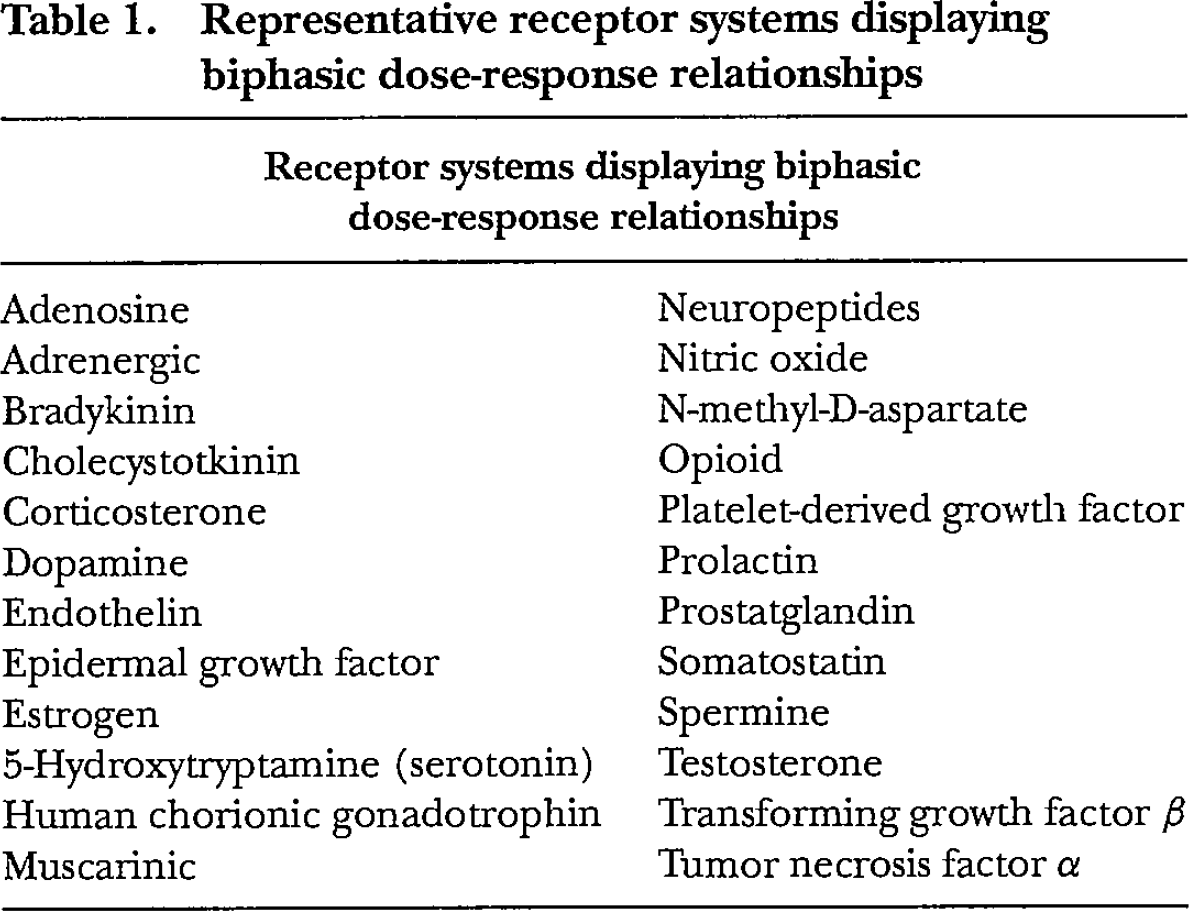
These findings reveal that hormetic responses may occur as a result of numerous mechanisms, depending on the cell type. There was clearly no single toxicological mechanism. However, there appears to be a common biological regulatory strategy that results in the achievement of limited biological goals (e.g., smooth muscle contraction/relaxation, regulation of neutrophil migration, cell proliferation enhancement or not) within the context of resource conservation while re-establishing and maintaining homeostasis.
Over the past seven years, therefore, we have been able to demonstrate that: 1) hormesis is widespread in the toxicological literature; 2) that it has consistent quantitative features of the dose response; 3) it is highly generalizable according to model, endpoint and chemical class; 4) it has a frequency in the toxicological literature that is approximately 40% using very rigorous objective criteria; 5) in head-to-head competition with the threshold model the hormetic model clearly outperforms it; 6) it has numerous underlying specific mechanisms. These findings challenge the most basic pillar of the toxicological community concerning what model best describes how biological systems responded to low levels of chemical and physical stressor agents. The data also challenge how toxicological studies are designed. That is, experiments with inadequate numbers of doses and dose spacing, which also lack a temporal component, are not going to be able to address the issue of hormesis. This is where the vast majority of toxicological studies reside.
HOW CAN HORMESIS BE USED?
The concept of hormesis changes how we think about toxicology and risk assessment. In the domain of hazard assessment, hormesis argues that there are meaningful biological effects below the toxicological NOAEL. Over the past several decades toxicologists and regulatory agencies have been content to derive NOAELs based on the assumption that there were no treatment-related effects below the NOAEL. If this can no longer be assumed, then it challenges researchers and regulatory agencies to rethink their study designs and perhaps the biological models used and endpoints measured.
The acceptance of hormesis as a default assumption in the risk assessment process is one that should be taken seriously. This is because of the overwhelming amount of data supporting it, especially those findings relating to its frequency in the toxicological literature, its dominance over the threshold model, its widespread generalizability and the fact that it is difficult to study unless adequate resources and time are allocated. To require that hormesis be proven for every case would place a substantial burden of both resources and time and for all practical considerations would limit the application of hormetic phenomenon when, in fact, the evidence argues that it is a general phenomenon.
The area of carcinogen risk assessment is likely to yield the biggest impact of hormesis. The most obvious implication of the hormetic model is not that low doses of carcinogens may actually reduce cancer risk, but that thresholds for carcinogens exist. Even though hormesis was shown above to outperform the threshold model, it may be ironically used to support the conclusion that thresholds exist for carcinogens. Unless hormesis can be demonstrated it is quite evident that thresholds for carcinogens will be nearly impossible to prove, as has been the case over the past two decades.
While the focus of this paper is environmentally oriented, it is important not to ignore that the hormetic dose-response is quite common in pharmacology and other biological fields concerned with dose-response relationships. Numerous drugs, including antibiotics, anti-viral agents, anti-tumor agents and other chemotherapeutic, as well as most peptides (see Calabrese and Baldwin, 2003a,b for their review), often display hormetic-like biphasic dose responses. Similar dose responses are seen for plant root exudates (Reigosa et al., 1999) and how they affect germination of fungal spores and the growth of plant systems in soil. Biphasic responses are quite common in the field of exercise science especially with respect to immune responses (Nieman, 2000). The hormetic dose response is therefore one that is most likely basic to all biological disciplines, the implications of which have only recently begun to be specifically explored (Calabrese, 2000).
Footnotes
Note that the criteria could have been even more stringent if temporal study design criteria were also included. In fact, the lack of measurement at multiple time points in most experiments satisfying the a priori criteria is a likely contributor to the reason why only 40% of the experiments satisfied the definition of hormesis.