




Abstract
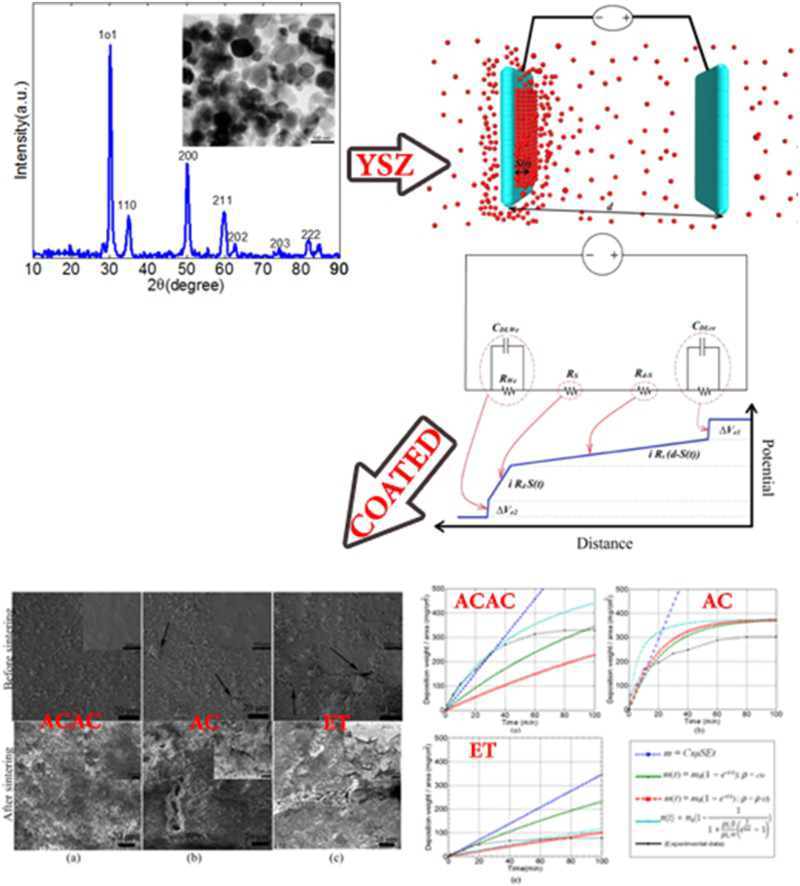
Electrophoretic deposition (EPD) was employed to coat yttria-stabilised zirconia (YSZ) on Fecralloy. Various non-aqueous solvents were utilised to achieve smooth crack-free YSZ coatings. The EPD parameters, including solvent type, sedimentation height, zeta potential, particle size, pH and deposition weight, were studied. The micro-structural evolution and mechanical properties of the coatings were studied by the field emission scanning electron microscopy and micro-hardness, respectively. It was found that coatings obtained from 0.4 g L−1 I2 acetyl–acetone were uniform, smooth and crack free. Also they had narrow particle size distributions and higher zeta potential in the suspension. The experimental results revealed that suspension stability was a requirement for obtaining high-quality coatings and deposition yield for stable suspensions was higher; however, particle coagulation resulted in coatings with low green density and poor sinter ability. A transition in deposition mechanism from linear to parabolic was observed during EPD where deposition rate was decreased by time.
GRAPHICAL ABSTRACT
Keywords
Get full access to this article
View all access options for this article.