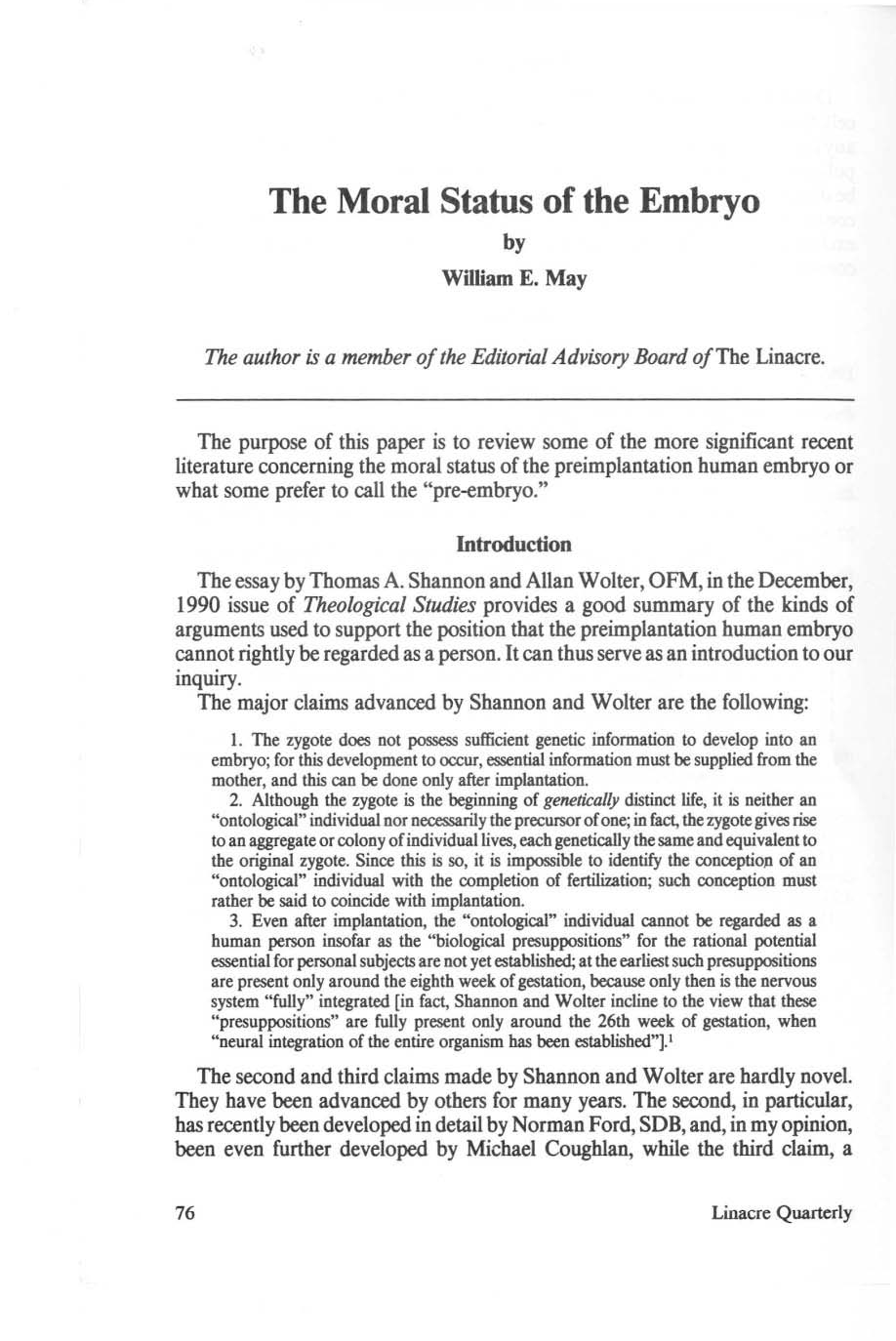
ShannonThomas A., and WolterAllan B.OFM, “Reflections on the Moral Status of the Pre-Embryo, Theological Studies51 (1990) 603–626.
2.
BedateC. A., and CefaloR. C., “The Zygote: To Be or Not To Be a Person,”Journal of Medicine and Philosophy14 (1989) 641–645.
3.
SuarezAntoine, “Hydatiform Moles and Teratomas Confirm the Human Identity of the Preimplantation Embryo,”Journal of Medicine and Philosophy15 (1990) 627–635, at 627.
4.
SuarezAntoine, “Hydatiform Moles and Teratomas Confirm the Human Identity of the Preimplantation Embryo,”Journal of Medicine and Philosophy15 (1990), 631. Emphasis in the original.
5.
BoleThomas J.III, “Zygotes, Souls, Substances, and Persons,”Journal of Medicine and Philosophy15 (1990) 637–652. It is, I believe, unusual for a journal of this kind to submit one article scheduled for publication to another author for criticism in the same issue. It seems evident that the editors of the journal, perhaps unhappy with Suarez's conclusions, wanted them immediately subjected to critique.
6.
BoleThomas J.III, “Zygotes, Souls, Substances, and Persons,”Journal of Medicine and Philosophy15 (1990), 643.
7.
BoleThomas J.III, “Zygotes, Souls, Substances, and Persons,”Journal of Medicine and Philosophy15 (1990)
8.
BoleThomas J.III, “Zygotes, Souls, Substances, and Persons,”Journal of Medicine and Philosophy15 (1990), 650, note 7.
9.
FordNorman M.SDB, When Did I Begin?: Conception of the Human Individual in History, Philosophy and Science (Cambridge: Cambridge University Press, 1988), pp. 119–120; cf. pp. 121-122, 135, 170-172.
10.
FordNorman M.SDB, When Did I Begin?: Conception of the Human Individual in History, Philosophy and Science (Cambridge: Cambridge University Press, 1988), pp. 139–145. On the formation of the “ontological” human individual at the primitive streak stage see ibid., p. 162; cf. pp. 170-177.
11.
CoughlanMichael, The Vatican, the Embryo and the Law (Iowa City: University of Iowa Press, 1990), p. 74; cf. pp. 69-70.
12.
CoughlanMichael, The Vatican, the Embryo and the Law (Iowa City: University of Iowa Press, 1990), pp. 58–77.
13.
CoughlanMichael, The Vatican, the Embryo and the Law (Iowa City: University of Iowa Press, 1990), pp. 75–76.
14.
HuarteJoachim, “Concepts fondamentaus d'embryologie,” inL'Embryon: Un Homme: Actes du Congres de Lausanne 1986 (Premier Congres de la Societe suisse de beioetique 8 et 9 novembre 1986) (Lausanne: Centre de documentation civique, 1987), pp. 65–68, at 67-68.
15.
GrisezGermain, “When Do People Begin?”Proceedings of the American Catholic Philosophical Association63 (1990) 27–47, at 37. The article of Yanagimachi to which Grisez refers is entitled “Mammalian Fertilization,” and is found in The Physiology of Reproduction, ed. KnobilE., NeillJ. (New York: Raven Press, 1988), p. 135. See Grisez, p. 45, n. 49.
16.
GrisezGermain, “When Do People Begin?”Proceedings of the American Catholic Philosophical Association63 (1990), 37.
17.
GrisezGermain, “When Do People Begin?”Proceedings of the American Catholic Philosophical Association63 (1990)
18.
GrisezGermain, “When Do People Begin?”Proceedings of the American Catholic Philosophical Association63 (1990), 38.
19.
See, for instance, AshleyBenedict, “A Critique of the Theory of Delayed Hominization,” inAn Ethical Evaluation of Fetal Experimentation: An Interdisciplinary Study, ed. McCarthyDonald, and MoraczewskiAlbert S., OP (St. Louis: The Pope John XXIII Medical-Moral Research and Education Center, 1976), pp. 113–133; Edgardo Giovannini, “Le statut de l'embryon,” in L'Embryon: Un Homme, pp. 69-89.
20.
de SiebenthalJean, “L'animation selon Thomas d'Aquin,” inL'Embryon: Un Homme, pp. 91–98, at 96-97. In stressing this aspect of St. Thomas's thought, Siebenthal cites texts from Summa Theologiae, 1, q. 118, a. 3; 3, q, 6, a. 4, ad 1; 3, q. 2, a, 5; 1, q. 76, a. 4, a. 6, ad 1.
21.
Siebenthal, 91–98.
22.
Grisez, “When Do People Begin?,”33–34.
23.
Grisez, “When Do People Begin?,”, 40.
24.
SchwarzStephen, The Moral Question of Abortion (Chicago: Loyola University Press, 1990).