




Abstract
The mass media are an important source of information about mental illness, particularly for those who have had little contact with mentally ill people. Research into the portrayal of mental illness in the media around the world, however, has generally found that negative depictions predominate [1]. Common depictions of the mentally ill include being dangerous to others, involved with crime, vulnerable, and unpredictable [2]. This is a concern because negative media reporting has been implicated in the formation of negative attitudes towards people with mental illness. For example, one study found that people's attitudes towards those with mental illness markedly worsened directly after media reports of two violent attacks on prominent politicians by two mentally ill individuals [3]. Another study showed that adolescents were more likely to describe a mentally ill person as dangerous and violent after reading news reports of mentally ill individuals committing violent crimes, compared to a control group who read a factual article about mental illness [4].
Two mass communication theories, cultivation theory and social cognitive theory, have been proposed for the mechanisms by which the media influences mental illness stigma [5]. Cultivation theory proposes that repeated exposure to consistent media messages shapes values and perceptions of reality to fit those presented in the media. Social cognitive theory proposes that, in addition to direct experience, individuals vicariously learn about appropriate behaviour and affective reactions through observation, particularly from media sources. Together these theories describe how the construction and perpetuation of mental illness stigma occurs through the media's social construction of reality.
A concerted effort to improve media reporting of mental illness in Australia has occurred since 2002 with the Mindframe Media and Mental Health Project, which educates journalists on how to sensitively report on issues of suicide and mental illness [6]. As part of the initiative, a resource kit for media professionals was developed and briefings with media organizations were held to promote the kit and discuss issues when reporting mental illness. The resource kit outlines responsible and appropriate reporting of suicide and mental illness, such as avoiding depicting the method of suicide, what language to avoid when describing individuals with a mental illness, and the importance of including contact details of helplines in stories [7]. Another initiative is Stigma Watch, by SANE Australia, which monitors media portrayals of mental illness and suicide, exposing cases of media stigma to public scrutiny and educating those responsible to change their practices [8].
Because of its potential to influence attitudes, the media can also be used as a tool in the battle against stigma. Positive news stories about successful recoveries and disclosures of mental illness by respected public figures can counter the frequent negative media reports of mental illness. Community awareness campaigns, such as beyondblue: the national depression initiative (beyondblue.org.au), the Defeat Depression Campaign [9], and the Compass Strategy [10], have used the media to raise awareness of mental illness, provide correct information about mental illness and promote help-seeking. There is some evidence to suggest that these campaigns can be successful in improving stigma and help-seeking attitudes [11].
We have previously reported on an analysis of predictors of stigma and help-seeking intentions from a survey of a national sample of Australian youth [12, 13]. These analyses found that age, gender, the particular mental illness, familiarity with mental illness, and awareness of mental health promotional campaigns predicted different aspects of stigma, and that help-seeking intentions varied according to disorder and age group. In addition to questions around stigma, the survey also asked respondents whether they could recall news stories related to mental health problems. Because the media is an important source of information about mental illness, we wanted to see whether recall of either positive or negative news stories added any explanatory power to the differences in stigma and help-seeking intentions previously found among respondents. The aims of the present paper were therefore to describe the types of news stories about mental health problems commonly recalled by Australian youth and to test whether these were associated with stigma and help-seeking intentions. We were interested in the media's effects on both negative and positive attitudes. We hypothesized that recall of positive stories (such as disclosures of mental illness by public figures) would be associated with lower stigma and social distance and more willingness to seek help, while recall of negative stories (such as crime or violence) would be associated with higher stigma and social distance.
Methods
Participants
Participants were a random sample of 3746 Australian youth aged 12–25 years (61.5% response rate), interviewed during 2006 (see [12] for more details of the sample).
Interview
A telephone interview based around a vignette of a young person with a mental illness was conducted to investigate mental health literacy in Australian youth (see [14] for details of the interview). As part of this interview, respondents were asked ‘Have you seen, read, or heard any news stories about mental health problems in the past 12 months?’ If they answered yes they were prompted with ‘Can you tell me what you remember about it?’ and their answers were recorded verbatim. They were then asked ‘Did you see or hear this news story in: The newspaper/A magazine/Radio/TV/Somewhere else?’ with multiple answers accepted. Up to three news stories were recorded per respondent. Personal and perceived stigma and social distance were assessed using 19 questions that have been described elsewhere[12]. Respondents were also asked questions about recognition of the disorder in the vignette, whether they would seek help if they had the problem, what they would do to seek help, beliefs and intentions about first aid, beliefs about interventions, beliefs about prevention, exposure to mental illnesses, exposure to campaigns, the K6 questionnaire to measure psychological distress [15], and sociodemographic characteristics. Exposure to mental illnesses was measured by asking whether the respondent or one of their family members or close friends had experienced a problem similar to that depicted in the vignette, for which they had sought professional help or treatment. Exposure to campaigns was measured by asking respondents if they could recall information about mental health problems delivered by teachers at school or in their workplace/university within the past 12 months, and whether or not they were aware of beyondblue.
Content analysis
News stories recalled by participants were analysed for the presence of themes of violence or crime, suicides or public disclosures of mental illness, based on research suggesting that these are commonly depicted themes in the media [1, 2]. Other themes emerged from the data upon analysis by one of the authors (AM). Answers that were vague or difficult to interpret were not coded, such as ‘Just stuff you see in magazines about mental health generally’. Coding of the news stories was carried out blind to other characteristics of the respondent.
Measurement of stigma
Stigma was separated into five components from a previously published principal components analysis [12]: ‘social distance’, ‘dangerous/unpredictable’, ‘weak not sick’, ‘stigma perceived in others’ and ‘reluctance to disclose’. The ‘dangerous/unpredictable’ component covered both personal attitudes and the perception of others, and the ‘weak not sick’ component involved personal stigma items concerning a belief that the person was weak, not ill, could control their behaviour, and should be avoided to prevent developing the problem themselves.
Statistical analysis
Because some stigma component variables had very skewed distributions, they were dichotomized at the median. Dichotomized stigma components and willingness to seek help (yes, no) were entered as dependent variables in a series of simultaneous logistic regressions with news story themes as predictors. Regressions included the following covariates, because these were previously found to be significant predictors of stigma components[12]: age, gender, vignette, awareness of beyondblue, received information about mental health problems from educational institution or workplace, and family, close friend, or personal experience of a mental illness and help seeking. Cases were dichotomized for whether or not they recalled particular themed stories, or any news stories at all. Due to the number of comparisons performed, results were considered significant for p < 0.01. All analyses were carried out using SPSS 16 (SPSS, Chicago, IL, USA).
Results
Recalled news story themes
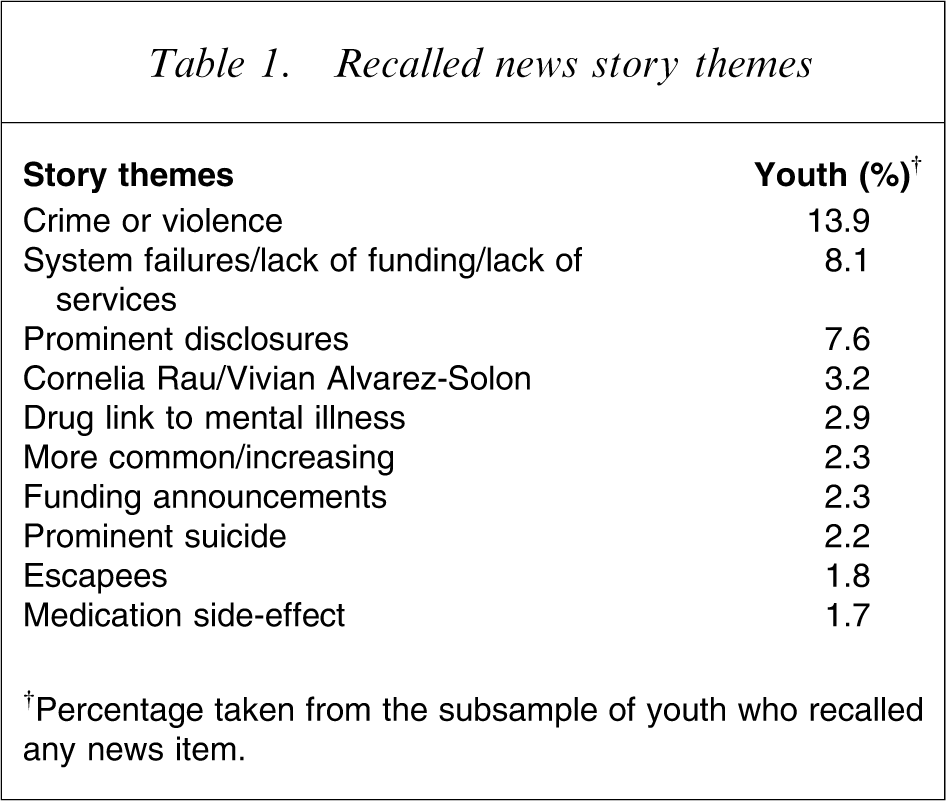
†Percentage taken from the subsample of youth who recalled any news item.
Predictors of stigma and help-seeking
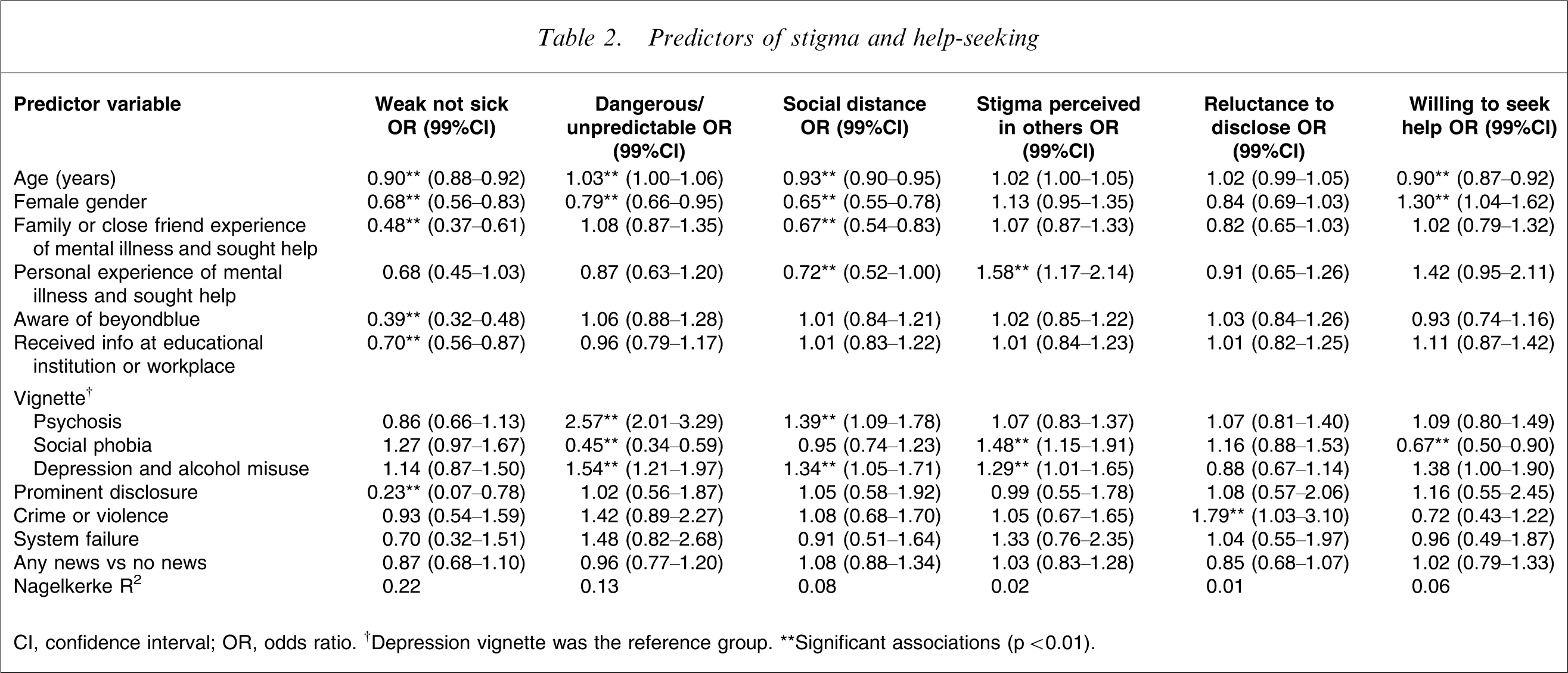
CI, confidence interval; OR, odds ratio. †Depression vignette was the reference group. ∗∗Significant associations (p < 0.01).
Discussion
We found that a minority of young people could recall and describe a news story about mental health problems. The most common stories involved crime or violence. This is consistent with analyses of media reports that generally find that the majority of items relate to violence or the criminal justice system. There were few young people who remembered stories on successful recovery, which is also consistent with the lack of reporting of this type of story. There were only two significant associations between type of story recalled and components of stigma or help-seeking beliefs. Recall of a disclosure of mental illness by a public figure was associated with beliefs that people with mental illness are sick rather than weak. Recall of a story about crime or violence was associated with less willingness to disclose a mental health problem to others, but not belief that the mentally ill are dangerous or violent, or any other stigma components. There were no stories, however, that predicted willingness to seek help. These results are only partially consistent with our predictions that positive news stories would be associated with lower stigma, while negative news stories would be associated with greater stigma.
Although most recalled news stories were negative, such as related to crime or system failures, this is unsurprising given the nature of news production. Journalists do not tend to hold more negative attitudes about mental illness than the general public [17], but news is produced to sell newspapers or television shows. A good story tends to focus on conflict, controversy or safety issues; hence the more negative a story, the more newsworthy it is. Because news is often about deviance, even if framed in a sensitive manner, news stories about crime that involve mental illness reinforce the myth that the mentally ill are all dangerous. Coupled with the higher frequency of negative news items is the tendency of memory to recall extremes, with a single dramatic event often overpowering positive news stories in the mind [17]. In contrast, the influence of the media on audience attitudes is no longer thought to be a direct transmission. Rather, audiences actively process media messages and draw upon their knowledge of mental illness to co-construct message meaning in a dynamic process that selectively reinforces existing bias [18, 19]. Thus, recall of a news story that reinforces mental illness stereotypes does not necessarily lead to prejudice if the audience does not agree that the stereotypes are valid [20]. The few significant findings would support the view that the media's influence on mental illness stigma is not straightforward, and audiences have more sophisticated responses to it than an uncritical absorption.
Recall of news stories about crime or violence was associated only with more reluctance to disclose a mental health problem to others, and not other stigma components such as social distance and beliefs about dangerousness or unpredictability, as might be predicted from other studies. Recall of crime or violence stories was the largest predictor of reluctance to disclose, more so than gender or experience of mental illness. Not being willing to tell anyone of a mental health problem eliminates the potential for social support and would make help-seeking more difficult. Fear of other people's reactions upon self-disclosure is an indication of self-stigma, the internalization of public stigma [21]. In addition to not receiving treatment or support, those who hide a concealable stigma, such as a mental illness, may face considerable stressors and psychological challenges in keeping the stigma secret [22].
The finding that recall of a disclosure of mental illness by a prominent individual predicted lower weak not sick stigma in young people is consistent with research that suggests that contact with mentally ill people is the most effective method for reducing stigma [20]. Disclosures of mental illness by a prominent individual are classed as one form of contact, because familiarity from contact can be secondary, as is usually the case with famous individuals. Although the best form of contact for reducing stigma is thought to involve interpersonal interaction as equals, widespread disclosure of mental illness may be the best way to promote contact and reduce stigma at a societal level [20]. The most commonly recalled disclosure of mental illness by a prominent individual was by Dr Geoff Gallop, the then premier of Western Australia, who resigned from Parliament so that he could get help for his debilitating depression. Most commentators lauded his disclosure as brave and advancing the cause of destigmatization of mental illness in Australia. His disclosure, by someone at the top of their field, demonstrated that depression can affect anyone regardless of their background, income, or role in society. Some feared, however, that his resignation might reinforce the myth that people with mental illness are incapable of being productive members of the workforce [23].
Although it was hypothesized that recalling a disclosure of mental illness by a prominent individual would predict more willingness to seek help, this was not supported by the data. Although it was encouraging that most young people said they would seek help if they had a mental health problem, intentions do not necessarily translate into real-world actions. It may be more useful to use a longitudinal design to assess whether recall predicts later help-seeking. Alternatively, perhaps public figures have less of an impact on attitudes towards help-seeking than previously thought. One study found that presenting examples of well-known individuals who had sought psychological treatment for mental health issues did not improve attitudes towards help-seeking [24].
There were a number of limitations to this study that must be acknowledged. First, we examined only associations between news recall and stigma or help-seeking, hence we cannot prove causality. Many respondents said they recalled news stories about mental health problems but then could not articulate details of the story. Even when they tried to describe the story, answers were often vague and difficult to code. Therefore respondents could have seen a story that affected stigma, but then later could not remember specifics about the news item. Also, respondents were asked only to recall stories about mental health problems from the news media. Fictional media, such as film and television dramas, may also have depictions of mental illness that may influence stigma or help-seeking attitudes [25], and these media may have more potential to influence young people due to young people's supposed declining interest in traditional news media [26]. We also did not have an estimate of the number and type of news stories related to mental health problems reported during the study period. This would have been useful to determine whether or not more negative stories were recalled because they were most reported.
In conclusion, there is some evidence that recall of negative news stories related to crime or violence is associated with higher stigma, and that positive news stories related to disclosure of mental illness by a prominent person are associated with lower stigma. Overall, however, recall of news stories about mental illness added little explanatory power to differences in stigma or help-seeking intentions.
Footnotes
Acknowledgements
Annemarie Wright assisted with the development and organization of the survey. Funding was provided by the National Health and Medical Research Council, the Colonial Foundation and beyondblue: the national depression initiative.