




Abstract
Previous prevalence studies of transsexualism have varied greatly in their estimates. Most estimates of male-to-female (MF) transsexualism have ranged between 1:12 700 and 1:45 000, and those for female-to-male (FM) transsexualism between 1:30 400 and 1:200 000 [1]. Exceptions to this have been Pauly's estimates of 1:100 000 (MF) and 1:400 000 (FM) [2], which are now likely to be outdated, and Tsoi's relatively high estimates of 1:2900 (MF) and 1:8300 (FM) in Singapore [3], which may be due to their comprehensive tracking system of transsexual people and/or cultural or biological differences in Singapore that influence the prevalence of transsexualism.
Prevalence studies of transsexualism have reported ratios of MF transsexualism prevalence to FM transsexualism prevalence of between 2.5:1 to 4.4:1 [1], with one exception: Ross et al. reported a ratio of 6.1:1 among transsexual people in Australia [4]. There are also reports that this ratio is reversed (there is a greater prevalence of FM to MF transsexualism) in Eastern Europe [5] and Japan [6].
Many of these prevalence studies have relied on reports of transsexual people completing sex reassignment surgery (SRS). This may result, however, in an underestimation of the prevalence of transsexualism because it excludes those transsexual people who are socially transitioned but who do not undergo SRS (reasons for this could be medical, financial, or personal preference). New Zealand is unique in that since 1995 passport holders have been able to apply to have the sex omitted on their passport (in these cases sex is shown as ‘X’ on the passport) if they provide a statutory declaration stating that they live as a member of the sex opposite to that on their passport. Epidemiological data on transsexualism in New Zealand has not been previously reported, and information on the number of passport holders who have, or have had an X for the sex on their passport can give an insight into the prevalence of transsexualism in New Zealand.
Method and Results
Contact was made with the New Zealand Department of Internal Affairs Passport Office, who provided the information reported in this section.
Department of Internal Affairs confirmed that for a transsexual person to get an X on the sex of their passport they must provide a statutory declaration stating ‘how long the applicant has lived as a member of the opposite sex’ and ‘the applicant must have changed their name by Name Change Declaration to a name more suitable to a member of the opposite sex, or have a unisex name’. This system is not used with persons with intersex conditions. If a transsexual person undergoes SRS they can change their birth certificate and passport to reflect this new sex – M or F [Department of Internal Affairs: personal communication].
Table 1 shows the numbers of transsexual people who have, or have had an X on their passport. Those individuals with ‘X to M’, ‘X to F’, and ‘X only’ would have provided the statutory declaration to get the X on their first New Zealand passport. In addition to the 385 individuals reported in Table 1, there were six individuals who had progressed from M to X to M, one from F to X to F, and one from M to F to X [Department of Internal Affairs: personal communication] – these individuals were excluded from the analysis because of the possibility that they are not transsexual.
No. transsexual people with an X on their passport
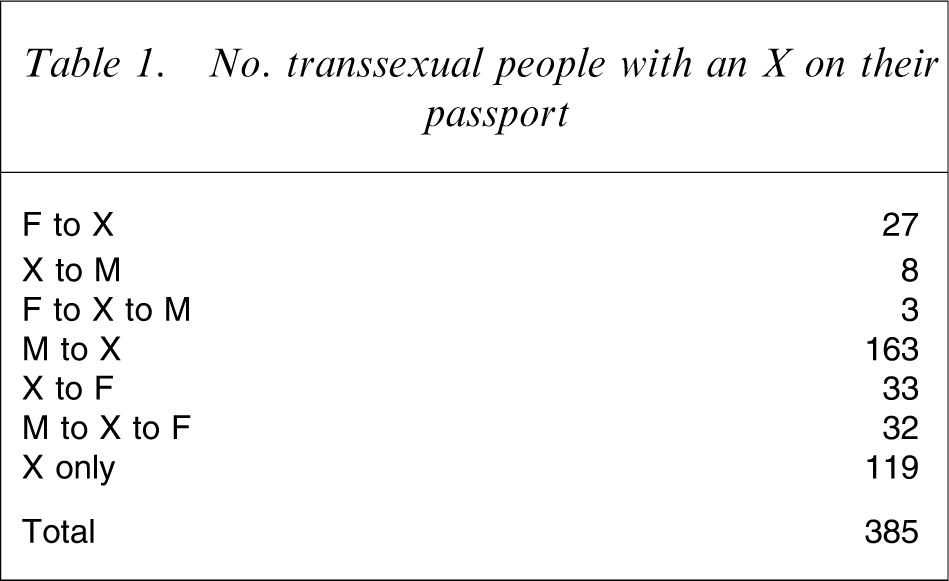
Although it was not possible to ascertain the birth-assigned sex of all of the transsexual people, among those for whom it was possible (266 individuals, 69%) there was a 6:1 prevalence of MF transsexualism to FM transsexualism. Given that there are approximately 2 450 000 New Zealand passport holders over age 15 [Department of Internal Affairs: personal communication], this equates to a prevalence of transsexualism of 1:6364 among all New Zealand passport holders; and given that 49.01% of these are male and 50.99% are female, this equates to a prevalence ratio of 1:3639 for MF transsexualism and 1:22 714 for FM transsexualism. Age 15 is used here because this has been used in most previous studies estimating transsexualism prevalence [1], [3], [4], but although New Zealand transsexual people are not able to legally change their name without parental consent until they are age 18.
Discussion
With the exception of the Singapore study [3], this estimate of the prevalence of both MF and FM transsexuality is higher than previous estimates, but this continues a trend of higher estimates of transsexuality over time. This trend is likely to be due to increased access to treatment for transsexual people and increased societal acceptance of transsexuality among the countries that have been surveyed, but also may be due to methodological differences between studies [7].
These prevalence figures should be regarded as underestimates because there are many transsexual New Zealand passport holders who choose not to have an X on their passport. A recent enquiry into the status of transgender people in New Zealand found that many transsexual people chose not to have an X because of not wanting to disclose that they are transsexual to officials, difficulties explaining the situation in countries where officials do not speak English or are not understanding of transsexualism, and some did not believe that an X represented them any better than the letter of their birth-assigned gender [8]. There may also be some New Zealand passport holders who would be eligible for an X on their passport but who have not applied because they were not aware this is an option, or had not yet got around to doing so (perhaps because of not needing to travel). Unfortunately the Department of Internal Affairs was not able to give figures on the number of individuals who had changed their passport directly from F to M or M to F (without going through a stage of having an X). The Human Rights Commission [8] reported that 114 individuals had applied to the Family Court to change the sex on their birth certificate after having undergone SRS. From the passports data we know that 77 individuals had altered the sex on their passport after previously having an X, leaving 37 Family Court applicants who either (i) do not have a passport or (ii) changed their passport directly from M to F or F to M. Given that the majority of transsexual New Zealanders who have undergone SRS have done so overseas [8], the majority of these 37 individuals are likely to fall into the latter category.
One notable finding is the particularly high ratio of MF transsexualism to FM transsexualism (6:1). This may in part be due to FM transsexual people being relatively overrepresented in the ‘X only’ group. There are two reasons why more FM transsexual people may be more likely to have only ever had an X on their passport: (i) FM transsexual people transition at a younger age on average than MF transsexual people [9], so would be more likely to have an ‘X’ on their first passport; and (ii) fewer FM transsexual people undergo SRS than MF transsexual people (reasons for this include greater cost, and less cosmetically desirable results) so would be less likely to move from the ‘X only’ group to the ‘X to M’ group. Interestingly, the only previous research that has found such a high MF:FM ratio was conducted in neighbouring Australia [4]. Ross et al. postulated that differences in equality between the sexes and attitudes towards homosexuality between Australia and Sweden play a role in both the higher prevalence of transsexualism and higher MF:FM ratio reported in Australia [4]. It is also possible that biological factors predisposing a person to transsexualism (e.g. genetics, prenatal hormone exposure) are differently allocated in Australasia. Further research should be conducted to verify this MF:FM ratio in Australasia.
Footnotes
Acknowledgements
I thank Dr Dave Clarke for his guidance with this paper.