




Abstract
Stalking is a problem behaviour that can damage victims [1], [2]. Deriving a clear operational definition of stalking has been problematic [3] but, broadly speaking, stalking involves repeatedly imposing unwanted communications and/or contacts in a manner that causes fear, or at least distress, to the target of these forced attentions. Associated with these core features are other harassing behaviours such as making vexatious complaints and ordering goods and services for the victim without their knowledge [1].
There are a number of methodologically adequate community-based studies on the prevalence of stalking [4–8]. The estimated prevalences vary according to the definition used and the methods of ascertainment, but the proportion of people who are stalked is approximately 10% for women and 5% for men. Part of the discrepancies in the estimates may be caused by the extent to which brief episodes of harassment, which usually last only 1 day or so, are included, and how rigorously the criteria of fear-inducing behaviour is applied.
The frequency with which stalkers attack their victims has been variously estimated at between 10% and 30%, depending on the definitions of attack and the nature of the sample. The risk factors for such violence have been extensively studied in clinic and convenience samples [9], [10]. Studies on random community surveys to date have not gone beyond confirming the observation that prior relationship is predictive, with ex-intimates being the most likely to attack, and strangers the least [5], [7], [8].
Taken together, and despite there being some uncertainty with figures [10–13], between one-quarter and one-third of stalking cases result in some form of violence against the victim. Much of this violence is in the form of kicks, punches, slaps or indecent assault [14]; but attacks can also be serious and even fatal [15]. Thus a stalking victim's fear of violence is not misplaced.
Simply considering actual violence as the outcome of concern can potentially misrepresent the harm that can be inflicted on stalking victims. Indeed a panoply of broader negative outcomes, such as psychological distress, impaired interpersonal and vocational functioning and enforced changes to lifestyle, are commonly reported as a direct consequence of the intimidation of the victim. Economic and social losses are frequently associated with enforced countermeasures that necessitate further lifestyle changes to deal with the stalking behaviour of the perpetrator [16]. Therefore, just as the modus operandi of stalking behaviour is heterogeneous, the degree of how much being a target of stalking behaviour affects the victim, is equally a very individualized experience.
The aim of the present paper was to therefore to determine whether stalkers who attacked their victims differed in any way from those who did not. It was hypothesized that victims would be more likely to be attacked if the stalking victimization was longer in duration and when it involved someone known to them.
Methods
Sample
Data were derived from a community survey of 3700 men and women randomly selected from the electoral roll in the State of Victoria, Australia, which sought to detail the prevalence and nature of stalking behaviours. Participants were sent a questionnaire covering sociodemographic characteristics and any experiences of harassing intrusions (questionnaire available from authors upon request). The overall response rate to the community survey was 61%; 1844 of the surveys were returned completed. Respondents were considered to be broadly representative of the base electoral population [7].
The data considered in this secondary analysis derive from 432 survey respondents who reported being subjected to victimization sufficient to meet the legal criteria for stalking in Australia, namely the experience of two or more unwanted intrusions by the same perpetrator that induced fear [17].
Data analysis
Basic descriptive data were utilized to characterize the sample in relation to those who reported that their pursuer had, or had not, attacked them; with those in the attacked group having reported that they had been subject to attempted or actual assault. Histograms were plotted to check the normality of the distribution of continuous data, and simple cross-tabulations drawn up for categorical data. χ2 tests of association were used to compare categorical data, while continuous data were compared using independent t-tests, cross-checking and reporting the Mann–Whitney U-test in instances where data were skewed. Univariately significant variables were converted into odds ratios (ORs), and then combined in a multivariate logistic regression model to determine if it was possible to derive a model differentiating those who were attacked from those who were not. Risk factors were entered using a forward stepwise method; adding univariately significant risk factors one by one, in descending order of strength of association, with variables automatically removed when p > 0.05. Possible confounders removed from the model by the iterative stepwise procedures were force entered back into the logistic model as a validity check, but only variables that remained significantly associated with the outcome were included in the final model. The multivariate logistic model automatically controlled for possible confounding and effect modification between variables. The area under the curve (AUC) of the receiver operating characteristic (ROC) curve was plotted to describe the predictive accuracy of the final model [18], and the Hosmer–Lemeshow test [19] was calculated to assess goodness of fit. Analyses were carried out using SPSS version 15.0 (SPSS, Chicago, IL, USA) and Stata version 10.0 (StataCorp, TX, USA).
Results
General characteristics
The general characteristics of the sample are summarized in Table 1. Seventy-five (17.4%) of the 432 stalking victims reported that they had been a victim of an attack by the stalker. More than half of those attacked sustained some level of physical harm. Those attacked were more likely to report being subjected to the stalking for a longer period or from a younger age. They were also significantly more likely to have been followed, spied upon, loitered upon, or been subject to unwanted approaches (all p < 0.001). Receiving letters, faxes or emails from the stalker were more commonly reported by those who were attacked (p = 0.041).
Characteristics differentiating those attacked from those not attacked.
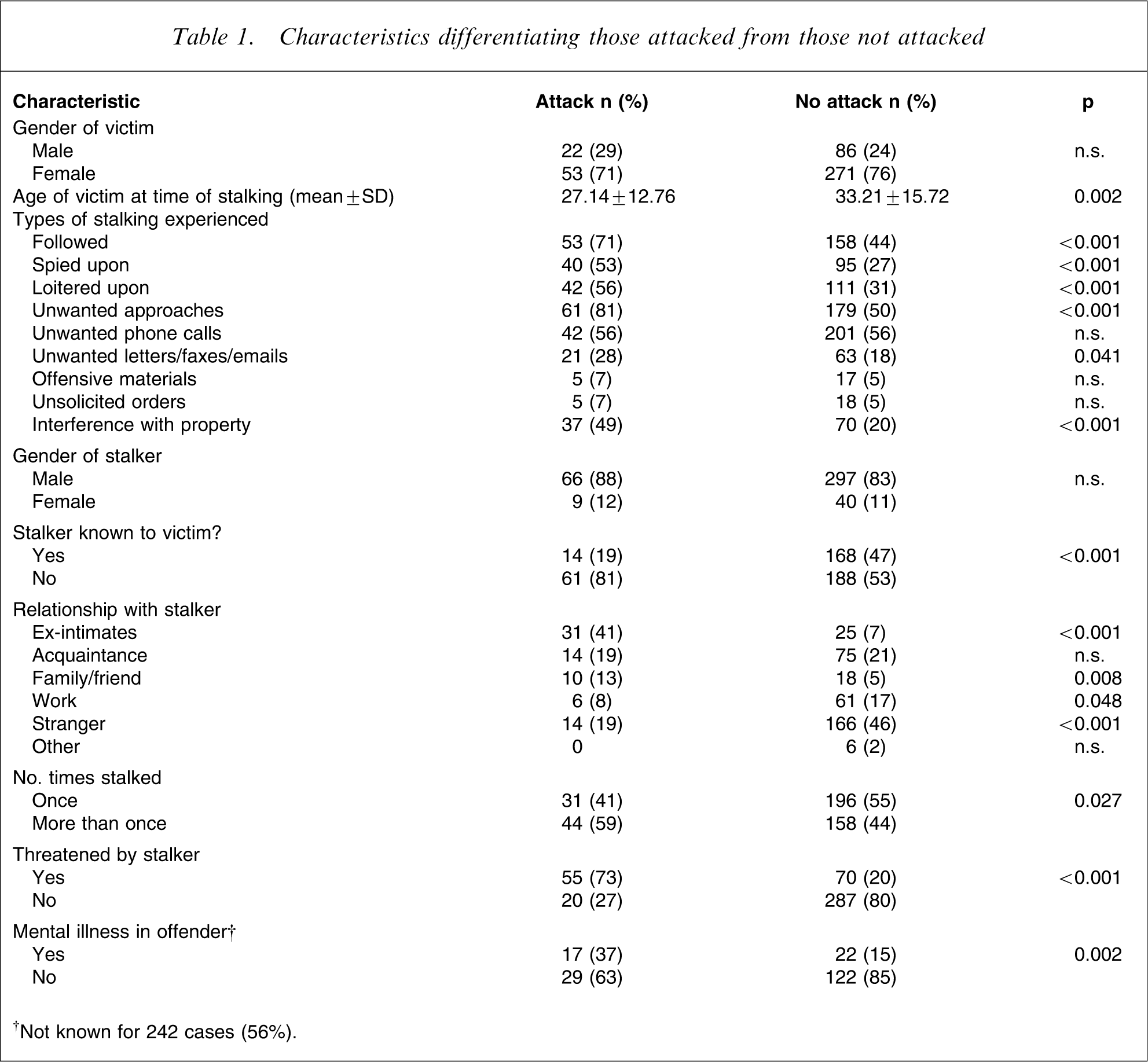
†Not known for 242 cases (56%).
Health-related indices
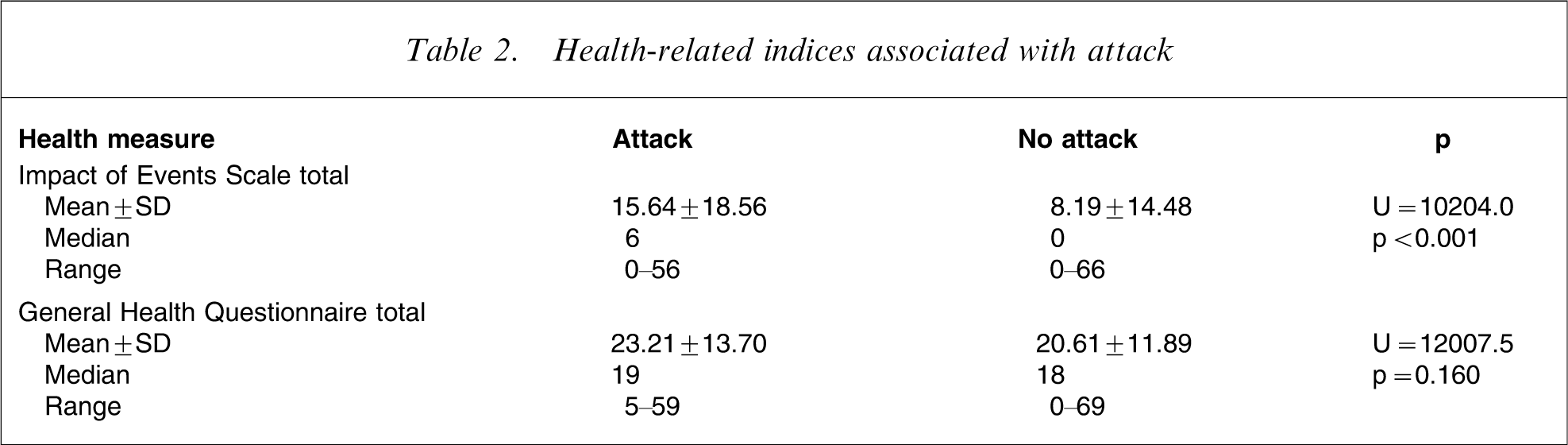
Those who reported having been attacked recorded significantly higher scores with respect to subjective stress, as measured on the Impact of Events Scale (IES) [20], and were significantly more likely to record IES totals indicative of significant post-traumatic stress (χ2=7.048, p = 0.009). Those subject to attack also reported higher scores on the 28-item General Health Questionnaire (GHQ) than those not attacked, although differences did not reach statistical significance (U = 12008, p = 0.160; Table 2).
Health-related indices associated with attack.
Factors associated with stalking victim reporting an attack
Risk factors differentiating those respondents who reported attacks, from those who did not, are summarized in Table 3. The strongest associations, at a univariate level, were the stalker having made threats (OR = 11.28, 95% confidence interval (CI) = 6.35–20.03) and being an ex-intimate (OR = 9.19, 95%CI = 4.97–16.97). Threats resulted in attack significantly more commonly in the ex-intimate group (25/35, 71.4%), as compared to 30/90 (33%) of the non-ex-intimate group. There were no differences with respect to gender of the victim or perpetrator, or the respondent's age at the time of completing the survey.
Univariate associations between risk factors and attack
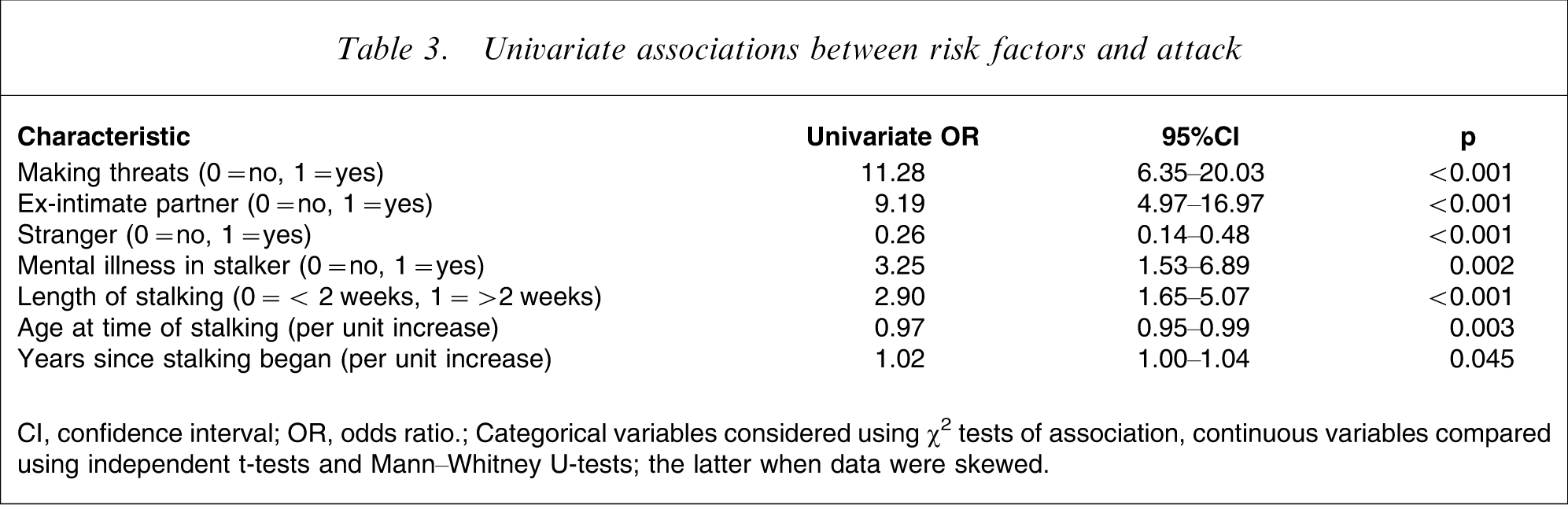
CI, confidence interval; OR, odds ratio.
Categorical variables considered using χ2 tests of association, continuous variables compared using independent t-tests and Mann–Whitney U-tests; the latter when data were skewed.
When considering only the 39 subjects who suffered significant physical harm, the strength of the relationships for threats and intimates/ex-intimates were similarly strong, positive and highly significant (OR = 10.32, 95%CI = 4.73–22.52; and OR = 11.9, 95%CI = 5.79–24.50, respectively).
Developing a model to predict common characteristics associated with attack
Three risk factors were included in the final multivariate model; the adjusted odds ratios and model characteristics are summarized in Table 4. A combination of the victim being threatened, the stalker being an ex-intimate, and the victim being younger at the time of the stalking predicted attack with a sensitivity of 39%, specificity of 97% and positive predictive value of 76%. The AUC of the ROC curve derived from the three-factor model was 0.87 (SE = 0.024; Figure 1). The Hosmer–Lemeshow test suggested no problems with the fit of the model (χ2=115.60, p = 0.96).
Areas under the curve of the receiver operating characteristic curve for multivariate model predicting attack for stalking victims.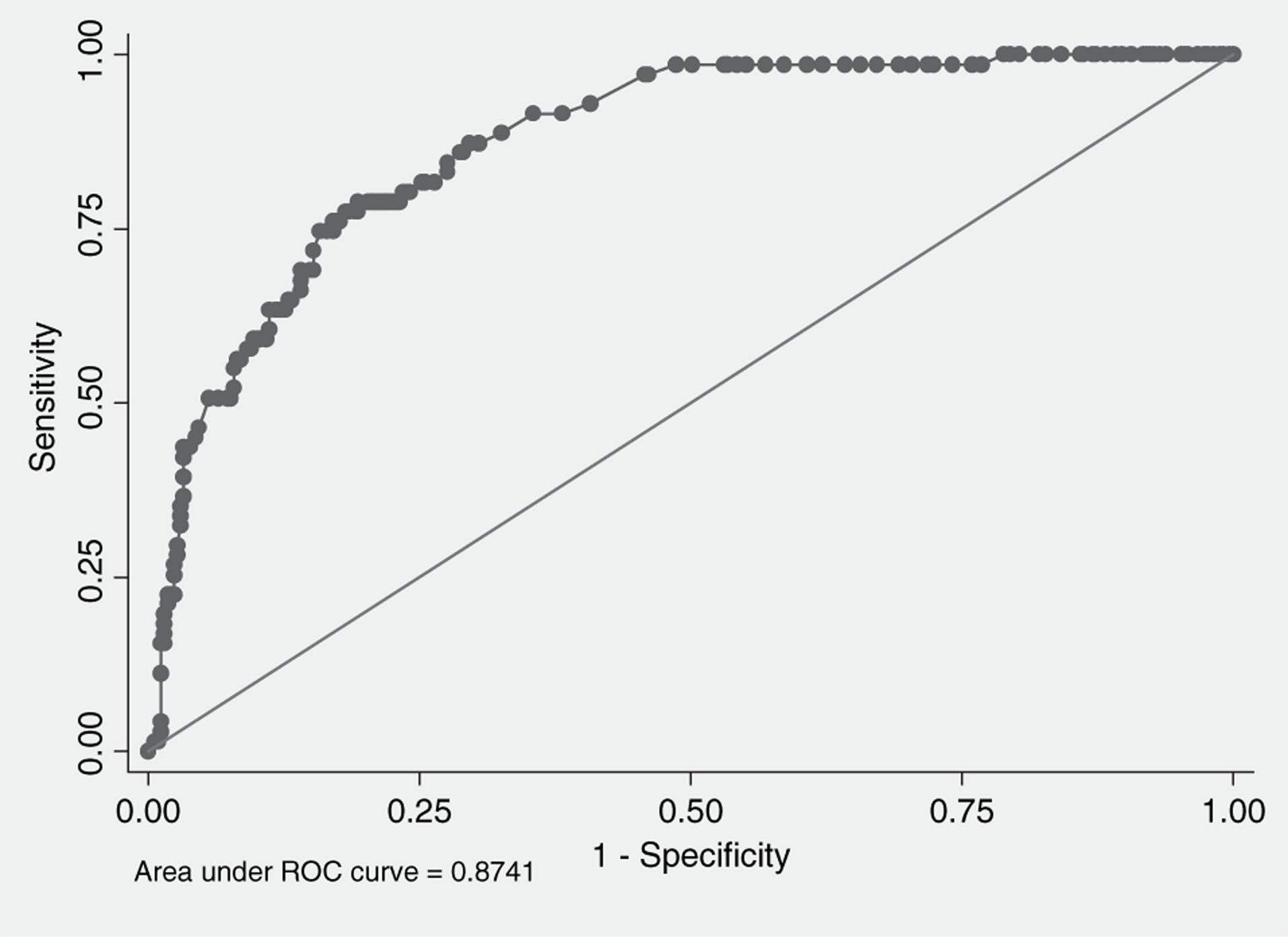
Multivariate model of characteristics predictive of attack.
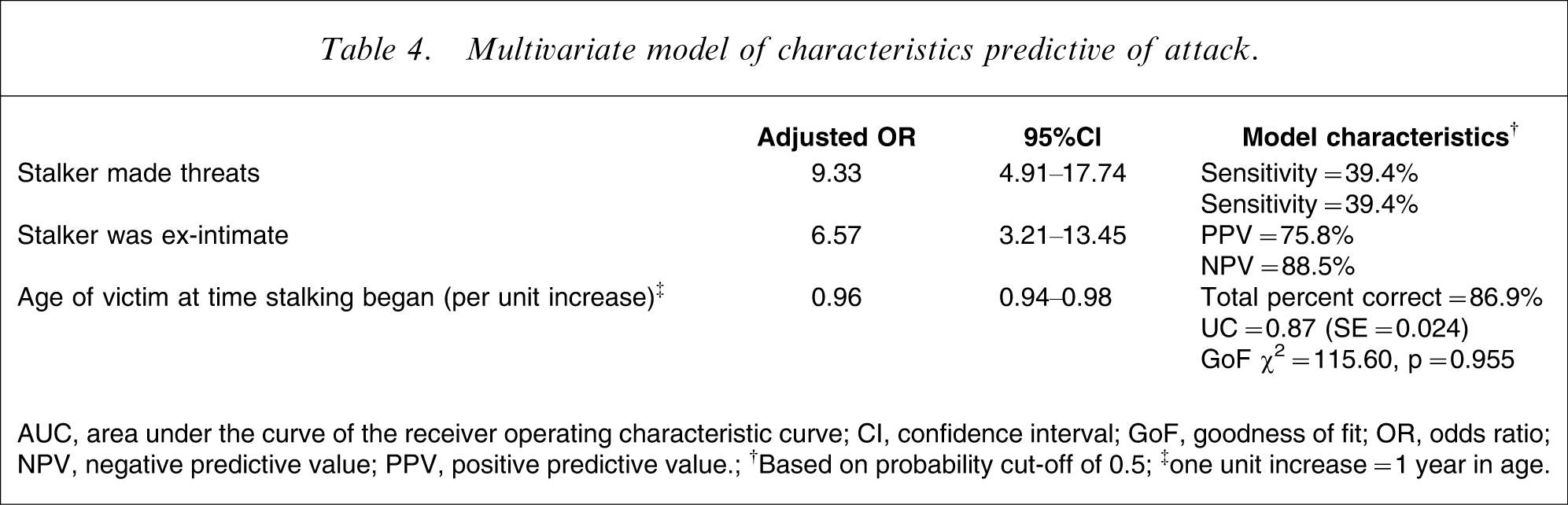
AUC, area under the curve of the receiver operating characteristic curve; CI, confidence interval; GoF, goodness of fit; OR, odds ratio; NPV, negative predictive value; PPV, positive predictive value.
†Based on probability cut-off of 0.5; ‡one unit increase = 1 year in age.
A plot of sensitivity against 1–specificity suggested that the model properties could be maximized by changing the probability cut-off, differentiating low from high risk, to 0.2. This modified model produced a sensitivity of 76%, specificity of 83% and correctly classified 82% of the cases included in the model.
Discussion
This study specifically focused on a group of 432 respondents from a community survey who indicated that they had been stalked at some point in the past. Seventy-five (17%) of these respondents reported being attacked, 39 of whom were physically harmed. Those who reported attacks were characterized by being younger at the time of the offence, having been previously threatened by the stalker, and being stalked by an ex-intimate.
Before the results reported here are discussed in any detail, a couple of methodological limitations are outlined and considered. Due to the community survey design the authors were somewhat limited with respect to the manner and depth in which survey respondents chose to interpret and respond to questions. An example of this was that only 12.7% of cases could be classified according to a stalker typology, based predominantly on the motivation for the pursuit. Therefore, although the community survey design is large in number, it creates an obvious limitation with regard to attempting such classifications. Further, we cannot be sure that the responses received are a true representation of the experiences of the wider community; but the overall response rate was commendable and supplied a rich source of data on the perceptions and experiences of the general community with stalking behaviours.
Threats
Making threats was significantly associated with attack. The relationship between threats and being physically harmed was equally as persuasive, with victims who were threatened by their stalker being more than 10-fold more likely to report having suffered injury. The strong relationship between threats and subsequent violence is consistent with findings from an earlier clinical sample [21]. It is also consistent with related contemporary research on threats [22]. Indeed, in an attempt to quantify this risk, McEwan et al. aggregated extant research findings and suggested that stalkers who make threats are more than threefold more likely to go on to be physically assaultive [23]. Therefore the risk perceived and harm or attempted harm reported by stalking victims, especially in the context of the stalker making threats, is both significant and of real, tangible concern.
Relationship between victim and stalker
The significance of the relationship between victim and stalker in the stalking situation is now well established. For example, Purcell et al. reported that three-quarters of violence against stalking victims was perpetrated by someone the victim knew; most commonly acquaintances, work colleagues and ex-intimates [17]. Findings presented here, that 71% (25/35) of those threatened by an ex-intimate were attacked as compared to 33% (30/90) of those threatened by a non-ex-intimate, therefore support the reported association between violence and being stalked by an ex-intimate [7], [24], [25].
Age
The relationship between the age of the victim at the time of the stalking behaviour, and subsequent violence lends interpretation to the traditional violence risk assessment literature, from which younger age is a consistent marker for increased risk of violence [26]. Harmon et al. suggest that the stalking perpetrators who go on to be violent are likely to be younger and less well-educated [27]. Therefore victims of stalking who are younger also find themselves in a demographic in which violence risk among the perpetrators is more likely and common due to their younger age.
The combination of threats being made, being an ex-intimate and harmful outcome is consistent with the findings of Tjaden and Thoennes, who reported that 40% of stalking cases involved direct threats of violence, and that 81% of the women stalked by former intimates reported having been physically assaulted by them previously [8]. Making threats and being an ex-intimate were both strongly positively associated with the victim reporting being attacked. Therefore the data reported here are in support of the current evidence base; that, when controlling for the uttering of threats and victim age at time of the stalking, victims were 6.5-fold more likely to report being attacked if the stalker was an ex-intimate.
Physical harm and psychological harm
Victims who were attacked were also more likely to report psychologically harmful outcomes, as indicated by higher GHQ scores, and IES scores reaching the threshold for significant post-traumatic stress caseness. Further statistical interpretations were not enlightening due to the inter-relationships between these indices of psychological harm and the other explanatory variables. These findings, however, are intuitive and suggest that additional concern should be raised for the psychological well-being of stalking victims; especially for those who are attacked.
Conclusion
This secondary analysis suggests that a simple model consisting of three risk factors predicts attack in >80% of the cases reported. The AUC of the model is considered very high [18] and the misclassification rate low, but it is likely that this predictive accuracy is over-optimistic due to over-fitting of the data. In order to test the robustness of the model, this combination of variables needs to be applied to other datasets with commonly determined outcomes, considering a range of different populations. This remains an area for further collaborative research and exploration. Further research should consider a more detailed analysis of stalking typology in terms of the interplay between the relationship between victim and stalker, duration of stalking, and the role and impact of threats on subsequent harmful outcomes.