





Abstract
Keywords
In the last decade stalking has emerged as a significant social problem which now constitutes a specific form of criminal offending in most Western jurisdictions, including Australia and New Zealand [1]. Stalking involves repeatedly imposing unwanted contacts and/or communications to such an extent that the victim fears for his or her safety. Recent studies have helped elucidate the motivations and psychopathology of stalkers [2–5], as well as the long-term impact of this behaviour on the victim's psychological and social functioning [6, 7]. At a population level, however, little is known about the prevalence and nature of stalking.
The Australian Bureau of Statistics [8] in 1996 conducted a survey of women's experiences of violence, which included the first ever examination of stalking victimisation. Some 15% of respondents, or an estimated one million Australian women, reported having been stalked by a man. The study defined stalking as repeated (2 or more) intrusions which the victim believed were intended to cause fear. This closely parallels the legal definition. Using similar criteria, subsequent studies in the US [9] and Britain [10] have estimated that 16% and 12% of adults, respectively, have been subjected to repeated intrusiveness at some time in their lives.
These studies provide a broad indication of the extent of harassment in the community, but there are limitations. The Australian study considered only the victimisation of women by men, ignoring men as victims and women as perpetrators. More importantly, none of the studies have imposed any time constraints on the conduct, thus combining intrusions which occurred over the course of minutes or hours (e.g. prank phone calls) along with instances of chronic harassment persisting for months or years. Such an approach obscures the incidence of more severe episodes of stalking which are exactly the incidents so damaging to the victim's mental health and social functioning. Finally, despite concerns that stalking is often a harbinger of more serious forms of violence, the association between stalking and assault in the community has been largely ignored.
The purpose of this study was to clarify the prevalence and nature of stalking behaviours in the community, from conduct meeting broad legal definitions to more protracted and damaging episodes of stalking. The relationship between stalking and other forms of violence was examined, along with factors which mediate the type and duration of stalking.
Subjects and methods
Survey packages containing a 14-page questionnaire booklet, explanatory letter and reply paid envelope were posted to a randomly selected sample of 3700 men and women whose names and addresses were obtained from the electoral roll in the State of Victoria.
The survey was identified as a ‘Community Study of Harassment’; consistent with previous studies [9, 10], the word stalking was not used to avoid preconceptions associated with the term. Each respondent completed questions regarding socio-demographic characteristics and the experience of harassing intrusions. Respondents who acknowledged any incidents of harassment were additionally asked to complete questions examining the duration of the behaviour, characteristics of the perpetrator, associated violence and their responses to the victimisation.
Definition of harassment
The study employed a behavioural definition of harassment. Ascertainment involved the responses to a series of specific probes which explored ‘whether any person, male or female, has ever: (a) followed you (b) spied on you or kept you under surveillance (c) loitered around your home, workplace or some other place you frequent (d) made unwanted approaches to you (e) made unwanted telephone calls to you (f) sent you unwanted letters, faxes or e-mails (g) sent you offensive material (h) ordered things on your behalf that you did not want, or (i) interfered with your property’. Respondents who endorsed any of the behaviours were asked to indicate the frequency with which it occurred (once, twice, 3–9 times, 10 or more times) and whether the conduct produced fear (not at all, a little or somewhat fearful, moderately fearful, very fearful).
The survey packages were mailed in November 1999. Several measures were taken to maximise return rates, including postage of reminder letters 1 and 4 weeks post-survey distribution, the second of which contained another survey package. More comprehensive followup of respondents was not pursued, however, as it was considered inappropriate in the context of the study to dispatch more than two (unsolicited) reminders to respondents who quite properly could have perceived such material as constituting harassment in itself. The study was conducted with the approval of the Human Ethics Committee at Monash University.
Data analysis
When considering reported rates of experiences such as harassment (as opposed to diseases) it is appropriate to express the rate in terms of cumulative incidence. This is calculated as the number of respondents experiencing the event during a specified period (e.g. the previous 12 months or the subject's lifetime), divided by the total study population at risk. The data analyses were conducted using SPSS (Version 9.0.1). Discrete variables were analysed using chi-square and continuous variables were compared between groups using independent t-tests or analysis of variance. In order to minimise Type I error associated with multiple comparisons, the error rate required to demonstrate significance was set at 0.01.
Results
Of the 3700 surveys distributed, 74% could be accounted for, including completed surveys, known refusals and surveys not received (e.g. subject no longer at that address/deceased/overseas). Adjusting for the 697 surveys not received, the valid response rate was 61% (n = 1844). Survey responders were representative of the base electoral population [11] in relation to gender, marital status, education, employment and occupational status. However the sample contained fewer people aged 18–25 years (10% vs 19%) and more individuals aged 56 years and over (39% vs 31%).
The incidence of stalking
The lifetime and annual cumulative incidence of stalking is shown in Table 1. Almost one in four respondents were at some time subjected to repeated intrusions sufficient to meet the legal criteria for stalking. One in 10 respondents reported a protracted course of stalking involving multiple intrusions (10 or more) that persisted for at least 4 weeks, with 2.9% exposed to this level of stalking in the previous 12 months. Females were more likely than males to report having been stalked in their lifetime, though the annual incidence did not differ significantly according to gender. Some 4.4% (19) of victims indicated that the harassment was ongoing, the majority stating that the behaviour had ceased (87%), or that they were unsure whether it had ended (8%).
The cumulative incidence of stalking
The experience of having been stalked was significantly more common among younger than among older respondents (χ2 = 54.9, STALKING IN AUSTRALIA 116 d.f. = 2, p = 0.000). For those aged 18–35 years at the time of the survey, the lifetime incidence of stalking was 31.8%, compared to 27.6% among 36–55-year-olds and 14.6% of respondents aged over 56 years. The 12-month incidence of stalking similarly varied according to age (χ2 = 27.3, d.f. = 2, p = 0.000), with those aged 18–35 at greatest risk (see Fig. 1). Instances of more prolonged episodes of stalking (i.e. greater than 1 months duration) also showed a significant age differential (χ2 = 25.5, d.f. = 2, p = 0.000). The rates of protracted victimisation were significantly higher among 18–35-year-olds (15.4%) and 36–55-year-olds (16.1%), with only 7.8% of those aged 56 years or more reporting this degree of victimisation in their lifetime.
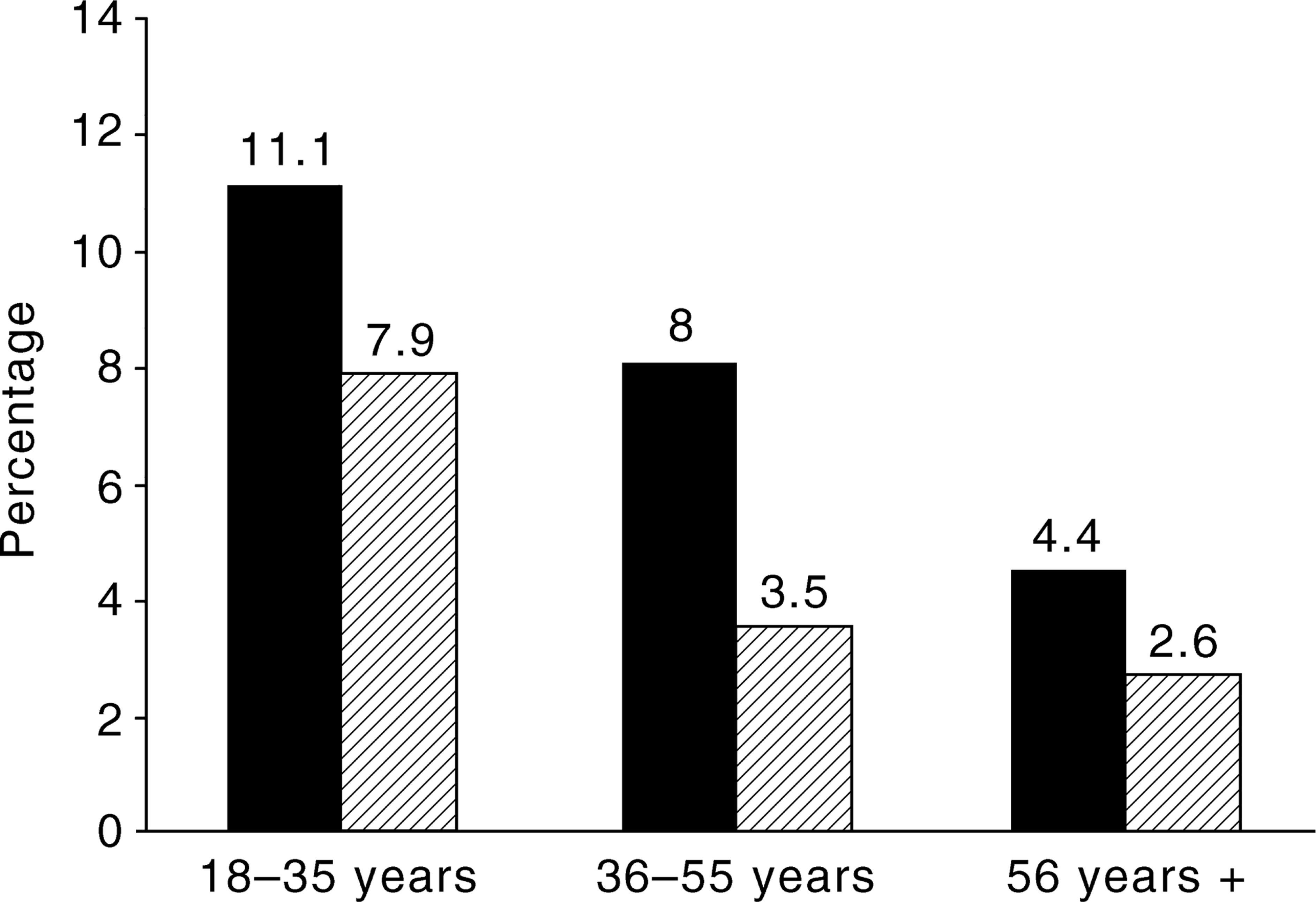
The 12-month prevalence of stalking by age and gender. The percentage of respondents reporting stalking victimisation (two or more unwanted behaviours causing fear) in the 12 months prior to the survey. The rates differ significantly according to age, but not gender. Abbreviations: ▪, women; □, men.
The nature of stalking
Victim characteristics
The majority of those reporting stalking were female (75%; 324). Some 43% were aged between 16 and 30 when the behaviour commenced, though all age groups were vulnerable to pursuit (range 6–76 years). Over half were currently partnered (58%). The majority were employed at the time of the study (76%), often in professional occupations (24%) including medicine and teaching, as well as in clerical (32%) and retail (23%) positions. Subjects reporting stalking were more likely than nonharassed respondents to be female (75% vs 49%; χ2 = 84.9, p = 0.000), currently separated or divorced (11% vs 5%; χ2 = 23.4, d.f. = 3, p = 0.000), and in paid employment (76% vs 62%; d.f. = 2, χ2 = 31.8, p = 0.000).
Perpetrator characteristics
Perpetrators were overwhelmingly male (84%; 363), though females accounted for 11% (49) of stalking with 5% (19) of cases where the gender of the stalker was unknown to the victim. Most were believed by their victims to be aged in their early thirties when they commenced the harassment (mean = 32.2 years; range: 12–70 years). Where the perpetrator's employment and marital status were known to the victim (in 45%), 22% were unemployed, with 45% single, and 20% separated or divorced. The rate of unemployment among perpetrators was higher than the Australian national average (22% vs 9%; z = 4.9, p < 0.01), with fewer perpetrators in married/de facto relationships (34% vs 53%; z = 6.4, p < 0.001).
Prior relationship
The majority of victims were pursued by someone previously known to them (57%; 248), being a prior intimate partner in 13% (56), casual acquaintance in 15% (64), or an individual encountered in a work context (16%; 67), including colleagues in 11% (46) and clients/customers in 5% (21). Harassment by neighbours (5%; 20), family members (4%; 17), estranged friends (3%; 11) and casual dates (1%; 4) was also reported. In 42% (180) the perpetrator was a stranger to the victim, or someone whose identity, though suspected, was yet to be revealed. The nature of the prior relationship did not differ significantly between male and female victims (χ2 = 6.0, d.f. = 4, p = 0.19).
In 24% (103) of cases victims were pursued by a person of the same gender, with males significantly more likely to experience such harassment than females (76% vs 8%; χ2 = 195.8, d.f. = 1, p = 0.000).
Duration and methods of harassment
The duration of harassment ranged from 1 day to 40 years (mean(SD) months = 7.8 (27.6)). For over half the cases (54.5%) the harassment lasted 1 month or less, with 22.6% pursued for between 1 to 6 months, and 13% for a year or more. The duration of harassment did not differ according to the victim's gender (see Fig. 2).
Duration of harassment by gender. Abbreviations: ▪, women; □, men; □, total.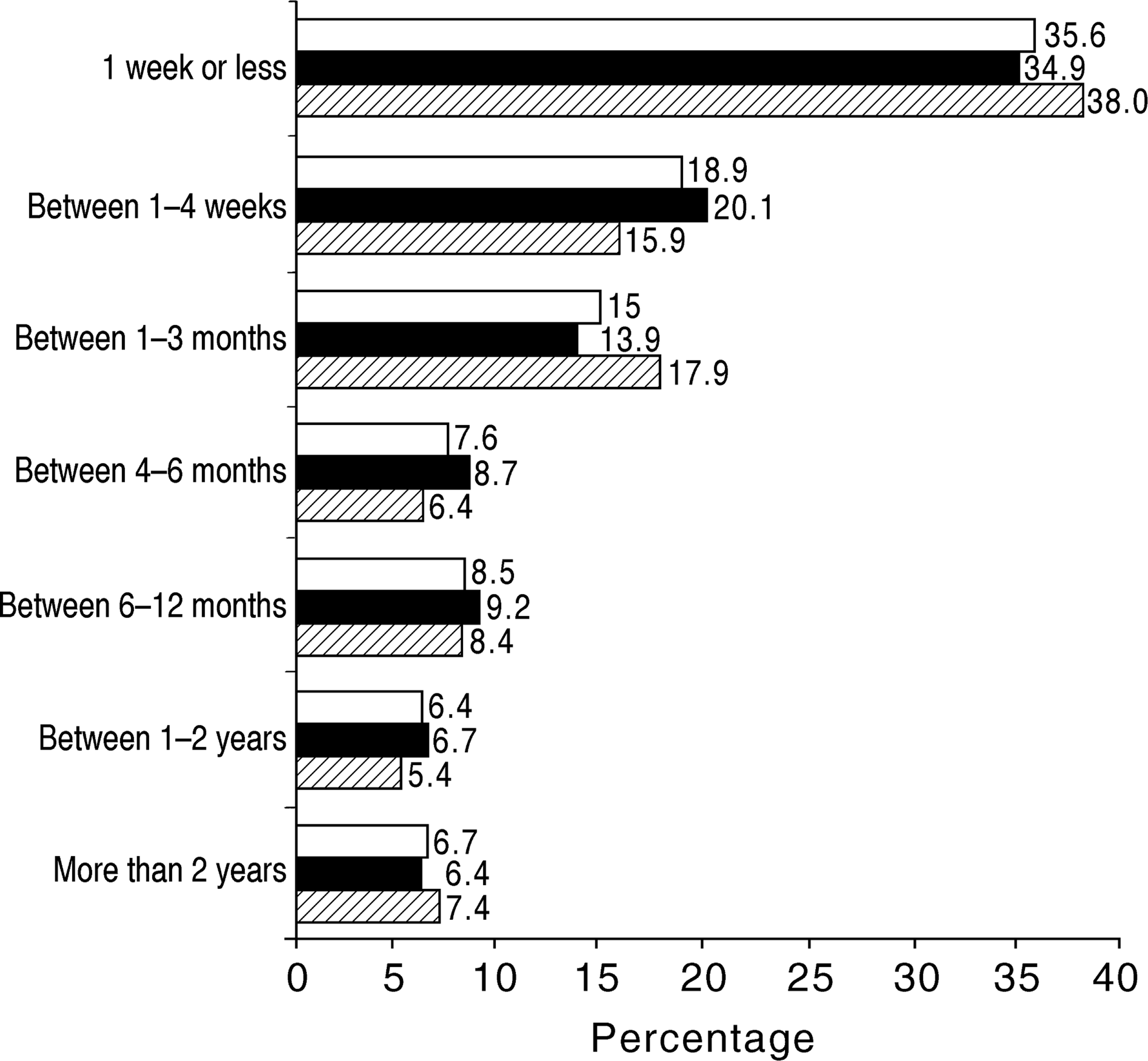
On average victims were subjected to 2.8 (SD = 1.6) methods of intimidation. The most common methods involved unwanted telephone calls (56%; 243), intrusive approaches (56%; 240) and following (49%; 211). Loitering nearby (35%; 153), maintaining surveillance (31%; 135) and unwanted letters, faxes or e-mail: (19%; 84) were frequently reported, though fewer victims acknowledged the receipt of offensive materials (5%; 22) and unsolicited goods (5%; 23). Analysis indicated that telephone calls and unwanted approaches were the most likely methods to occur in isolation, compared to the receipt of offensive materials, unsolicited orders, loitering, surveillance and following, which almost always occurred in the context of a range of harassing behaviours.
Threats and assault
For 29% (125) of victims the stalking was accompanied by explicit threats. These consisted not only of threats to injure, but promises to destroy the victim's reputation or to kidnap or harm children. Threats were made in 16% (68) to harm third parties, most often family members, intimate partners or friends of the victim. Assaults were reported by 18% (75) of victims, half of whom sustained some form of injury. Assaults usually involved slapping, hitting and punching, the injuries including black eyes, broken teeth and avulsed hair. More serious attacks involved attempted suffocation and strangulation. Sexual assaults were reported by 2% (8). Third parties were the target of assault in 10% (44) and domestic pets were killed or injured in 3 instances. Property damage occurred in 23% (99), most commonly directed at doors and windows, car tyres, and gardens. One victim found obscene messages scrawled in wet concrete outside her home, and another returned to find her house flooded after her stalker had threaded a garden hose through a window.
Nearly half of the victims who were threatened were subsequently assaulted (44%), though 73% who were attacked had previously been threatened (χ2 = 85.6, d.f. = 1, p = 0.000). Responses to victimisation
The majority of victims (63%) modified their lifestyle in response to the stalking behaviours, often increasing their home security (29%), changing telephone number (14%) or going to the extreme of relocating (7%). Work absenteeism was reported by 15% (63), victims on average losing 7 working days to attend police, court or counselling appointments. Social outings were restricted by 16%, and 31% altered their daily routine in an attempt to minimise incursions. One in 10 victims directly attributed increased alcohol consumption to the harassment and 13% reported an increase in their tobacco consumption.
The majority of victims (69%) sought assistance to manage their harassment, usually seeking counsel from family and friends (51%). Only 35% reported the harassment to the police, 13% consulted health practitioners and 12% legal professionals. Assistance was most likely to be sought when the perpetrator was known to the victim rather than a stranger (79% vs 55%, χ2 = 27.5, d.f. = 1, p = 0.000). Female victims were more likely than their male counterparts to discuss their predicament with family or friends (56% vs 35%, χ2 = 13.7, d.f. = 1, p = 0.000), though the rates of seeking help from other professionals did not differ according to gender.
Qualitative data indicated that while most victims found the assistance of family and friends useful, satisfaction with the responses of police, health and legal professionals varied considerably, with a number of victims claiming that their complaints were trivialised or dismissed by such helping agencies (e.g. ‘psychiatrist not helpful, general response was to get on with it and just forget it’, ‘the police treated me like a stupid woman… said I was over-reacting’).
Predictors of type and duration of stalking behaviours
The number of harassment methods varied according to the prior relationship (Table 2), with ex-intimate partners being subjected to the widest range of behaviours and strangers the most restricted repertoire. Female perpetrators of stalking behaviours used more harassment methods than males (mean (SD) = 3.7 (1.9) vs 2.8 (1.6); t = 3.4, p = 0.001), specifically sending more written materials (48% vs 16%; χ2 = 27.8, d.f. = 1, p = 0.000) and telephoning (71% vs 54%; χ2 = 9.3, d.f. = 1, p = 0.002). The duration of harassment also varied according to the prior relationship, with ex-intimate partners being subjected to the most persistent pursuit, and strangers the shortest duration. Associated violence similarly varied according to prior relationship, with ex-intimates more likely than all other groups to be threatened, assaulted and subjected to property damage.
Variations in type and duration of stalking behaviours according to prior relationship
Discussion
A significant proportion of Australian adults will fall victim to stalking at some time in their lives. Almost 25% of survey respondents met the broad legal criteria for stalking in that they reported two or more unwanted intrusions that rendered them fearful. Some 10% were subjected to multiple intrusions which spanned a period of at least 1 month, with 3% being exposed to such persistent stalking in the previous 12 months. Women were twice as likely as men to report having been stalked at some time in their lives, though recent victimisation did not differ according to gender. Most victims reported disruption to their lives as a consequence of the behaviour.
Comparison with previous estimates
The rates of victimisation in this study are almost double those previously reported. The British study reported that 12% of adults had been subject to an episode of unwanted persistence at some time [10], while 16% of victims in the US study by Tjaden & Thoennes reported experiencing repeated intrusions that rendered them fearful [9]. The higher rates here most likely reflect variations in survey methodology, in particular how stalking is defined. For example, the British Crime Survey used a single gating question to determine ascertainment rates, with subjects being asked whether or not they had ever been subjected to ‘persistent and unwanted attention’. Only if subjects endorsed this question was further information sought. Such an approach produces lower ascertainment rates than when specific behavioural items are employed to examine the incidence of a given behaviour. In addition, all previous epidemiological studies on stalking have relied on telephone or home-based interviews to elicit information, an approach not ideally suited to this group of victims, most of whom frequently avoid or screen incoming calls and visitors [6]. It is likely that the use of a postal questionnaire in this study enabled not only better access to victims, but provided respondents with a greater opportunity to reflect on past experiences.
Is stalking on the rise?
Of interest was the higher incidence of stalking among younger respondents. Consistent with the findings of the British Crime Survey [10], the lifetime and annual incidence of stalking for those under 30 years was double that of respondents aged 56 years or more. There may be several explanations for this result. First, stalking may essentially be an experience of younger people. If so, it could be expected that older respondents may have difficulty recalling incidents which occurred many years prior. However, the incidence of more prolonged episodes of harassment which are unlikely to be forgotten (i.e. greater than one month's duration) also showed a similar age differential, suggesting that recall difficulties alone cannot account for this result. A second explanation may involve greater awareness among younger respondents of stalking as an emergent social problem. However, care was taken in this and previous studies to avoid the use of the word stalking, in order to circumvent any confusion or preconceptions associated with this term. In our view the higher rates of stalking among younger respondents probably reflects a real increase in this behaviour over the last 20 to 30 years. This may reflect several influences, including higher rates of relationship breakdown, changes in traditional courtship practices, increased job insecurity and workplace violence, and anxiety about vulnerability to crime which can heighten suspicions about the intentions of others, particularly strangers [12]. Comparative studies will be required however, to systematically determine whether the rates of stalking in the community are in fact increasing.
The nature of stalking
The legal definition of stalking has ensured that the term has come to encompass a wide range of unwelcome conduct, from frightening yet brief intrusions to protracted and damaging pursuit. The results of this study bear out such diversity. For a significant proportion of respondents the stalking behaviours consisted of a brief burst of harassment, usually confined to instances of unwanted phone calls or approaches, often perpetrated by strangers. Other victims were persistently pursued and intruded upon over months or years. Consistent with clinical observations [4, 13, 14], prior intimate partners were subjected to the longest duration of pursuit and the most extensive range of stalking behaviours, suggesting that the greater the emotional investment in the victim, the more likely the stalker will persist with his or her quest.
Associated violence
Almost 1 in 5 victims in this study were physically attacked. While this rate of assault is lower than that encountered in forensic and clinic-based samples [3, 6, 15], where average estimates range between 30 and 40% [16], it is nonetheless disconcerting. Early studies suggested reassuringly low rates of assault associated with stalking [17–19] however, these were based on highly selective samples (e.g. celebrities and other public figures), many of whom by virtue of their fame could remain well protected from violent intrusions. Our results also indicated that the majority of victims who were assaulted had previously been threatened. This accords with the findings of Mullen et al. [4] suggesting that threats are important predictors of stalking-related assault. It should be emphasised however, that while victims are often at risk of being assaulted, stalking in itself is a form of violence. Irrespective of whether threats and assault accompanied the stalking behaviours, many victims in this study were rendered fearful by the conduct and the majority experienced serious social and economic disruption.
Seeking assistance
Most victims sought some assistance to manage the stalking incursions, typically consulting relations or the police. Those who consulted health professionals frequently reported dissatisfaction with their level of knowledge and their advice. While victims were often sympathetic to the limited responses available to law enforcement (particularly as many were harassed prior to the introduction of antistalking laws), they were less willing to tolerate inadequate assistance from helping professionals such as GPs or mental health practitioners. Several victims indicated they had abandoned treatment in response to judgmental reactions by therapists, such situations only serving to exacerbate their sense of violation. Given the prevalence of stalking, it is imperative that mental health professionals are well versed not only in the psychological impacts of crime victimisation, but are familiar with the services and legal options available to stalking victims.
Study limitations
Random community studies are likely to produce the most widely applicable prevalence estimates, however, this design is not without limitations. Systematic errors in ascertainment rates will reflect the extent to which the willingness to participate in a survey of harassment is directly influenced by whether or not the subject has been harassed. Those who have been harassed or stalked may be more eager to participate, or conversely, may experience any unsolicited inquiry as intrusive and unwelcome. In either case, response rates would directly reflect the experience of harassment and bias the resulting prevalence estimates. Furthermore, the true incidence of stalking in the community may be obscured by a reluctance among victims to disclose experiences of adverse events such as harassment, to acknowledge themselves as ‘victims’ of such conduct, or simply a failure to recall episodes which occurred many years earlier. The loss of recall, in particular, is a limitation of any retrospective study, but can be overcome to some extent by framing questions in terms of specific events or behavioural probes, rather than utilising overarching questions such as ‘have you ever been stalked?’.
Summary
Since the advent and proliferation of antistalking legislation throughout most Western jurisdictions, stalking has generated a growing discourse in legal, scientific and popular domains. The results of this study confirm that such attention and concern is not misplaced. Stalking is a prevalent and damaging form of behaviour to which all members of society are potentially susceptible. It is incumbent upon mental health practitioners to be aware of the extent, nature and impact of this problem, given their potential contribution to the alleviation of distress and disability in both the victims and perpetrator, and ultimately the resolution of the stalking.
Footnotes
Acknowledgements
Ms Purcell is the recipient of an Australian Postgraduate Scholarship from the Australian Government.