




Abstract
Parental criminality and antisocial behaviour are predictors of a range of negative outcomes in children. A meta-analysis of 34 prospective studies has shown that having a criminal parent or parents is associated with aggressive and delinquent behaviour in adolescence and young adulthood [1]. In turn, children's aggression and delinquency are the strongest predictors of a range of adverse outcomes in adolescence and adulthood, including school drop-out, crime and substance use [2, 3]. Notwithstanding this, there is a paucity of evidence about the association between experience of paternal criminality in childhood and use of illicit drugs by that child in early adulthood.
Incarceration is a common criminal justice response to crime in many countries, including the USA [4, 5]. In the majority of countries worldwide, rates of incarceration are increasing [6]. As a result, there is a large and growing number of families headed by a single parent – usually a mother – due to the incarceration of the other (usually male) parent. Incarceration of a parent can alter the prospects of the family in a number of significant ways, some of which can be anticipated from the literature on single parenthood [7]. Studies suggest that children raised in two-parent families are less likely to engage in harmful substance use than are children who have experienced changes in their parents’ marital status or lived with single parents or in families with a step-parent [8, 9]. Therefore, it might be expected that family structure following the incarceration of a parent can influence outcome for children. Although there is evidence that children of prisoners experience impairment of health, and emotional and behavioural problems [10, 11], little attention has been given to the association between paternal incarceration and use of illicit drugs including cannabis in children.
In Australia and elsewhere, a substantial proportion of people who commit crimes and are arrested do not receive a custodial sentence. According to McLanahan and Sandefur, because living with both biological parents reduces the risk of negative outcomes, the children of individuals who are arrested but not incarcerated would be expected to fare better than children raised in single-parent families [7]. In a study exploring the merits of being raised in a traditional, two-parent family, Jaffee et al. investigated the association between fathers’ antisocial behaviour and children's behaviour problems, and specifically whether the father was present or absent [12]. In contrast to McLanahan and Sandefur [7], Jaffee et al. found that the impact of paternal absence depended on the father's antisocial behaviour: if the father engaged in ‘low levels of antisocial behaviour’ (as defined by the authors), outcomes for the child were worse if the father was absent. Conversely, for fathers who engaged in ‘high levels of antisocial behaviour’, outcomes for the child were relatively improved when the father was absent [12]. In light of these findings, it is unclear what impact paternal incarceration might have on child outcomes, and there remains a need to investigate the association between paternal arrest or incarceration and use of cannabis in children.
Because pathways to substance use are complex, it is possible that any association between paternal arrest or incarceration and substance use in young adulthood may not be causal, but instead reflect other genetic or environmental factors related to both exposure and outcome [12]. These factors may include socioeconomic status (SES), parental mental health, parental substance use, maternal marital status and quality. Thus, in exploring the association between paternal arrest or incarceration and use of cannabis in young adulthood, it is important to allow for confounding by other factors. Given that a mother's marital status is associated with use of illicit drugs by her child [8], it is logical to compare paternal incarceration with single-motherhood to determine whether observed associations are directly or indirectly attributable to paternal incarceration.
No previous published study has undertaken the comparisons suggested here. Using data from a prospective birth cohort, we investigated the relationship between the experience of arrest or incarceration of the mother's partner during childhood and use of cannabis in young adulthood, and the extent to which any such association is confounded or mediated by other factors. Based on the model outlined by Jaffee et al. [12], we hypothesized that a history of paternal arrest or imprisonment would be associated with increased illicit drugs including cannabis use in children, although the effect would be greater for arrest than for imprisonment. It was also expected that children who lived with unpartnered mothers (for reasons other than paternal incarceration) or with mothers whose partner had no history of arrest or incarceration would be less likely to use cannabis in early adulthood.
Methods
Participants
We used data from the Mater University of Queensland Study of Pregnancy (MUSP) and its outcomes, a birth cohort study of women enrolled in the study at the Mater Misericordiae Hospital in Brisbane, Australia between 1981 and 1983. Baseline data were collected at the first antenatal visit from 7223 consecutive women who gave birth to live singleton babies and were followed up at 3–5 days, 6 months, and 5, 14 and 21 years after birth. Informed consent from the mother was obtained at all phases of data collection and from the young adult at the 21 year follow up. Ethics committees from the Mater Hospital and the University of Queensland approved each phase of the study. The present analyses used data from the baseline, postnatal, 5, 14 and 21 year follow-up surveys. At the 14 year follow up, a subsample of 3684 mothers completed a supplementary questionnaire about their own or their partner's history of arrest or incarceration. The cohort for this paper consists of 2386 young adults (1123 male, 1263 female) for whom information on use of cannabis at 21 years and on maternal partner arrest or incarceration by 14 years was available.
Instruments
Young adults’ use of cannabis
Consumption of cannabis was assessed at the 21 year follow up via a self-report questionnaire in which participants were asked ‘In the last month, how often did you use cannabis, marijuana, pot, etc.?’ Options for response included: have never used, used every day, every few days, once or so, and not in last month. Based on the frequency of use reported at the 21 year follow up, ever users of cannabis were divided into two categories: ‘occasional use’ and ‘frequent use’, referring to use of cannabis ‘once in last month’ or ‘not in the last month’, and ‘every day’ or ‘every few days’, respectively.
Maternal partner arrest and incarceration
At the 14 year follow up mothers were asked two questions regarding their current partner's criminal history: ‘Has your current partner ever been arrested for any offence?’ (Options: no/yes/no partner), and ‘Has your current partner even been detained in prison for any offence?’ (Options: no/yes/no partner). Using these questions, we created a new variable with four categories: (i) partnered mothers with no history of partner arrest or incarceration (77.7%); (ii) partnered mothers with experience of partner arrest but not incarceration (6.7%); (iii) partnered mothers with experience of partner incarceration (5.2%); and (iv) unpartnered mothers (due to reasons other than incarceration; 10.4%). The 14 year variable does not clarify the age of child when his or her ‘father’ was arrested or incarcerated, but because mothers were asked the same questions at the 5 year follow up, we could identify the impact of timing of partner arrest or incarceration on the children's use of cannabis at 21 years.
Other covariates
Any association between maternal partner arrest or incarceration and child cannabis use may be confounded by other factors. A selected range of possible confounding factors used in the present study included: SES, maternal marital status and quality, maternal mental health, and maternal substance use. SES indicators included maternal age (<20 years and ≥20 years) and education (did not complete high school, completed high school, and post-high school education), assessed when the child was born, and gross family income at the 14 year follow up (selecting the 25th centile as the cut-off below which family income was defined as ‘low’).
Maternal marital status was self-reported by mothers at the 14 year follow up as being unpartnered or living with the child's biological or stepfather. The quality of maternal marital relationships at 14 years was assessed using a short form of the Dyadic Adjustment Scale (DAS) [13]. Accordingly, mothers were divided into three categories: unpartnered mothers; mothers reporting good adjustment; and mothers reporting poor adjustment (top 20% of mothers with marital disagreement). Combining these two variables, we distinguished five types of marital circumstances: intact families with good adjustment; intact families with poor adjustment; reconstructed families (mother and stepfather) following marital disruption (separation, divorce, or biological father's death) with good adjustment; reconstructed families with poor adjustment; and unpartnered mothers (who were divorced, separated, widowed or had never married at 14 year follow up).
Maternal mental health at the 14 year follow up was assessed using the short form of the Delusions–Symptoms–States Inventory (DSSI) [14]. The DSSI has been widely used and its validity has been well established [15]. For the purposes of the present study, mothers were classified as anxious or depressed if they reported three or more of seven symptoms related to anxiety or depression, respectively. Maternal self-reported cigarette smoking (smokers/non-smokers) and alcohol consumption (drinkers/abstainers) were assessed at the 14 year follow up.
One of the objectives of the present investigation was to examine factors that mediate associations between maternal partner arrest and incarceration, and child cannabis use. The potential mediators included were parent–child communication, adolescent problem behaviour, and adolescent smoking and drinking assessed at 14 years. The Parent–Adolescent Communication Scale [16] was used to assess mother–child communication at the 14 year follow up. Participants were divided into two groups: nil, few or some problems; and many problems in mother–child communication (top 20%).
Symptoms of problem behaviours in adolescents at the 14 year follow up were sought using the Youth Self-Report (YSR) [17], which is a self-report questionnaire for subjects aged 11–18 years, and asks about behavioural problems in the last 6 months. The YSR has been used widely as a measure of child and adolescent behaviour in both clinical and research contexts. Subscales used in the current study included internalizing behaviour (consisting of items addressing withdrawn behaviour, somatic complaints and anxious/depressive behaviour); and externalizing behaviour (consisting of aggression and delinquency). In the current study, cases of problem behaviour at the 14 year follow up were defined using 10% cut-offs of scores on the relevant scale.
Smoking and drinking by the youth at 14 years were assessed via self-report questions concerning the average number of cigarettes smoked and glasses of alcohol consumed per day during the week preceding the survey. Subjects were then divided into two categories: non-smokers/smokers and abstainers/drinkers.
Statistical analysis
We used χ2 tests and logistic regression to examine unadjusted associations between experience of partner arrest or incarceration, or other partner absence, and other covariates at 14 years, and pattern of cannabis use in early adulthood. Because the outcome consists of three values (never used cannabis; occasional use; frequent use), we analysed the data using multinomial logistic regression [18]. This separates the regression into a series of binary regressions comparing each group with a baseline group (two-parent family without history of arrest or incarceration and never use of cannabis). In order to examine the impact of possible confounding and mediating factors, we progressively developed four multivariate models. We used the likelihood ratio test to examine whether there was a statistically significant difference between results for male and female subjects and found no gender interaction in the apparent associations. We then repeated likelihood ratio tests iteratively to obtain the fully adjusted model that best fitted our data. By means of log likelihood ratio test, we calculated the χ2 test statistics to examine whether a multivariate model is significantly different from its nested model. Non-significant covariates were not included in the final model.
In model 1 we adjusted for the child's gender and sociodemographic variables (family income, mother's age, and family structure measured between the child's birth and 14 years of age). We subsequently controlled for maternal mental health, and maternal smoking and alcohol consumption (model 2). Next, we controlled for mother–child communication, adolescent internalizing and externalizing behaviour at age 14 (model 3). Finally, we tested a regression model that also controlled for adolescent smoking and alcohol consumption at 14 years (model 4). Odds ratios (ORs) and 95% confidence intervals (CIs) were used to estimate relative risks associated with explanatory factors. Analyses were carried out using SPSS version 14 (SPSS, Inc., Chicago, IL, USA) and STATA version 9 (STATA Inc., Texas, TX, USA).
Of the 3684 14-year-old participants for whom we had data available on arrest or incarceration of the mother's partner, 64.8% (n = 2386) provided data about their frequency of use of cannabis as young adults. Previous investigations using MUSP data have indicated that the loss to follow up seen in the present study usually does not substantially affect the interpretation of multivariate analyses [8, 19]. Nevertheless, to determine whether loss to follow up at 21 years affected the validity of the findings, we undertook a weighted analysis using inverse probability weights [20]. In the current study, loss to follow up was predicted by gender, family income, maternal marital structure, and maternal tobacco use at 14 years, and adolescent behaviour and smoking at 14 years. The probability weights were computed from a logistic regression model assessing the associations between all covariates used in our primary analyses and having complete data or not. The regression coefficients from this model were then used to determine probability weights for the covariates in the main analyses.
Results
At the 21 year follow up, 2386 young adults provided information about frequency of use of cannabis. Just over half (51.1%) reported having never tried cannabis. Of the remainder, 37.3% had used cannabis occasionally while 11.6% reported use of cannabis at least every few days (frequent use) during the month preceding the 21 year survey. Among the 2386 young adults, 6.7% and 5.2% had experienced arrest or incarceration of their mother's partner, respectively (as reported by mothers) by 14 years of age, while another 10.4% were living with an unpartnered mother at that age.
Table 1 shows univariate associations between young adults’ frequency of use of cannabis and mother-reported history of partner arrest or incarceration, or unpartnered mother status, at age 14, plus a range of childhood and adolescent background factors assessed between birth and 14 years. Young adults who reported occasional or frequent use of cannabis at 21 years were more likely to have had their ‘fathers’ arrested before 14 years, with the stronger association being for frequent use of cannabis (OR = 2.9; 95%CI: 1.9–4.5). A modest increase in risk of occasional use of cannabis was found for children who had lived with unpartnered mothers (due to reasons other than paternal incarceration) at 14 years (OR = 1.5, 95%CI: 1.1–2.0). Surprisingly, incarceration of the mother's partner before the child reached 14 years of age did not predict later use of cannabis by young adults.
Univariate risk of young adults’ use of cannabis
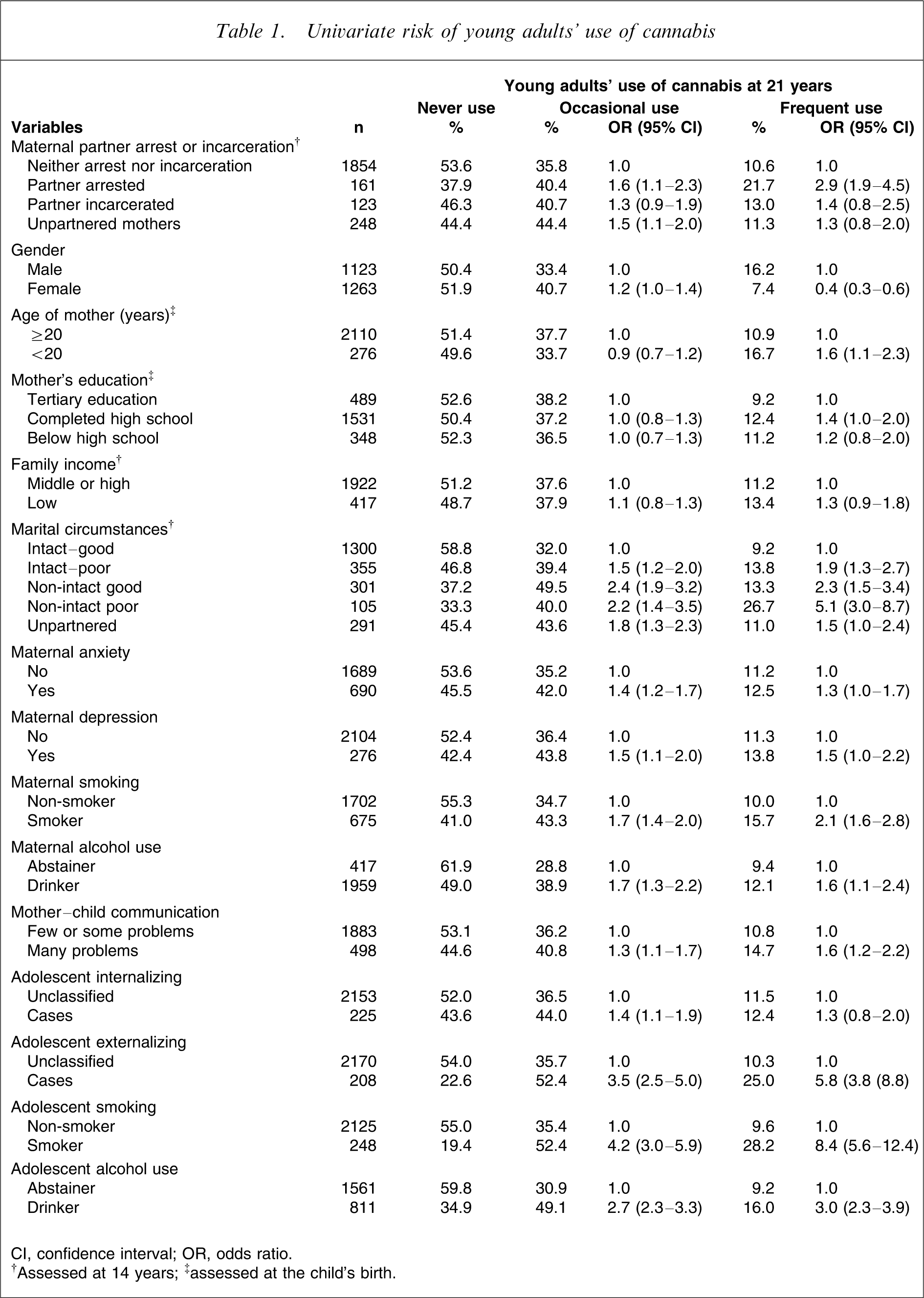
CI, confidence interval; OR, odds ratio.
†Assessed at 14 years; ‡assessed at the child's birth.
Frequent users of cannabis were more likely to be male, to have had younger mothers and to come from non-intact families, or families characterized by conflict in the marital relationship. Those who reported cannabis use at age 21 were also more likely to have had poor communication with their mother at 14 years, to have lived with mothers who smoked or drank, and to have themselves been users of tobacco and alcohol at the age of 14 years. These individuals were also more likely to have reported symptoms of externalizing behaviour at the 14 year follow up.
In order to address the second objective of the study (i.e. adjusting for the factors that confound or mediate the association between arrest or incarceration of the mother's partner and young adults’ use of cannabis), we constructed a multivariate model for all other factors in Table 1 that were significantly associated with use of cannabis. Table 2 shows the multivariate associations between partner arrest or incarceration, or single motherhood, and young adults’ frequency of cannabis use at 21 years. Adjustment for sociodemographic factors (model 1) slightly attenuated the risk of young adult frequent use of cannabis as a function of partner arrest (OR = 2.5; 95%CI: 1.6–4.0). Adjustment for these factors also resulted in the relationship between living with an unpartnered mother (never married, separated, divorced, or widowed) and occasional use of cannabis becoming non-significant.
Multivariate risk of young adults’ use of cannabis
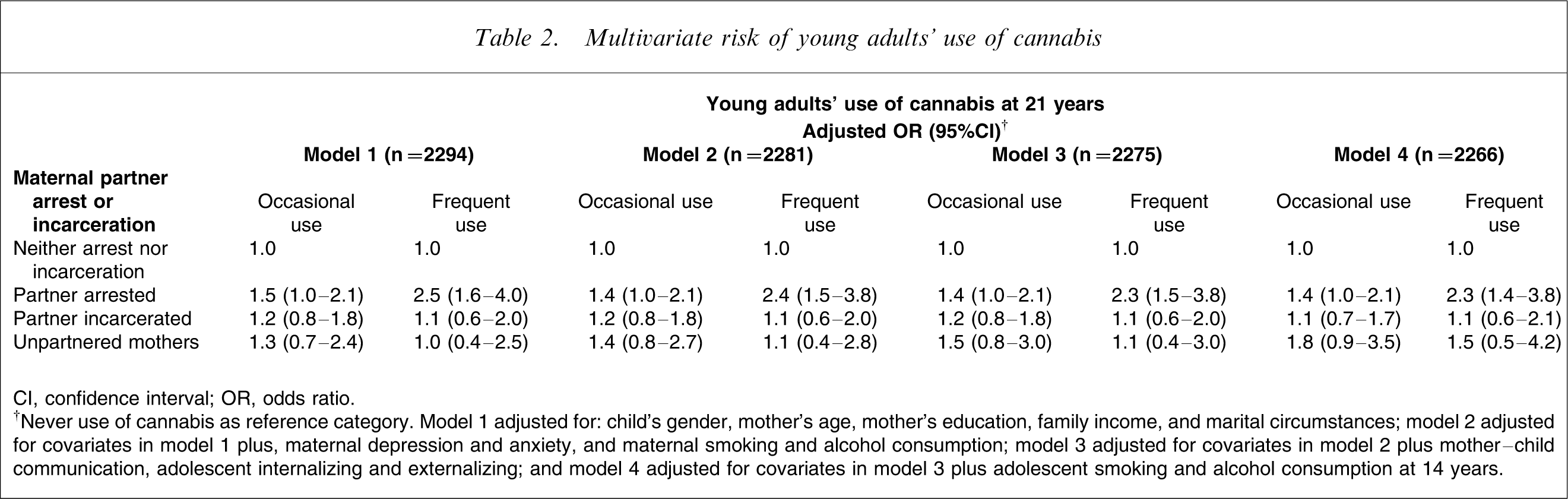
CI, confidence interval; OR, odds ratio.
†Never use of cannabis as reference category. Model 1 adjusted for: child's gender, mother's age, mother's education, family income, and marital circumstances; model 2 adjusted for covariates in model 1 plus, maternal depression and anxiety, and maternal smoking and alcohol consumption; model 3 adjusted for covariates in model 2 plus mother–child communication, adolescent internalizing and externalizing; and model 4 adjusted for covariates in model 3 plus adolescent smoking and alcohol consumption at 14 years.
Controlling for maternal mental health, and maternal substance use (model 2) did not substantially change the strength of association between experience of partner arrest by age 14 and frequent (at least every few days) use of cannabis at age 21. The significant association again remained apparent when further adjusted for mother–child communication and adolescent externalizing behaviour (model 3) and child's use of tobacco and alcohol at 14 years (model 4). The fully adjusted model indicated that the relationship between experience of maternal partner arrest before 14 years and young adults’ use of cannabis was not confounded by a variety of individual and family factors, or fully mediated by a selected range of maternal and individual factors that were associated with both events.
Validity of results
History of partner arrest and incarceration was assessed at age 14 by asking mothers whether their current partner had ever been arrested or incarcerated in the past. For a proportion of mothers (n = 406) their current partner was not the child's biological father, and thus may have been arrested and/or incarcerated before meeting the mother and her child. The presence of a mother's partner with a history of arrest or incarceration might affect the child differently from the experience of having their own biological father arrested or incarcerated. Thus, in a sensitivity analysis, we excluded those young adults for whom the mother's partner when the child was 14 was not the child's biological father. No significant differences were observed in the association between paternal arrest or incarceration and young adults’ use of cannabis.
We also assessed history of partner arrest or incarceration at 5 years when mothers were also asked whether their partner had been arrested or incarcerated in the past. In contrast to the results based on responses when the child was 14, this multivariate model suggested no significant association between history of partner arrest or incarceration by child's age 5, and use of cannabis by young adults at age 21. This suggests that the impact of partner arrest may be specific to the interval between child's age 5 and 14 years.
A proportion of adolescents started using cannabis at or before 14 years of age, and in those cases there might be threat to the temporal sequence of association between mother's partner arrest and cannabis use. In order to address this issue, we excluded 86 children who had used cannabis by the age 14 years and repeated the analyses. Findings of these analyses were not substantially different from those presented in Tables 1 and 2.
Discussion
Using data from a prospective birth cohort study, we examined the association between experience of arrest or incarceration of the maternal partner by early adolescence and young adults’ use of cannabis. The findings show that the arrest of the mothers’ partner (but not his incarceration) predicted the child initiating use of cannabis by early adulthood; children reared in families affected by arrest of the ‘father’ are more likely to use cannabis at 21 years. In contrast, once the effects of other covariates were taken into account, individuals with experience of their fathers being incarcerated during their own mid and late childhood, or who lived with an unpartnered mother before 14 years of age, were not at increased risk of cannabis use at age 21. The findings of the present study indicate that the association between maternal partner arrest and use of cannabis is independent of other covariates.
Our finding, that maternal partner arrest is associated with increased use of cannabis in young adulthood, is consistent with that of Jaffee et al. [12], who reported that the impact of paternal absence on child behaviour depended upon the father's behaviour. They found that if father exhibited ‘low levels of antisocial behaviour’, paternal absence was associated with child conduct problems. However, among children whose fathers exhibited ‘high levels of antisocial behaviour’, paternal absence was associated with lower levels of problem behaviour. In the present study arrest of the maternal partner (but not incarceration) could be viewed as a marker of a father engaging in significant antisocial behaviour, with partner incarceration indicating the removal of an antisocial father.
Explanations of the observed relationships
One possible explanation for the link between paternal arrest and use of cannabis is that paternal arrest is a marker of genetic or environmental characteristics that both predispose the father to antisocial behaviour, and predispose the child to use of cannabis. The present study does not have the capacity to test for genetic influences, but a different relationship with paternal arrest and paternal incarceration suggests that a simple genetic pattern cannot explain these associations. In addition, our multivariate model showed that the apparent association between paternal arrest and young adults’ use of cannabis was not due to the measured confounding factors.
Consistent with Jaffee et al. [12], a more likely explanation for the observed association between paternal arrest and young adult's cannabis use is that father's antisocial behaviour as indicated by his arrest legitimizes antisocial behaviour for the child, leading to use of illicit drugs. This process could occur in a number of ways. First, there is exposure to behaviour that is overtly antisocial. Second, there is contact with a home environment that is accepting of this antisocial behaviour. And third, there is likely to be greater exposure to social networks that accept the appropriateness of antisocial behaviour. When fathers were both arrested and incarcerated, the societal rejection of antisocial behaviour is manifested and the child has less daily contact with the offending behaviour.
Limitations
The first limitation of the study is the sizeable reduction in the sample between the birth and 21 year surveys. Of the 3684 subjects for whom we had data available on partner arrest or incarceration by the time the child reached the age of 14 years, 64.8% (n = 2386) completed the questionnaire about frequency of use of cannabis as young adults. In the present investigation, non-response at 21 years was predicted by gender, family income, maternal marital structure, maternal tobacco use at 14 years, and adolescent behaviour and smoking at 14 years.
Loss to follow up may influence the results in two different ways. First, if the prevalence of cannabis use at 21 years was higher in those lost to follow up than in the study group, our findings might be an underestimation of the true association between the mother's partner arrest and use of cannabis. Second, if the pathways to cannabis use were different for those lost to follow up and those included in the sample at age 21, the association found here may have been absent or lie in the opposite direction in those lost to follow up. In the MUSP study, it is generally the case that those lost to follow up experience worse outcomes than those retained in the study [21]. When we used inverse probability weighting to restore the representation of those lost to follow up, the results were virtually the same as those presented here, suggesting that selective attrition is unlikely to have substantially affected our findings in either direction.
Another limitation is that, although based on mothers’ reports, we were able to distinguish between fathers who had been arrested only and those who had been incarcerated, we were unable to explore the association between the nature, timing and duration of the incarceration and young adults’ use of cannabis. The question used to measure the mother's partner history of arrest or incarceration did not specify when this event (s) may have occurred. While it is possible that the criminal history reported by the mother represents an occasional offence, it is common for those arrested and/or imprisoned to have a long history of contact with criminal justice system and the answer to our questions should be interpreted from that observation [22].
Similarly, although the present study was able to control for maternal mental health and substance use, and for family functioning, it was unable to assess fathers’ mental health, behaviour or substance use. In addition, the MUSP study did collect data between child age 14 and 21 years, precluding explanation of the influence of other factors (influential between the ages of 14 and 21 years) on the association between maternal partner arrest and cannabis use. Finally, despite the fact that many incarcerated women have dependent children in the community [23], it was not possible to assess the association between maternal arrest or incarceration and later child outcomes. Future studies should include more detailed measures of offending history, for both fathers and mothers, and should include measurement of relevant paternal factors, in order to explore more thoroughly any impact of parental offending on child's cannabis use.
Implications and conclusion
Despite these limitations, the findings of the present study are novel in that they explore the association between maternal partner arrests or incarcerations and child cannabis use, in comparison with single-parent status, using a prospective birth cohort design. The results indicate that after controlling for a range of covariates and mediating factors, arrest but not incarceration of the mother's partner before the child is 14 year of age is associated with cannabis use by age 21, and in particular frequent cannabis use. These findings are consistent with those of Jaffee et al. [12] and suggest that for children whose fathers engage in antisocial behaviour, the father's ongoing presence in the family environment may result in worse outcomes for the child, including an increased risk of cannabis use and abuse in young adulthood. Further research that explores the pathway linking paternal arrest and cannabis use may help identify and test opportunities for prevention of cannabis abuse and dependence in young adults.
Footnotes
Acknowledgements
We thank all participants in the study, the MUSP data collection team, and Greg Shuttlewood, University of Queensland, who has helped to manage the data for the MUSP. We also thank Rosemary Aird and her colleagues for Phase 7 data collection. The core study was funded by the National Health and Medical Research Council (NHMRC) of Australia, but the views expressed in the paper are those of the authors and not necessarily those of any funding body.