





Abstract
Successfully adjusting to change and harnessing the opportunities it brings requires new approaches and attitudes. Innovation, creativity and resiliency to endure change have become critical determinants in future prosperity and are linked to good youth development [1].
In Aotearoa/New Zealand and elsewhere, the changes experienced by young people in their social environments have been at a pace unknown to earlier generations of young people [2]. Increasingly, it is argued that these broad changes in the social, political, economic and cultural environments, along with the influence of personal qualities and circumstances impact on the health and wellbeing of young people [3, 4]. At an individual level the normative developmental, cognitive and psychosocial changes associated with adolescence have been identified as points for growth opportunity and/or vulnerability [5, 6]. Additional change, loss and transition experiences (non-normative) such as bereavement, family relocation, friendship and/or relationship breakup, family separation or divorce, cultural alienation, sexual/physical abuse and being bullied can also have developmental consequences for young people [7, 8].
It is readily acknowledged that for young people who have to cope with several change, loss and transition events at once, the impact of these experiences can be a pathway to emotional distress, behavioural and academic difficulties, and mental health issues, such as anxiety and depression [9, 10]. Research has indicated that one in five young people will experience signs of depression by the age of 18 years [11]. Studies of adult depression have indicated that the roots of first experience of depression often occur in adolescence [12]. Furthermore, the association of life stressors such as interpersonal losses (e.g. break-up with a boyfriend or girlfriend) with suicidal behaviour in young people has also been identified [13]. In Aotearoa/New Zealand the statistics surrounding youth suicide have been identified as a significant public health concern [14]. In this country suicide is the second leading cause of death and attempted suicide is the fourth leading cause of hospitalization for young people under the age of 25 years [15].
In recent years, national and international concern about the mental and emotional wellbeing of young people and the rising social and economic costs has led to a search for innovative public health responses, including exploration of the scope for mental health promotion, prevention and early intervention strategies [14]. As a key setting in communities, schools have almost universal access to young people and are therefore in a unique position to promote and support mental and emotional wellbeing and identify young people experiencing emotional distress [16, 17]. Wyn and colleagues [17] have adapted the World Health Organization's (WHO) four-level whole-school approach to school change to offer an infrastructure to promote and support mental health in school settings. While the model is segmented into parts, the parts do not operate in isolation. Increasingly, it is argued that mental health promotion values of empowerment and equity underpin a ‘way of working’ that needs to be at the core of a wide range of prevention and promotion initiatives [16, 18].
The current TRAVELLERS programme is positioned in the third level of the WHO model (Fig. 1) where it is estimated that 20% to 30% of young people in schools will benefit from targeted psychosocial interventions. This layer of the model serves to legitimize the relevance and scope for early intervention programmes within a mental health promotion framework. Arguably one of the biggest benefits from incorporating small group interventions as a resource within schools is that young people who participate may well experience the school environment as a context that supports and promotes social and emotional wellbeing as well as academic achievement [19, 20].
The World Health Organization's 4-level whole-school approach to school change [17]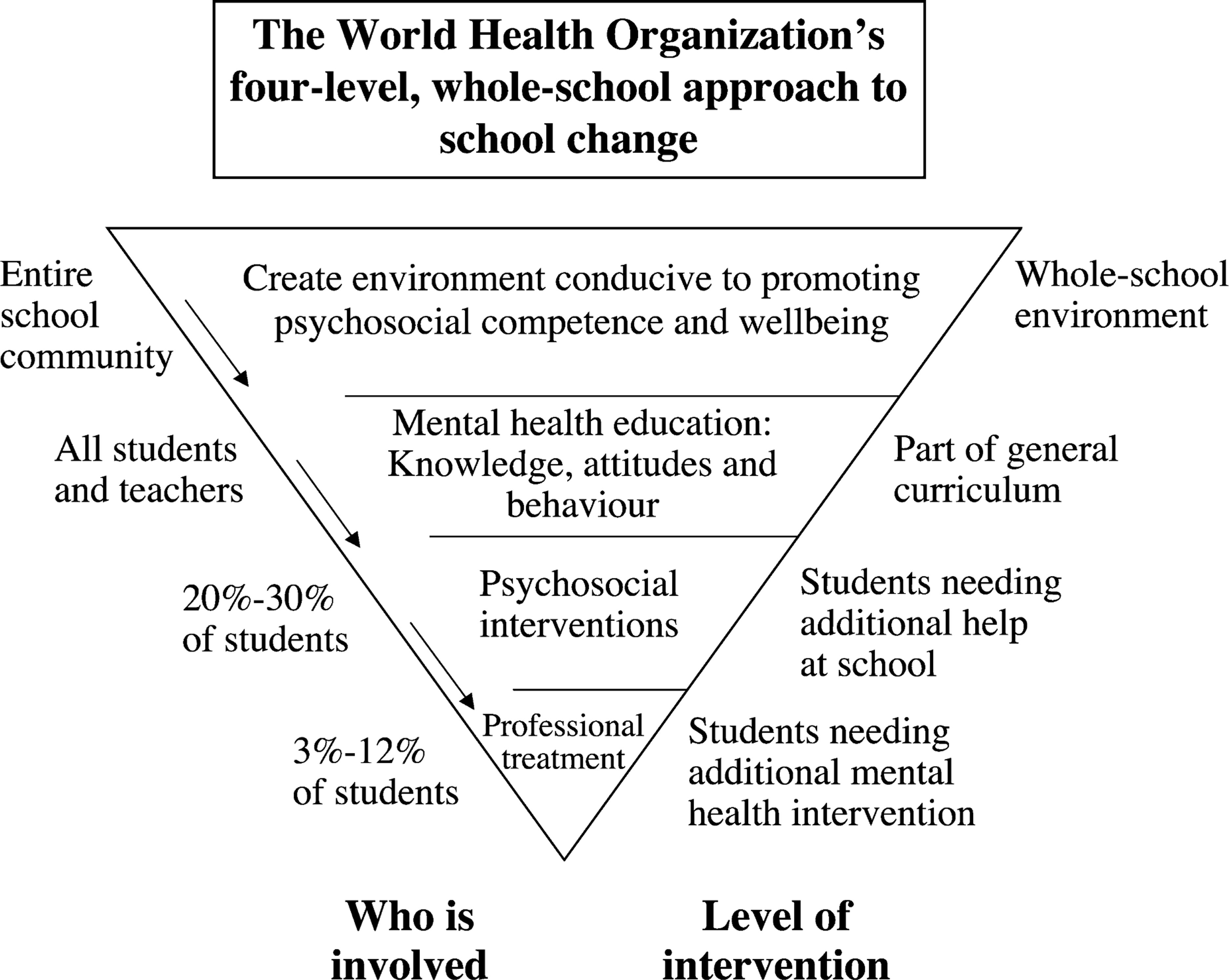
Various authors, while acknowledging the value in offering universal skills-based programmes to all young people, have pointed out the need to offer small group programmes that are targeted and focused to meeting the specific needs of more vulnerable young people [19, 21]. Findings from selective and indicated programmes reviewed for the current study have indicated that young people screened for depressive symptoms experienced increased self-reported coping and problem-solving skills and increased rates of self-referral to the school counsellor [19, 21]. Indicated programmes have also been effective in reducing suicidal behaviours, hopelessness, stress and anger, while increasing protective factors such as self-esteem, sense of personal control and social support [19].
This article outlines both the conceptual background and the findings from the pilot phase of TRAVELLERS – an indicated early intervention programme designed to enhance protective factors for young people experiencing change, loss and transition events and early signs of emotional distress. The pilot study aimed to determine whether the TRAVELLERS programme was an appropriate, feasible, acceptable, and promising intervention for young people.
Description of the TRAVELLERS Project
Background
TRAVELLERS has been funded by the Aotearoa/New Zealand Ministry of Health. The programme partners are the Injury Prevention Research Centre, University of Auckland and skylight (a charitable trust that focuses on helping children and young people deal with loss and grief). The study comprises two phases, a demonstration pilot phase (year one) and a trial phase (years two and three).
Programme aims
The TRAVELLERS programme aimed to foster the healthy development of young people by: (i) exploring their change, loss and transition experiences; (ii) developing ways to navigate their movement through change, loss and transition in safe and adaptive ways; (iii) supporting young people in exploring links between how they think and feel about change, loss and transition situations and how their thoughts and feelings influence how they cope, respond and make meaning; and (iv) enhancing supportive environments for young people experiencing change, loss and transitions, and thereby improving their learning outcomes.
Theoretical framework
The theoretical framework, content and strategies for TRAVELLERS is focused on six key areas.
1. A critical mental health promotion framework, which positions young people as being capable of leading healthy and productive lives and avoids the trap of labelling and reinforcing problematic behaviour or a pathological focus on models of mental illness [22]
2. The use of metaphor (life is a journey) which can help young people develop a vision of the life process through symbols, words, objects and mental images that help facilitate the expression of personal meanings [23, 24]
3. The construction of meaning, which acknowledges the importance and value of individual stories as well as positioning people within a social context. The process of meaning reconstruction can help young people find meaning and purpose in their own lives, rather than necessarily finding meaning in the change/loss/transition experience [24, 25]
4. Thinking/cognitive strategies have been successful in helping young people understand the relationship between thoughts, feelings and behaviours and learning how to challenge unhelpful thoughts. Research among clinical samples of depressed young people using randomized controlled trials indicates the efficacy of cognitive–behavioural approaches [26, 27]
5. Coping, which has been conceptualized as an important mediator between stressful life events and mental and emotional wellbeing [28, 29]
6. Social support from adults and peers can reduce a young person's sense of isolation during stressful situations [30].
Description of the TRAVELLERS programme
TRAVELLERS reflects the idea that ‘life is a journey’. At times the journey will be more challenging than others with many experiences involving situations of change, loss and transition that have to be negotiated. TRAVELLERS aims to help young people identify, develop and access the resources they need to travel through life. The journey metaphor is the key link between all sessions (Table 1) and activities within sessions. TRAVELLERS groups comprise eight sessions of 60–90 min, held in school time. School counsellors, health educators and guidance personnel within schools are trained to facilitate the groups.
Key concepts and sessions
Evaluation methods
Aims
A formative approach was adopted for the evaluation of TRAVELLERS. The aim was to ensure that this early intervention model was responsive to emerging information about its appropriateness and feasibility. Two schools supported the pilot phase of this study. School A was urban, with 800 students and 60 staff. The ethnic distribution was mainly Pakeha/European, 18% Asian, 5% Maori and 5% Pacific Nation with a significant migrant population. School B was rural with 600 students and 40 staff. The demographics comprised 80% Pakeha/ European, 15% Maori, 3% Asian and 2% other ethnicities. Year 9 students (13–14 years) were the target population for the TRAVELLERS programme. Both schools had previously developed and implemented whole school approaches to promoting the wellbeing of young people. These approaches included: the implementation of a range of health related policies and procedures; staff professional development relating to mental health and mental health promotion; the key learning area of mental health included in the schools’ health education curriculum; involvement of young people in planning and implementing mental health promotion initiatives; and the provision of accessible guidance and counselling. Both schools also have clear, open communication with parents/caregivers through weekly newsletters, parent evenings, cultural events, and an open invitation for parents to contact the school as required.
Methods
Evaluation activities included: review of programme materials; identification and analysis of potential selection tools; and feedback from participants, facilitators and parents/caregivers. Feedback from participants (n = 34, female n = 24, male n = 10) was provided through diary writing, end of session feedback forms, end of programme feedback forms and in-depth interviews at 1-month follow-up. Facilitator feedback was provided after each session and at the end of the programme. A thematic analysis of the qualitative responses was undertaken manually.
The Subjective Experience of Distress Scale – short-form of the Weinberger Adjustment Inventory (WAI) [31] was administered prior to participating in the programme and at 1-month follow-up to all participants of the TRAVELLERS programme. This scale provides a general measure of an individual's tendencies to feel dissatisfied with themselves with proneness to anxiety, depression, low self-esteem, and low wellbeing operationally defined as subtypes of distress. The validity of the distress dimension of the WAI has been evaluated and has demonstrated generally excellent construct validity [32]. Quantitative data analysis was completed using SAS.
Participant selection procedure
The screening tool developed for this study employed four selfreport measures: (1) a closed question ‘Do you feel good about yourself most of the time?’ Yes/No; (2) identification of number of schools attended (7 +, 4–6, and 1–3); (3) a life-events checklist whereby participants selected events experienced in the previous 12 months and rated them as low, medium or high impact; and (4) The Weinberger Distress scale.
All Year-9 students from the two schools were invited to take part in the screening procedure. Parents/caregivers and students were informed by mail. Those who were not willing to participate informed the school prior to the selection tool being implemented (n = 2). A total of 290 students in the two schools completed the selection tool, two students refused.
Analysis of the selection tool indicates how the potential participants were selected for the TRAVELLERS programme in one school (urban) (Fig. 2). Those who answered ‘No’ to the question ‘Do you feel good about yourself most of the time?’ were selected for the programme. The next group to be selected were students who scored 40 and above on the Subjective Experience of Distress scale. Those who rated four or more life-events with major impact (experienced in the last 12 months) were the next group to be included. Finally, those who had attended 7 or more schools were also included. The selection tool operates as a filter, therefore those students who were selected in the first box, do not appear in consecutive boxes (i.e. no one student is counted twice).
The tool used to select TRAVELLERS participants.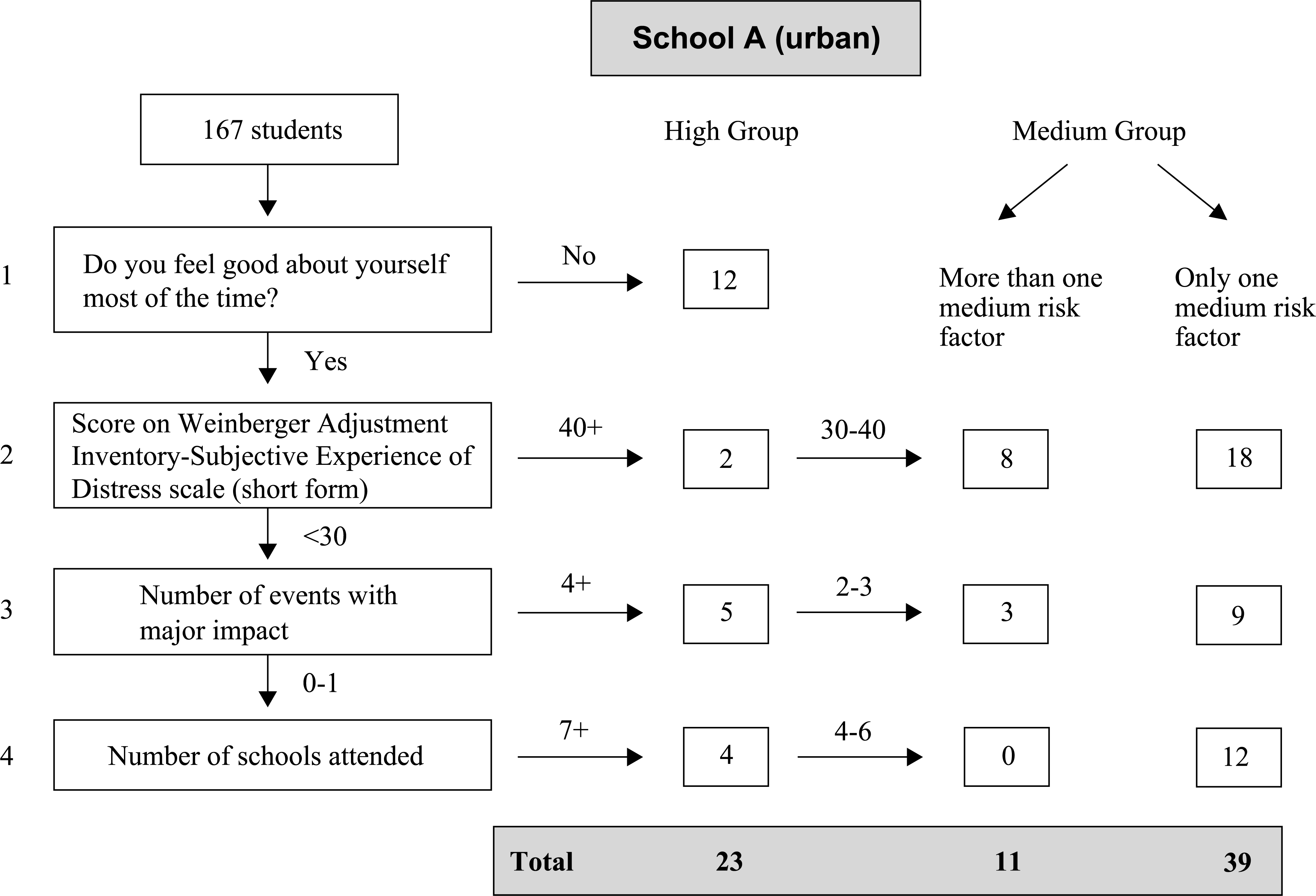
Members of the project team met with school counsellors and a senior management team staff-member of each of the pilot schools to discuss the participants who had been identified. Both schools commented ‘you have picked up all of the high risk students that we know of’. The selection tool also identified students not previously known in terms of emotional distress to the school. In consultation with school personnel some young people were excluded from the programme (n = 6). Exclusion criteria related to concerns due to behavioural difficulties and how this would impact on other participants, English language difficulties and intellectual disability. These young people were provided with specialized individual support within the schools.
A total of 45 students from both schools were identified by the selection tool as being potential TRAVELLERS group participants. Letters were sent home to all 45 participants parents/caregivers. A total of 34 parents/caregivers and participants agreed to participate in TRAVELLERS giving a response rate of 76%. Students who provided written informed consent were assigned to four TRAVELLERS groups in order of returning consent forms. One group was offered in each of the two schools in the first half of the year (n = 20) and the remaining students were wait-listed to participate in TRAVELLERS groups in the second half of the year (n = 14). All participants completed the TRAVELLERS programme, with 98% attendance.
Pilot phase findings
Participant feedback
In-depth interviews were conducted at 1-month follow-up to gain insight into participants’ experiences both in general terms and at a more personal level. Overall, participant responses were very positive and the following key themes emerged.
1 Relevance of key concepts and slogans Life is a journey and not everyone finds it easy. I'm not the only one finding trouble. I can change some things and I can't change others.
2 Support and help seeking Being in the group got me the help I needed. I can now tell the school counsellor and sort it out. I can talk and now I've got someone to go to.
3 Feeling more positive about self TRAVELLERS helped me, made me feel a bit better about myself, more confident, don't worry so much.
4 Thinking/cognitive skills I liked the fact that it focused on teenagers and how we thought.
5 Relate differently to others I now persevere with friends and family, don't jump to conclusions, think more.
6 No stigma I could relate to TRAVELLERS… I hadn't thought about life's a journey before the group. I talked to my friends and told them that we talked about things going on in our lives and my friends thought I was lucky. There was no shame and no teasing.
7 Improved school performance Last term I wasn't doing so well and after the group I went to parent interviews and my teachers were pleased. I have started to smarten up and do better. I think I have learnt that from TRAVELLERS. It made me put my head down and work harder.
8 Sharing stories and making meaning It was fun and it was challenging and it felt better to listen to other people's stories and once I started explaining myself it felt better. It was very hard for me to change countries and leave family and friends but I have learnt to think positively about this.
9 Recommend programme to a friend It really helped me and would help them in the same way I think it can make a difference if people have problems and it can kind of help them take a step forward.
These comments from young people who participated in the TRAVELLERS groups have highlighted the value of the key constructs of the programme. Added benefits included self-reported improvement in school performance by several participants and no stigma attached to participating in the programme.
Table 2 indicates that the participants at School A (urban) showed a significant decrease (p < 0.01) in their score on the Distress scale. The School B (rural) participants showed a slight decrease in their score on the Distress scale, although this result was not statistically significant.
Mean distress scores for participants
Facilitator feedback
Facilitators provided feedback after each session and at the end of the programme. They reported a high level of satisfaction with the programme, activities and resources. They stressed the need to take time to fully process session content and participants’ life maps.
We may have too many ‘activities’ which could mean that the programme becomes a rush to ‘do activities’ rather than being really meaningful for the participants in terms of them being able to process and share their stories when they are ready. We realized how important it was to think about and process life maps.
Parent/caregiver feedback
While feedback from parents/caregivers who contacted the school was minimal (n = 6) all expressed satisfaction with the outcomes for their children.
I was really concerned about how my son was settling. It was such a huge change, moving countries and a new school. TRAVELLERS has really helped him settle and feel more positive about himself and his life here.
School counsellor feedback
At 1-month follow-up the school counsellors in both schools reported that over half (n = 18) of the 34 participants had accessed individual counselling during the programme and post-group. Fifteen young people had self-referred with several bringing friends for support. Facilitators referred three young people who had indicated self-harm behaviour such as repetitive cutting and suicidal thoughts. One counsellor reported that: I probably would have picked up some of the TRAVELLERS participants eventually but attending the group meant that some students self-referred for counselling. Some really distressed students were referred by the facilitators which enabled them to get the help they needed much earlier.
The counsellors in both schools reported that several of the supporting friends had also self-referred for individual counselling.
Discussion
Similar to other targeted interventions the findings from this pilot study have highlighted the value of targeting high-risk young people for indicated early intervention efforts [19, 21]. The selection tool enabled young people who were experiencing one or more of the following to be identified: (i) not feeling good about themselves most of the time; (ii) a high degree of school change; (iii) several life events rated by young people as high impact; and (iv) moderately high to high levels of distress. The early identification of these young people has provided an early warning system that can detect concerns that might have been concealed from adults, at least initially. In this respect the selection tool has been successful in that some young people previously not recognized as in need of support (the ‘silent’ group) were identified along with those already known to school personnel. Feedback from school guidance and counselling personnel has indicated that these ‘silent’ young people were able to access support at least 6 months earlier than would usually happen.
It appears that both the selection tool and the programme have facilitated access to support for young people who may not have readily sought help. This finding is particularly important from an early intervention perspective considering the evidence relating to young people experiencing depression but not reaching clinical attention [33, 34].
The TRAVELLERS group programme appeared to be a promising intervention for mediating levels of emotional distress as well as enhancing protective factors such as self-esteem, social support resources, personal coping skills and resources, and increased help-seeking. These programme effects were evident immediately postintervention and were maintained at 1-month followup. Qualitative feedback from young people has also provided a rich description of young people's experiences and their perceived benefits of participating in TRAVELLERS groups. Feedback has also helped inform the ongoing refinement and development of the programme content.
In contrast to a number of similar prevention programmes [35, 36], the current study observed high recruitment and retention rates. One possible explanation for the high retention rate, supported by the qualitative data, was that young people found the programme fun and enjoyable, the content relevant and the school context was supportive. Similar to other study results [19, 37] the findings from the pilot phase have indicated that schoolbased early intervention programmes targeting adolescents need to be carefully constructed both in terms of content, and the school context in which the programme is delivered. A critical factor is to ensure that such programmes do not stigmatize or pathologize young people's experiences.
Issues relating to stigmatizing young people through a screening or selection process have been raised by a number of researchers [19, 20]. However, participant feedback indicated this was not an issue in the current study. TRAVELLERS appeared to be acceptable to those young people who participated in the groups. Qualitative feedback from TRAVELLERS participants indicated that the name and content of the programme appealed to young people, the content was relevant to their age group and that schools and teaching staff were supportive of the participants. Additionally, participants friends thought they were lucky to be part of the TRAVELLERS programme. A number of young people not included in the programme approached the school counsellors to ask if they could attend the TRAVELLERS group.
There are a number of limitations to the current study. First, the results are based on a small sample and are not generalizable. The small sample size also precluded testing for interaction effects involving variables such as ethnicity and gender. Second, the programme developers also facilitated the TRAVELLERS groups with input from the school counsellors. One facilitator was a clinical psychologist working in adolescent mental health, two were school counsellors and one was experienced in pastoral care and guidance and school health education. These facilitators were skilled in both working with adolescents and group process and this could have contributed to the overall success of the group experience for participants. One possible explanation for the relatively minor impact of the TRAVELLERS programme for participants in the rural school was that one facilitator mainly implemented the group whereas in the urban school there were two facilitators for each session.
Where to from here?
Findings from the pilot phase were considered sufficiently positive to encourage the Ministry of Health to provide additional funding for a 2-year randomized control trial to be undertaken in 10 secondary schools during 2002–2003. Findings to date appear to provide the groundwork for health and education policy development in Aotearoa/New Zealand targeting early intervention services for distressed young people. Within a public health framework, TRAVELLERS offers one possible approach to promoting the mental and emotional wellbeing of young people that has the potential to protect against risk, as well as enhancing protective factors that enable young people to develop in positive ways. Reflecting on the programme's benefits, one participant commented:
TRAVELLERS really really helped me. I can now talk to my parents and my friends about my troubles. I feel more positive about my life.
Footnotes
Acknowledgements
Thank you to the principals, counsellors and young people in the two schools for participating in the pilot phase of the TRAVELLERS programme.