





Abstract
In 1991, a review of mental health services in the Hunter Region resulted in a number of recommendations including ‘that an Institute of Mental Health be established’ [Barclay W
Background
The Hunter Institute of Mental Health came into being in 1992 as a unit of the Hunter Area Health Service, being initially staffed by a part-time Executive Officer and one Administrative Officer. In the first year of its operation, the Institute's activities were supported by 50% funding from the Area Health Service, on the understanding that progressively reduced levels of funding in the following 2 years would see the Institute eventually meet its entire costs from its own revenue-raising activities. In 1999 the Hunter Institute of Mental Health had a full-time staff of six and varying numbers of project staff with tenure contingent on contract work undertaken from time to time. It is entirely self-funded from its own marketed activities which include fee-paying courses, consultancies, professional development workshops, research and other contracted project activities. In addition, the Institute provides ‘grants-in-aid’ to local mental health research initiatives, as well as providing some educational programs and information services to the community free of charge as resources permit.
Owing to the Institute's need to maintain its existence by revenue-raising activities it has not been possible to fully assess the outcomes of the education and training provided except in those areas where funds for such evaluation are provided under a particular contract arrangement. Nevertheless, all face-to-face training is subject to immediate evaluation by participants and the Institute maintains a continuous commitment to quality improvement.
In accordance with national recommendations [1,2] the Institute has targeted young people as a priority for its mental health promotion and prevention programs. This paper describes the overall approach to mental health promotion and prevention and highlights several of the Institute's projects (both direct service provision and evaluation) which focus directly on the mental health of young people.
Approach to mental health promotion
The term ‘mental health promotion’, like the more general term ‘health promotion’ has largely been used without precise definition. Current usage of the terms, however, implies a clear distinction between health promotion and prevention [3]. ‘Health promotion’ is focused on positive health attributes (including such concepts as ‘wellbeing’ and ‘fitness’ in which individuals and communities are self-determining and ‘fit’ physically, mentally and socially) while ‘prevention’ is focused on removing or restricting the impact of threats to this positive state. The Institute approaches the task of mental health promotion with the expectation that its activities are likely to address both health-enhancement and problem-avoidance goals simultaneously. In fact, mental health and well-being are likely to be maximised when both are adequately addressed. In this way the Institute's approach is inspired by broad definitions of health promotion such as ‘Health promotion is the combination of educational and environmental supports for actions and conditions conducive to health’ [4] and ‘Health promotion comprises efforts to enhance positive health and prevent ill-health, through the overlapping spheres of health education, prevention and health protection’ [5].
The Institute's promotion and prevention activities
The nature of the Institute's role as a provider of mental health education and training has influenced its particular approach to mental health promotion. In keeping with the health promotion focus of this paper, the Ottawa Charter for Health Promotion [6] is used as a convenient conceptual framework to describe the work of the Institute (Figure 1).
The targets and strategies of the health promotion work of the Hunter Institute of Mental Health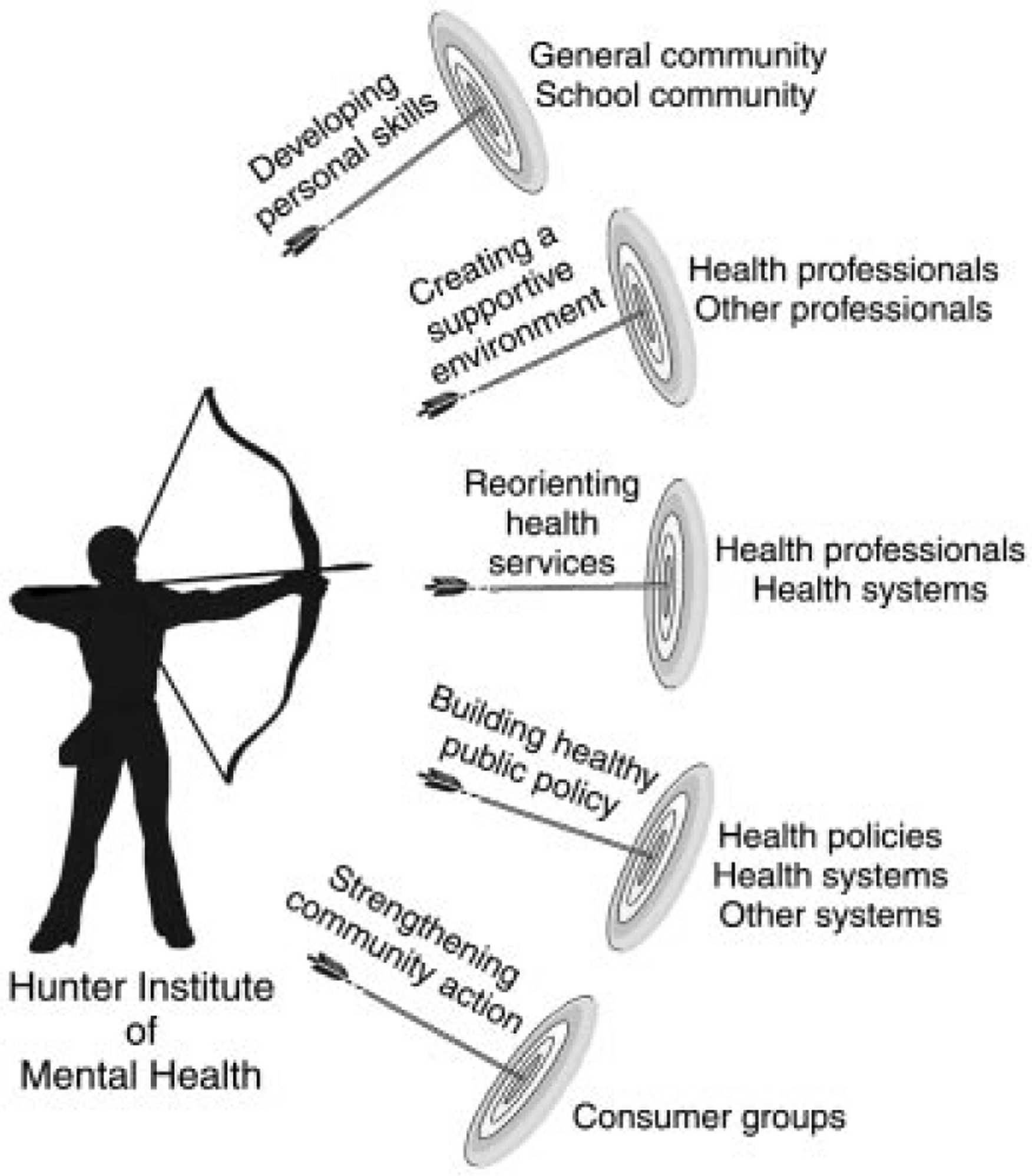
Development of personal skills
Very often the key to individuals (and communities) maintaining good health and avoiding health problems is access to factual information. Such information increases the individual's capacity to make informed and healthy choices and includes: knowledge of strategies to avoid or minimise health risks; knowledge of the nature of health problems and the known biological, behavioural and environmental precursors; knowledge of proven strategies to minimise the effects of illness; and the availability of health and other support services. In relation to mental health specifically, the National Action Plan for Mental Health Promotion and Prevention states that ‘poor mental health literacy contributes to the stigma and discrimination experienced by people with mental illness, discourages people from seeking early and appropriate help for mental health problems and illnesses and may perpetuate behaviours and environments which are risk factors for mental health problems and disorders’ [1].
The Institute addresses this issue in a number of ways. First, on a regular basis, the Director has a regular television segment on a daily talk show, broadcast throughout the Hunter and northern areas of New South Wales, in which topical and common mental health issues are aired with a view to increasing general understanding of the issues and debunking harmful mythical thinking. Second, a number of the courses offered by the Institute are targeted at the general community (e.g. ‘Understanding People’ and ‘Understanding Mental Illness’). Third, the Institute responds to a variety of requests to present short workshops on mental health issues which provide an opportunity for awareness raising and skill development. An example of this is the ‘Surviving the Higher School Certificate (HSC)’ workshop.
The Schools Drama Festival is an innovative and empowering universal health promotion initiative which specifically addresses the mental health literacy of high school students.
Creating a supportive environment
In mental health it is very important that the environment, within which people with a mental illness live, is as supportive as possible. An important component of this is ensuring that health professionals are able to recognise and respond to the early signs of mental illness with evidence-based strategies and the capacity to deliver effective interventions. To this end the largest proportion of the Institute's work is directed at the ongoing development of health professionals through a range of strategies including: (i) a program of skills workshops (e.g. ‘Counselling the Bereaved’; ‘Gestalt Therapy’; ‘The Nature and Treatment of Child and Adolescent Anxiety’); (ii) development of curriculum resources; (iii) symposia on a range of mental health issues in which eminent researchers and clinicians present the latest in evidence-based approaches (e.g. ‘Depression: How Sharp is the Cutting Edge?’; ‘Substance Use and Mental Illness’; ‘Mental Health in Primary Care’); (iv) a mentoring program for rural-based, recently graduated clinical psychologists; and (v) a CD-ROM-based education program for general practitioners on the recognition and treatment of postnatal depression.
An example of a more structural and long-term approach is the ‘Suicide Prevention — National Universities Curriculum Project’. This project has involved the development of curriculum resources on suicide prevention for the undergraduate training of professionals such as doctors, nurses, teachers and journalists.
The Institute is also involved in a number of initiatives which aim to ensure that other key professionals in the community are able to respond well when mental health issues arise. For example, a general ‘Counselling Skills’ course aims to raise the proficiency of para-professionals and volunteers who are in a position to interact with and provide support to people with, or at risk of, mental health problems. A video entitled ‘More than Just a Hairdresser’, currently in production, recognises the opportunities that present to personal care professionals to provide an important level of support to people in moments of high stress. It aims to increase the likelihood that such professionals will respond positively to these opportunities and also addresses the potential for them to cause harm by inappropriate behaviours such as gossiping and the giving of gratuitous advice.
Reorienting health services
Much can be achieved in health promotion without the addition of new resources by reorienting existing services towards new goals. Two important initiatives have been undertaken by the Institute in recent times which have attempted to reorient the work of general medical practitioners and general nurses towards mental health promotion. First, in 1998 a National Symposium on ‘Mental Health in Primary Care’ was held to assist general practitioners to identify and discuss the latest evidence for the effectiveness of GP-based mental health interventions. Second, the ‘Mental Health Education for Nursing Development’ (MHEND) project aims to increase the knowledge and skills of nurses in general (non-psychiatric) health settings. Self-education resources have been developed to increase nurses' awareness of the common mental health problems that may be experienced by many of the patients they encounter in the course of their work. In so doing, the project aims to reorient nurses towards greater understanding and empathy with patients with a psychiatric illness and to improve the treatment and support provided to them.
Building healthy public policy
Being a centre for mental health education and training, based in one of Australia's largest regional centres, has positioned the Institute to participate in a number of state and national projects which, in part, contribute to the development of new policy and practice in the mental health field. A most significant initiative in this regard is the undertaking of the evaluation of the National Mental Health in Schools (MindMatters) Project. In this evaluation the Institute was able to not only contribute to the available store of knowledge about school-based programs, but also to participate in the development of ideas for the further dissemination of the project.
In 1998 the Institute was engaged by the Centre for Mental Health (New South Wales Health) to develop a Resource Manual for newly recruited Youth Suicide Prevention Officers and to contribute to their ongoing training. Further, as an offshoot of its work in the development of undergraduate curriculum resources for student teachers and journalism students, the Institute has been involved (in an advisory capacity) in the development of a resource kit for the media in the reporting of suicide, and the development of a guide for preventing suicide in high schools, two initiatives of the National Youth Suicide Prevention Program.
Strengthening community action
One of the important principles of effective health promotion action is the empowerment of target communities. Much of the education and training undertaken by the Institute is targeted at, and driven by, demand from health professionals. Nevertheless, the Institute has also been engaged in collaborative endeavours with consumer organisations. Of particular interest, the Institute has added its expertise and administrative capacity to assist consumers to organise symposia on issues important to them (e.g. ‘ADD/ ADHD’; and ‘Maximising Resilience in Children’). These are events at which eminent speakers share their expertise with local clinicians, researchers and consumer groups. Further, the Institute has assisted in the training of members of consumer organisations in such areas as support skills, communication and advocacy.
Four examples are given to illustrate the work of the Institute in more detail.
Example 1: Surviving the Higher School Certificate
This example of the Institute's work is a targeted health promotion program which aims to increase the knowledge and skills of young people who are under situational stress, and to enhance the support available to them. The project evolved in response to local media reports about the stress experienced by both young people and their families during the young person's final year of high school. Concern about the problem was fuelled by a perception that some completed suicides and episodes of self-harm were causally linked with pressures experienced during the higher school certificate year. To address this issue in the Hunter Region of Australia, a seminar-style health promotion program, titled ‘Emotional Survival and the HSC’, was developed by the Institute.
Schools were invited to participate by putting aside an evening early in the year when young people in their final year of school and their parents would come together. The evening was structured around a three-stage program. During the first stage a facilitator outlined the various pressures facing both young people and their parents during the final year of high school. The presentation was designed to be informal, interactional, fun, non-threatening and carried a general theme directed toward pressure-reduction and the enhancement of help-seeking behaviours. Students were encouraged to view their scholastic efforts as being ‘my best shot, but not my last shot’. During the second stage of the evening program, students were involved in small group discussions centred on themes such as ‘How can my parents really help?’ and ‘What is it that they do that really doesn't help?’ Meanwhile, parents also worked in small groups discussing ‘What we want from our child’ and ‘What we don't want from our child’. During the final plenary session groups fed back the results of their discussion.
To date, 28 schools have participated in this program. Continuation of the program has been made possible through the support and sponsorship of parent and citizen's groups. While participant feedback was obtained and used to refine the program, systematic evaluation has not been undertaken. The feedback obtained suggests that parents and students react very positively to the program. A particular strength is the realisation through feedback from the small group discussions that students and their parents often share common expectations.
Example 2: Schools Drama Festival
This project, now in its fourth year, adopts a universal approach to increase the mental health literacy of high school students using the medium of dramatic productions within schools. Capturing the imagination of young people and having them focus on mental health for longer than a single school period presents a logistical problem to teachers, who have to manage an already full curriculum. In most settings, a didactic lecture from a visiting speaker is as much as one can ask. Just how much information is retained and what attitudes might flow from such ‘flying visits’ is questionable. This program, the ‘Schools Drama Festival’, takes a more innovative and, hopefully, more effective approach.
In this program each high school is approached to invite year 11 drama students to research an area of mental health, to write and produce a short drama about their chosen topic and to present the play firstly to their peers within the school and then at a community festival of drama. As an incentive, prizes are awarded at the festival. Participating schools are provided with resources and consultative support from the Institute's staff as well as from other sources such as consumer groups, local general practitioners, libraries, and written material from the New South Wales Health Department. Participants are encouraged to place a particular emphasis on increasing the acceptance of individuals suffering from mental illness, raising awareness of sources of help and promoting help-seeking behaviour.
A strength of the Schools Drama Program is that the participating students are engaged closely with the theme of mental illness for 7 months or more. Further, the project incorporates the feature of peer education in recognition of the principle that ‘adolescents should be part of the process of developing and implementing adolescent health promotion programs’ [7]. Feedback from drama teachers indicates that the issue of mental health is one which excites the interest of drama students and is valuable in assisting them to integrate learning of the drama curriculum while achieving a great deal of increased knowledge and understanding of mental health. The value-added nature of the project is that the themes developed in the dramas reach not only the participating students, but also their teachers, fellow students, family and friends. To increase exposure to the program, the finalists in the festival present their work to a public audience. Further value is added by the production of a professional video of the ‘winning’ play to which study notes are attached for use by other schools.
Thirty-one schools have participated in the drama project in the past 4 years. An average of 10 students have been involved in each production. It is not possible to estimate exactly how many students may have been exposed to the plays, although it is likely to be several thousand. The Festival represents a unique collaboration between the mental health system and the secondary school system in the Hunter Region. An essential tenet of health promotion is that success of a program is dependent on it being acceptable to the relevant individuals, cultural groups and communities for whom it is intended. Participation at a range of levels is an important way of achieving this level of acceptability.
During 2000 the program will be formally evaluated by a student enrolled in a Masters of Psychology program to determine its impact on knowledge and attitudes of participating students, their colleagues, teachers and families.
Example 3: youth suicide prevention through education and training
In 1997, the Institute began a national project funded under the National Youth Suicide Prevention Strategy. This project entitled ‘Youth Suicide Prevention — National University Curriculum Project’ aimed to influence the pre-employment university training of professionals by developing curriculum resources for use in their professional education. It illustrates a different approach to mental health promotion from those activities above, in that the impact of the project on the mental health of young people is achieved more indirectly and the likely effects are likely to be more ongoing. Further, as the project was funded by the Commonwealth, it allowed a greater level of evaluation to be achieved than is usually possible with other Institute programs.
A systematic review of the literature conducted prior to the development of curriculum materials identified just six papers reporting university courses directed at suicide prevention. Evaluation of effectiveness was limited in that only three papers included evaluation, none established a ‘satisfactory’ level of knowledge, attitudes or skill, and none included an assessment of interactional skills [8]. A subsequent survey of suicide prevention curricula taught in Australian universities conducted by the project team confirmed that knowledge and attitudes related to suicide prevention are taught more comprehensively than are skills [8].
Curriculum resources were produced under the collective title of ‘Response. Ability’ for the disciplines of medicine [Hazell P: unpublished data], nursing [Walton J: unpublished data], secondary education [Allen J: unpublished data] and journalism [Sheridan-Burns L: unpublished data]. In addition, generic resource materials were prepared for use in all courses [Hazell T: unpublished data]. The materials are best suited to a problem-based learning approach, but may be adapted for use in a traditional lecture or seminar program. The material can be used in its entirety, or course coordinators may choose to use selected modules. Three case scenarios have been developed, representing a range of suicidal behaviour from ideation to completed suicide. The same case scenarios are used across the four disciplines to enable interdisciplinary teaching. For medicine and nursing, the resources focus mainly on the presentation of suicide attempts in a hospital setting. Students are challenged to explore theoretical explanations, risk factors, prevention strategies and professional responses. For secondary education, the focus is more on the recognition of a range of behaviours in high school students which may indicate a risk of suicidal behaviour. Whole-school approaches to suicide attempts and completed suicide are also dealt with. For journalism, the focus is on the principles of reporting suicide events in a manner that will minimise the risk of copycat suicide and will promote help-seeking behaviour.
Evaluation was undertaken in a series of field trials across 30 Australian universities [Hazell T.
While the evaluation approach suffers from similar deficiencies to those identified in other reported education programs, the results obtained are very encouraging. Academic feedback was that the resources could be easily adapted to a range of teaching approaches and that they articulated well within a variety of subject areas. Modifications suggested by the academics have been incorporated into a recent revision of the resources. Substantive modifications include the following: suggestions have been made as to how the issue of student reaction to the material can be handled including advice about arrangements with student counselling services; the material has been reviewed to clarify issues surrounding parasuicide and to comment on the suicidal behaviour of people with a personality disorder; the materials are now available on the internet (http://www.himh.org.au/responseability) in order to increase ease of access and flexibility of the resources. Other recent changes include: the development of trigger videos to support the case studies in nursing and secondary education; the development of modules on ‘Substance Abuse and Youth Suicide’, ‘Social and Political Issues and Youth Suicide’ and ‘Rural Youth Suicide’; and the revision of the module on ‘Indigenous Youth Suicide’.
Student feedback was obtained from nine schools of nursing (n = 465), seven schools of secondary education (n = 185) and four schools of journalism (n =120). Detailed reporting of the findings is beyond the scope of this paper, but importantly 95% of nursing students, 92% of secondary education students and 72% of journalism students endorsed the item ‘The material about youth suicide was relevant to my career’. More than 70% of journalism students, and around 90% of student nurses and teachers indicated that because of this topic, they had developed an interest in the issue of youth suicide and in how their profession could respond.
Baseline and follow-up measures of knowledge about youth suicide were obtained using a 10-item questionnaire that covered the definition of suicide, rates, methods, putative causes, risk factors, clinical responses and discipline specific roles. Mean aggregate scores increased significantly for nursing (baseline = 5.11, n = 424; follow up = 5.87, n = 361; p< 0.001), secondary teaching (baseline = 3.62, n = 261; follow up = 4.39, n = 222; p< 0.001) and journalism (baseline = 4.02, n = 175; follow up = 4.59, n = 137; p < 0.01), but the results are weakened by the attrition of respondents from baseline to follow up.
Attitudes towards youth suicide were assessed at baseline and follow up using an instrument consisting of four general attitude items, four items concerning specific discipline role, and three items concerning perceptions of competence and confidence. Mean scores for nursing and journalism students improved significantly on one general attitude item and all three competence items. Mean scores for secondary teaching students improved significantly on one general attitude and two competence items. Once again the results are weakened by attrition of respondents from baseline to follow up.
Potentially, the Youth Suicide Prevention — National University Curriculum Project has the capacity to influence the training of 1000 medical graduates, 11 000 nursing graduates, 5000 secondary education graduates each year (1997 figures). It is not known how many students graduate in journalism each year and commence practice. If the increase in knowledge and changes in attitude detected by the evaluation of this project carry over into positive approaches to suicide prevention and intervention by these graduates, this may improve the problem.
Example 4: external evaluation of the National Mental Health in Schools Program — MindMatters
In November 1997 the Hunter Institute of Mental Health was invited to undertake an external evaluation of the National Mental Health in Schools Project (MindMatters) [9]. Outcomes specified in the brief were: (i) improved attitudes, values and knowledge of mental health and the value of promoting mental health and wellbeing among school communities; (ii) improved life skills competencies among young people; (iii) improved access to mental health resources and increased incidence of mental health programs in schools, particularly where school policy is affected; (iv) promotion and dissemination of models of excellence.
The sample (selected prior to the appointment of the team) consisted of 24 schools, including representation from all states and territories. Data concerning quality of school life (Quality of School Life Questionnaire [10]), personal coping style (the COPE scale [11]) and knowledge and attitude of mental illness (instrument generated by the team) were obtained for students from 19 schools at baseline and follow up. Qualitative data were obtained from key informants (such as teachers, principals, students, parents) in all pilot schools.
The quantitative aspect of the evaluation produced descriptive data primarily due to the absence of comparator schools. Few conclusions could be made about changes in knowledge and attitudes between baseline and follow up. Observed changes could be due to unknown factors, or to unavoidable methodological problems with sampling and implementation of the surveys. The qualitative research yielded rich data from which beneficial outcomes were identified. Feedback was given to program designers about the efficacy and usefulness of the program structure and materials. Much was learned about the circumstances under which the program can be optimally implemented. A full report will be available on the Internet (http://www.himh.org.au/mmep).
Conclusion
We have found that participation in these youth mental health promotion programs has required not only a solid grounding in clinical and educational principles, but also more than a little dose of creativity. An unexpected side-effect of developing and implementing such interesting and challenging programs is that the professionals involved can also have some fun.