




Abstract
Objective:
Individuals who stalk strangers and acquaintances are under-studied, although there is some evidence suggesting a greater prevalence of psychopathology than is present in those who stalk former partners. This study investigated the nature and prevalence of psychopathology in a sample of stranger and acquaintance stalkers and whether psychopathology was associated with increased duration or serial stalking in this group. It was hypothesised that mental illness, and specifically psychosis, would be more prevalent among strangers and acquaintances than among ex-intimate stalkers.
Method:
Two hundred and eleven stalkers (10% female; mean age = 35, SD = 10.8; 71 ex-intimates) were recruited between 2002 and 2007 from a specialist service in Melbourne, Australia. Each underwent psychiatric and psychological assessment and disorders were diagnosed according to DMS-IV-TR criteria. Non-parametric independent sample tests were used to examine associations between relationship type and psychopathology, and to identify individual and stalking-related characteristics associated with increased duration and serial stalking.
Results:
Axis I disorders were significantly more prevalent among strangers and acquaintances than ex-intimates (71% vs 48%, OR = 2.6, 95% CI = 1.4 to 4.7), as were psychotic disorders (29% vs 9%, OR = 4.4, 95% CI = 1.8 to 10.9). Psychosis was significantly associated with increased duration of stalking behaviour (U = 3043, p < 0.001). Those with a personality disorder were twice as likely to have stalked multiple times (OR = 2.4, 95% CI = 1.2 to 5.0).
Conclusions:
Those who stalk strangers and acquaintances are often mentally ill and psychopathology is associated with more persistent and recurrent stalking behaviour. Although limited by the use of clinical interview rather than structured assessment, these findings strongly support the argument for routine mental health assessment of stranger and acquaintance stalkers who become involved with the criminal justice system.
Introduction
Stalking is defined as the persistent harassment of one erson by another in a manner that produces concern or fear (Mullen et al., 2009). Stalking typically involves unwanted communications (e.g. phone calls, letters) and contacts (e.g. accosting the victim, loitering in their vicinity, following) and, in an unfortunately high proportion of cases, threats, property damage and assault (Purcell et al., 2002). Repeated studies have shown 15% lifetime prevalence of stalking in Western societies (Australian Bureau of Statistics, 2006; Finney, 2006; Swedish National Council for Crime Prevention, 2006; Baum et al., 2009). Women are the predominant targets, accounting for 75–80% of all victims, while 75–80% of perpetrators are male (Spitzberg et al., 2010). Studies of stalkers conducted in clinical and forensic contexts frequently identify high rates of psychopathology amongst perpetrators, with psychotic, personality and mood disorders featuring prominently (Mullen et al., 1999; Rosenfeld and Harmon, 2002; Mohandie et al., 2006).
International epidemiological studies and meta-analyses conducted since the late 1990s have repeatedly shown that at least half of all stalking victims are targeted by strangers or former acquaintances (Purcell et al., 2002; Dressing et al., 2005; Spitzberg and Cupach, 2007; Baum et al., 2009; Smith et al., 2011). Pathé (2002) described a range of victim–perpetrator prior relationship types, including casual contact or friend, professional contact (e.g. doctor, lecturer, lawyer), workplace contact (co-worker, customer), strangers and the famous. Mohandie and colleagues (2006) simplified this to Acquaintances (incorporating the first three of Pathé’s categories), Private Strangers and Public Figures in their Relationship-Context (RECON) typology. While stranger and acquaintance stalking is common, these groups are under-studied. There is some evidence that they differ from ex-intimate stalkers in a number of potentially important ways, although failure to report data by relationship type limits the amount of available information.
The strongest evidence of differences between strangers, acquaintances and ex-intimates concerns the prevalence and nature of psychopathology. Psychosis appears to be more prevalent in the former groups, with direct implications for the treatment and management of associated stalking behaviour. This difference was identified in early studies of stalking (Keinlen et al., 1997) and firmly supported a file review by Mohandie and colleagues (2006) of over 1000 legal case files, in which 25% of stranger and acquaintance stalkers and 11% of intimates experienced psychosis. Studies of professional victim groups report psychosis rates between 25% and 45% (Purcell et al., 2005; McIvor et al., 2008; Abrams and Robinson, 2011; Morgan and Kavanaugh, 2011), while public figure victim studies have identified rates in excess of 80% (James et al., 2009). Symptoms are often difficult to ascertain because data is collected from the stalkers’ communications or victim impressions of mental state, but erotomanic or persecutory delusions, morbid infatuations and delusions of kinship have been reported.
Information about the specific role of psychopathology in stranger and acquaintance stalking is available from case studies (Peterson and Davis, 1985; Samuels et al., 2000; Schlesinger, 2002; Barry-Walsh and Mullen, 2004; Reisner, 2006). These authors link specific symptoms or deficits with the stalking behaviour and make hypotheses about possible causal relationships. Studies of psychotic disorders identify a close temporal relationship between the onset of the disorder and the onset of stalking behaviour. For pervasive and chronic disorders such as borderline personality disorder or Asperger’s syndrome, stalking appears to be one of a range of problematic behaviours associated with the social and interpersonal deficits of the disorder, but these symptoms are not temporally linked to stalking onset.
The other type of psychopathology that is potentially relevant to stalking is personality disorder, which is present in 30–50% of stalkers in clinical/forensic samples (Mullen et al., 1999; Rosenfeld and Harmon, 2002). Cluster B disorders of the narcissistic, antisocial and borderline types are most common (Meloy, 2007; Sansone and Sansone, 2010). The best specific prevalence estimates come from studies of mental health professional victims, who report rates ranging from 35% to 45% in perpetrators (Galeazzi et al., 2005; Purcell et al., 2005; McIvor et al., 2008). Studies using diagnostic interview designs have not reported personality disorder by relationship type (Mullen et al., 1999; Rosenfeld and Harmon, 2002; McEwan et al., 2009), so any differences in personality pathology among ex-intimate, stranger and acquaintance stalkers remain unexamined.
In addition to psychopathological differences, there is also evidence that stranger and acquaintance stalkers differ markedly from their ex-intimate counterparts in stalking outcomes. Prior acquaintanceship and psychosis have been independently linked with stalking of greater than one year’s duration, while strangers have been shown to stalk for the shortest duration (Purcell et al., 2004; McEwan et al., 2009). Although there have been few studies of recidivism, strangers and acquaintances appear less likely than ex-intimates to be charged multiple times, both with further stalking against the same victim, and with violent offences (Rosenfeld, 2003; Mohandie et al., 2006; Eke et al., 2011; Malsch et al., 2011). Personality disorder – particularly Cluster B type – has been associated with stalking recidivism (Rosenfeld, 2003). Stalking outcomes most clearly differ by relationship group in the area of stalking-related violence. Violence is present in at least half of ex-intimate stalking situations but in only 10–25% of non-ex-intimate cases, with former family members or friends the most common targets in the latter group (Purcell et al., 2002; Rosenfeld and Harmon, 2002; Mohandie et al., 2006; McEwan et al., 2009).
Based on the evidence to date, differentiating stalkers by relationship appears to be a useful first step in understanding the range of possible outcomes in stalking cases. However, knowing the prior relationship alone provides little information about how to manage the stalking behaviour or what treatment might be indicated. Stalkers with very similar relationships to the victim might have quite different motivations. For example, an acquaintance pursuing intimacy with the victim due to erotomanic delusional beliefs will require psychopharmacological treatment, regardless of any legal interventions. An acquaintance who is angry at the victim because of perceived mistreatment requires conciliation, and possibly psychological and legal interventions to make them desist from their behaviour (Mullen et al., 2009). Mullen et al. (1999) proposed a multiaxial motivational typology incorporating both prior relationship and psychopathology to try to clarify these differences and guide assessment and treatment. The stalker type is determined first by the nature of the prior relationship, then by the apparent initial motivation for the stalking behaviour, and finally by the presence of psychopathology (Mullen et al., 2009). The first type, Rejected, consists mainly of ex-intimates, while the remaining four categories describe different types of stranger and acquaintance stalking. The Intimacy Seeker’s stalking is an expression of their love and seeking of love in return and the perpetrator often develops a pathological fixation on the victim. The Resentful target someone who they perceive has mistreated them, either in their own right or because they are representative of some organisation that has provoked their ire. The Incompetent Suitor is socially inept and uses stalking to pursue a date or a friendship with the hope of something more. Finally, the Predatory stalker tends to target strangers with the aim of gratifying a deviant pattern of sexual arousal. This classification system is phenomenologically derived and has not been empirically validated, but it is recommended for clinical use by the American Group for the Advancement of Psychiatry as it allows users to “understand the broad range of assessment issues, treatment interventions, victim management strategies and legal considerations associated with stalking” (Pinals, 2007, p. 55).
Aims and hypotheses
This study aimed to investigate the nature and prevalence of psychopathology among stranger and acquaintance stalkers, examine how this differed by motivation type, and compare rates with psychopathology among ex-intimate stalkers. It was hypothesised that Axis I disorders and specifically psychosis would be more prevalent amongst non-ex-intimate stalkers. A second aim was to examine outcomes in cases of stranger and acquaintance stalking by identifying factors associated with multiple separate episodes of stalking and increased duration of stalking behaviour 1 . As only one study has previously examined psychopathology and recurrence, these analyses were exploratory. With regards to stalking duration, in addition to exploratory analyses, it was specifically hypothesised that psychosis would be positively related to increased duration of stalking behaviour, and Intimacy Seeking and Resentful stalkers would persist for longer than other motivational types. The third aim of the study was to present detailed descriptive statistics of a large sample of stranger and acquaintance stalkers for reference in future research, as this information is currently missing from the literature.
Methods
Participants
Participants were recruited from clients referred to a specialist community clinic in Melbourne, Australia, between 2002 and 2007 for assessment of stalking behaviour. Referrals to the clinic can be made on the presence of behaviour alone and a psychiatric diagnosis is not a prerequisite. Clients were referred by courts, probation services, general mental health services and a variety of private and non-governmental organisations. Each client was interviewed at length by a forensic psychiatrist and a clinical/forensic psychologist and completed psychometric personality testing. At the conclusion of the assessment, a research officer provided the client with an explanation of the research and asked them for consent to use their data in the project. Clients were excluded if their English language skills or mental state was such that they were unable to give informed consent. The research was conducted with the approval of the Monash University Human Research Ethics Committee.
Of a consecutive sample of 232 clients, 211 met inclusion criteria and provided consent. Seventy-one (33.6%) were ex-intimates. Age in the total sample ranged from 18 to 76 (mean = 35.6, SD = 10.8).Twenty-one (10%) participants were female and 22 (10.4%) spoke English as a second language. One hundred and eighty-nine (89.6%) participants were single at the time of the stalking episode and 199 (94.3%) identified as heterosexual (in six cases sexual orientation was unreported). Thirty-five per cent of the sample had finished secondary schooling and 50% were employed at the time of the stalking episode. Personality disorder or marked problematic traits were the most prevalent diagnoses, present in 46.2%. Fifty-five per cent of these participants were also diagnosed with an Axis I disorder. In the total sample, psychotic disorders were diagnosed in 21.3%, mood disorders in 17.6%, substance use disorders in 10.4%, and a range of other disorders in less than 10% of the sample. Seventeen per cent had no psychiatric diagnosis.
Procedure
Stalking was defined as repeated unwanted intrusions causing fear or concern. If no stalking charge was present at referral the stalking behaviour must have continued for at least two weeks to qualify for inclusion. Separate stalking episodes were defined by an intervening period of at least six months in which the client was at liberty but there were no known stalking behaviours. Violence was defined as physical contact with the intention to coerce or harm, or attempted contact with a weapon, and threats included only explicit statements of intention to harm or kill. All historical offending information (e.g. history of violence, threats, stalking) was coded based on police records and unprosecuted behaviours acknowledged by the participants. Psychiatric diagnoses were made based on clinical interview and diagnoses coded using DSM-IV-TR criteria. Personality disorder diagnoses were informed by the results of the MMPI-2 (Hathaway et al., 1989) or the MCMI-III (Millon et al., 1994) and diagnosed by the clinician according to DSM-IV-TR criteria (American Psychiatric Association, 2000). In addition to collecting information on the prior relationship between stalker and victim, each stalker was classified according to Mullen and colleagues’ motivational typology. Decisions about motivational type were made at the time of assessment by the assessing clinician and where there was any uncertainty, the case was discussed with the clinical team (including authors of the typology) until consensus was reached.
Statistical analyses
Data analyses used SPSS, version 19. Univariate categorical analyses used the χ2 statistic (Fisher’s exact test where cell size was less than five), with odds ratios (OR) as measures of effect size. As stalking duration was not normally distributed, non-parametric tests were adopted. The Mann–Whitney U-test was used for two independent samples with the effect size statistic θ estimated by U/mn, where m and n are the sample size of each group and θ = 0.5 is analogous to d = 0 (Newcombe, 2006a, 2006b). For three or more samples the Kruskal–Wallis H-test was used with η2 as the measure of effect size.
As both exploratory analyses and specific hypothesis testing were undertaken for investigations of duration, the overall significance level for these analyses was set at α = 0.002 using the Bonferroni correction to control the family-wise error rate. Correction for multiple comparisons was not applied to univariate analyses of recurrent stalking. There is so little published data on recurrent stalking that this study sought to report all possible associations to provide information for future research. The results of this section should therefore be treated with particular caution before any clinical application.
Results
Stranger and acquaintance stalker descriptive statistics
Demographic characteristics
The sample consisted of 18 (13%) female stalkers and 122 male stalkers who targeted 106 (76%) female victims and 21 (15%) male victims. Thirteen participants (9%) targeted multiple victims of both genders. Participants were aged between 19 and 70 years (mean = 35.6, SD = 11.0). Eleven per cent spoke English as a second language. One hundred and twenty-eight (91%) reported heterosexual orientation, six (4%) identified as gay, lesbian or bisexual, and in six cases sexual orientation was unreported. One hundred and twenty-five (89.3%) were single at the time of stalking. Fifty-five (39%) had completed secondary schooling, a further 6% had commenced but not completed university, 13% had an undergraduate or postgraduate qualification, and 4% had completed some form of trade training. At the time of the stalking 61 participants (44%) were employed, 20 (14%) received a government pension as their main source of income, eight (6%) were students and three (2%) were retired.
Criminal history
One hundred and nineteen participants (85%) had charges or convictions related to the index stalking episode (including 36% of the 44 clients referred by health services). Fifty-nine participants (42%) had been subject to a restraining order protecting the victim; 41 (69%) of these participants were known to have breached the order. Forty-seven (34%) had a history of violence outside the stalking situation and 22 (16%) had a history of making threats. Fifteen (11%) had a history of both threats and violence.
Relationship and motivation
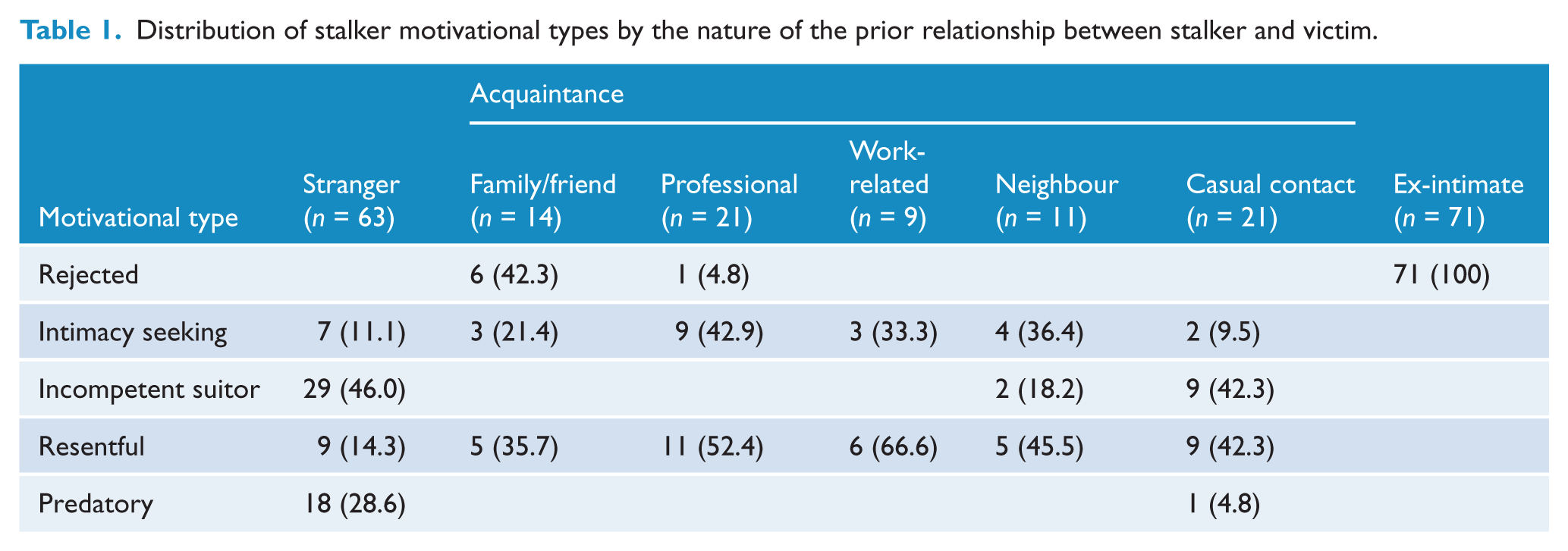
Strangers accounted for 64 (46%) cases, casual acquaintances for 32 (23%; 11 being neighbours), professional contacts 21 (15%), friends and family 14 (10%), and workplace contacts 9 (6%). Using the RECON typology, 76 (54%) were Acquaintances, 60 (43%) were Private Strangers, and 4 (3%) were Public Figures. Table 1 shows the distribution of stalker motivation by relationship type.
Distribution of stalker motivational types by the nature of the prior relationship between stalker and victim.
Stalking behaviours
Telephone calls (62; 45%) and writing to the victim (including email) (42; 30%) were the most common stalking behaviours. Twenty-one stalkers sent unsolicited items to the victim (15%), some clearly intended as gifts such as flowers or money, while others had more threatening overtones, such as a bullet or dead animals. Only a small number used mobile phone text messaging to harass (8; 6%). Almost one-quarter of the participants used multiple communication methods.
Most stalkers made some form of approach to the victim (99; 71%). Twenty-six (19%) followed and 66 (48%) loitered where they knew the victim would be. Fifty-three (38%) actually accosted the victim and eight (6%) entered the victim’s home. Seven stalkers (5%) employed others to harass the victim for them (stalking by proxy), including one man who hired someone to fire a gun at the victim’s home in the hope that he could then take on a ‘saviour’ role and inveigle his way into the family.
Threats occurred in just over one-third of cases (51; 36%). Over half directed threats at the primary victim (55% of all threats), 35% targeted both primary and secondary victims and in 4% of cases threats were made only to a secondary victim. Violence was present in 12 cases (9%), including two ‘near miss’ cases where the stalker attended the victim’s home armed with a knife and with the intention to harm them but the victim was not present. In three cases the violence was considered serious due to the level of harm caused to the victim or the fact that a weapon was used. The target of assaults was mainly the primary victim (9; 75%) and seven of the 12 violent stalkers (58%) committed multiple assaults on the victim in the course of the stalking episode (range 1–6).
Psychopathology
Table 2 shows the distribution of diagnoses by relationship type. Ninety-eight strangers and acquaintances and 34 ex-intimates received an Axis I diagnosis (71% vs 48%; χ2 = 10.3, p < 0.001, OR = 2.6, 95% CI = 1.4 to 4.7). Stranger and acquaintance stalkers were significantly more likely to be diagnosed with a psychotic illness than ex-intimates (28.8% vs 8.5%; χ2 = 11.4, p = 0.001, OR = 4.4, 95% CI = 1.8 to 10.9). Seven stranger or acquaintance stalkers were diagnosed with a mono-delusional disorder, six erotomanic and one persecutory type. Thirty-two (23%) were diagnosed with schizophrenia. Twenty-seven of these 32 files were available for review at the time of writing, revealing that 12 participants had secondary erotomanic delusions, three were morbidly infatuated with the victim, and five had other types of delusions incorporating the victim (three persecutory and two grandiose). Five had no delusional beliefs involving the victim. Five of the 27 were experiencing thought disorder at the time of assessment.
Prevalence of psychopathology among stalkers by the nature of the previous relationship with the victim.
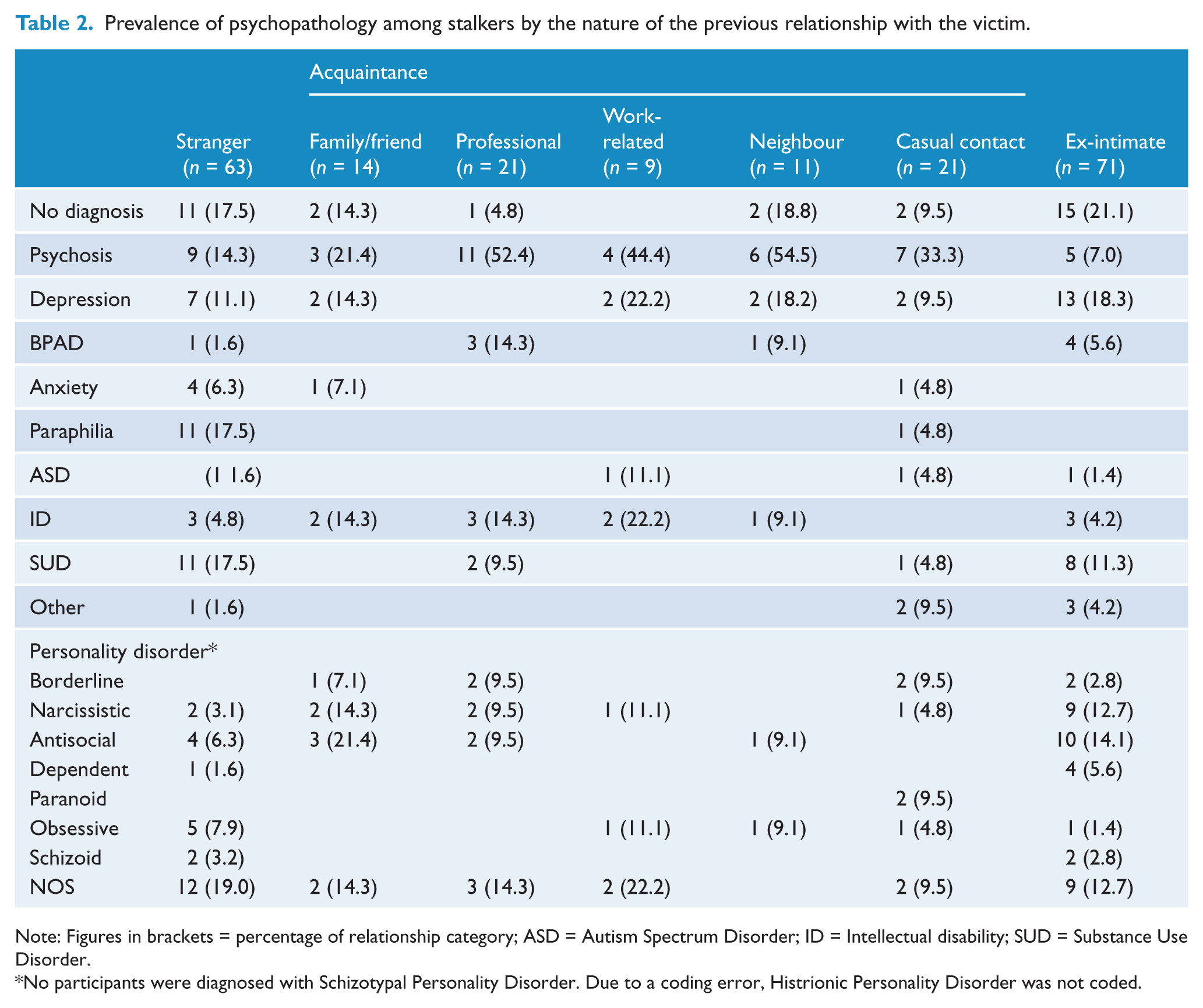
Note: Figures in brackets = percentage of relationship category; ASD = Autism Spectrum Disorder; ID = Intellectual disability; SUD = Substance Use Disorder.
No participants were diagnosed with Schizotypal Personality Disorder. Due to a coding error, Histrionic Personality Disorder was not coded.
The majority of psychotic stalkers had Intimacy Seeking motivations (57.5%); most of the remainder had a Resentful motive (27.5%), a small number were Incompetent Suitors (12.5%), and one was a Rejected stalker (2.5%). In all Intimacy Seeking and Resentful cases the stalking victim was incorporated into delusions and the psychosis directly related to the stalking behaviour, but for Incompetent Suitors and the Rejected the stalking behaviour was not associated with delusional beliefs about the victim. Psychotic stalkers were less likely to target multiple victims simultaneously (40% vs. 15%, χ2 = 8.30, p = 0.04, OR = 0.3, 95% CI = 0.1 to 0.7) and more likely to be subject to a restraining order (67% vs. 32%, χ2 = 14.40, p < 0.001, OR = 4.3, 95% CI = 2.0 to 9.5). They were no more or less likely to breach a restraining order once it was in place than stalkers without a psychotic disorder.
Exploratory analyses of other diagnoses showed that stranger and acquaintance stalkers were significantly more likely to be diagnosed with a paraphilia (8.6% vs. 0%, χ2 = 6.6, p = 0.009). Nine of these individuals had a Predatory motivation and three were Incompetent Suitors. Although only 10% of stranger or acquaintance stalkers were diagnosed with a substance use disorder on assessment, almost half the participants (62; 44%) reported substance misuse at the time of the stalking episode, most commonly illicit substance use (26; 41% of all substance misusers).
Fifty-eight strangers and acquaintances and 36 ex- intimates had an identified personality disorder or problematic personality traits (42% vs 51%; χ2 = 1.5, p = 0.22, OR = 0.7, 95% CI = 0.4 to 1.2). Personality disorder or marked problematic traits were the primary diagnoses for 14.4% of strangers and acquaintances and 31% of ex-intimates. A further 27.3% of stranger and acquaintance stalkers had personality pathology co-morbid with an Axis 1 disorder (most often a substance use disorder, psychotic disorder or depression). The same was true of 19.7% of ex-intimates (primary co-morbidities were depression and substance use disorders). Cluster B disorders were most prevalent in both groups (29.6% of ex-intimates and 18.7% of strangers and acquaintances) and there were no significant differences in the frequency of particular personality disorder clusters. Different types of personality disorders were observed in acquaintances versus strangers. The former group was dominated by Cluster B disorders, accounting for 59.4% of all personality disorders/problematic traits (Clusters A and C were present in less than 10% of cases). Amongst stranger stalkers Cluster B accounted for 23.1%, Cluster C for 26.9% and Cluster A for 11.5%.
Stalking outcomes
Duration
Duration was measured in weeks, with ‘one week’ including cases where a stalking charge was laid for harassment lasting 1–6 days. Stalking duration therefore ranged from one to 832 weeks (16 years). Median duration was 12 weeks (q1 = 4 weeks and q3 = 65 weeks), with 16 cases considered extreme outliers (ranging from 156 to 832 weeks). Univariate analyses showed that psychosis was associated with increased duration (U = 3043, p < 0.001, θ = 0.69; median 8 vs 59 weeks), as was the presence of unsolicited materials (U = 692, p = 0.001, θ = 0.72; median 12 vs 52 weeks). These variables were uncorrelated; φ = 0.09, p = 0.29.
Statistical comparison of stalking duration by motivational type showed significant differences, although with a relatively small effect size (H(4) = 40.7, p < 0.001, η2 = 0.30). Subsequent contrasts (using Dunn’s procedure for multiple pairwise comparisons) revealed that all stalker type pairs significantly differed in duration, with the exception of the Incompetent Suitors and the Predatory (see Table 3). Intimacy Seekers stalked for the longest time (median = 77, q1 = 36 and q3 = 260 weeks), followed by Resentful stalkers (median = 25, q1 = 4 and q3 = 91), then Incompetent Suitors (median = 8, q1 = 3.25 and q3 = 13.75 weeks) and Predatory stalkers (median = 2, q1 = 1 and q3 = 12 weeks). Rejected stalkers were excluded from this analysis as only seven were non-ex-intimates.
Pairwise comparisons of mean rank stalking duration between stalker motivational types.
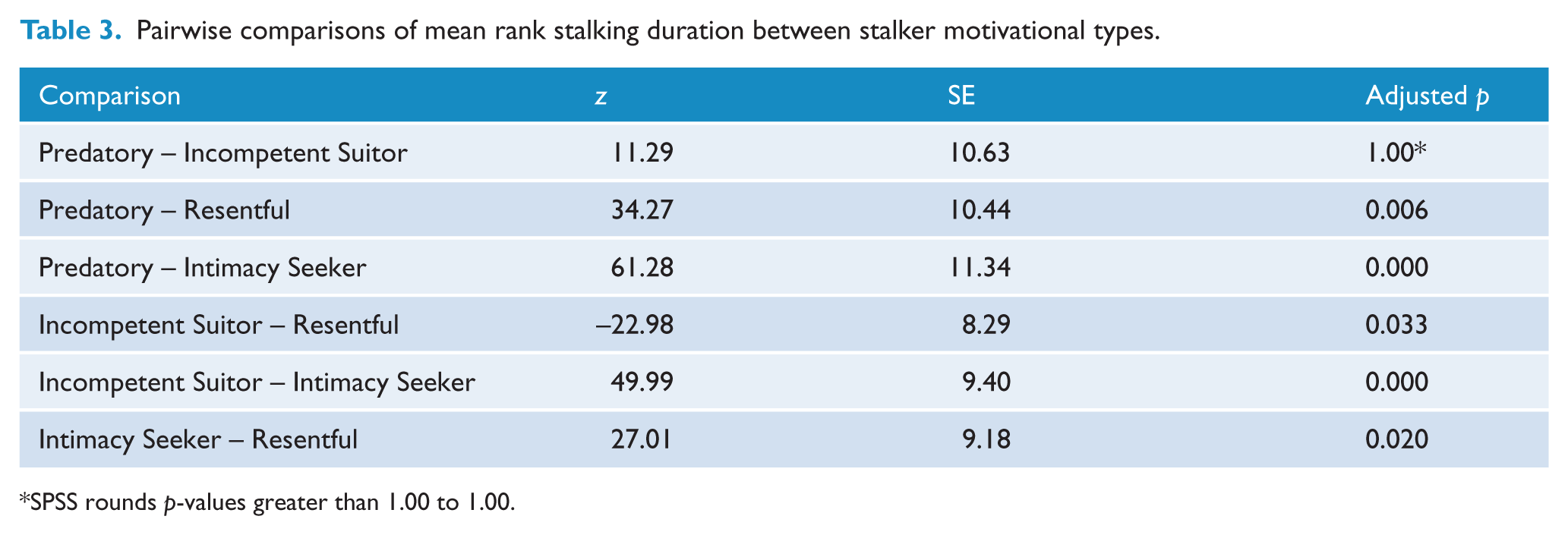
SPSS rounds p-values greater than 1.00 to 1.00.
Recurrent stalking
Forty-four (32%) participants had engaged in at least one separate episode of stalking behaviour prior to the episode leading to assessment (hereafter referred to as the index episode). Nine recurrent stalkers (20%) had previously targeted the index episode victim. There were few demographic differences between single episode and serial stalkers, with only unemployment being more prevalent in the latter group (36% vs 54%, χ2 = 3.80, p < 0.05, OR = 0.5, 95% CI = 0.2 to 1.0). Those with a history of stalking were more likely to also have a history of violence (52% vs 27%, χ2 = 8.71, p = 0.003, OR = 3.0, 95% CI = 1.4 to 6.4) and a history of making threats (32% vs 8%, χ2 = 11.94, p = 0.001, OR = 4.9, 95% CI = 1.9 to 13.0). The relationship between these variables could not be ascertained due to the manner of data collection. Serial stalkers were less likely to have stalked a neighbour during the index episode (0% vs. 12%, χ2 = 5.5, p = 0.02). They were more likely to be diagnosed with a personality disorder or have marked problematic personality traits (57% vs 36%, χ2 = 5.56, p = 0.02, OR = 2.4, 95% CI = 1.2 to 5.0). There were no index episode motivational differences between first time and repeat stalkers. Information about motivation in previous stalking episodes was not collected.
Discussion
These results indicate that stranger and acquaintance stalkers are significantly more likely to be diagnosed with an Axis 1 disorder than former intimates. Specifically, they are more likely to be diagnosed with either a psychotic or a paraphilic disorder. The distribution of these diagnoses in this study differed by prior relationship and motivational type, with the majority of stalkers with a psychosis pursuing acquaintances and stalking in pursuit of intimacy or to assuage a grievance, while those with paraphilias stalked predominantly strangers in pursuit of deviant sexual gratification or a sexual relationship.
These findings also suggest that psychopathology in the stalker is related to specific stalking outcomes. Psychosis was associated with increased stalking duration, meaning that motivational types in which psychosis was prevalent (Intimacy Seeking and Resentful) tended to stalk for longer. Personality disorder was significantly associated with recurrent stalking.
The role of psychopathology in stalking behaviour
Almost one in three stranger and acquaintance stalkers was diagnosed with a psychotic disorder in this study, versus only one in ten ex-intimates. This replicates Mohandie and colleagues’ (2006) file review-based finding with an improved methodology, providing increasing evidence that psychosis is more prevalent in the former group. These findings strongly suggest that individuals who attract police attention or appear before courts for stalking a stranger or an acquaintance should be routinely referred for forensic psychiatric assessment. This would provide an avenue for individuals who have fallen out of care and whose offending behaviour is directly related to an active psychosis to be diverted into appropriate treatment rather than being subject to criminal penalties that are unlikely to have a significant deterrent effect. Half of the psychotic participants in this study who were referred by mental health services already had charges or convictions related to their behaviour. If a standard referral procedure were in place these individuals could have been identified, assessed and treated during earlier court proceedings, and possibly diverted away from the criminal justice system.
This cross-sectional study cannot address the causal role of mental illness in stalking, however the pattern of results suggests hypotheses that could be investigated in longitudinal research. Delusional beliefs that incorporate the victim and are associated with Intimacy Seeking or Resentful stalking may directly cause stalking behaviour. An indirect relationship is more likely for disorders that result in impaired social processing and emotional expression (e.g. autism spectrum disorders or negative symptoms of schizophrenia). Similarly, symptoms of depression and paraphilia may create an environment conducive to stalking behaviour without directly causing it to occur (e.g. rumination about the victim, experiencing sexual desires that are difficult to satisfy in a prosocial way). Future research needs to take a more sophisticated approach to symptoms of mental illness and the psychological mechanisms by which they may cause or contribute to the emergence of stalking behaviour.
This may be particularly true for personality disorder, which was equally prevalent across prior relationship groups in this study. Cluster B disorders predominated among acquaintances and ex-intimates, while strangers had a much wider range of pathological personality traits. Although these findings need to be replicated using structured assessments, the prevalence of personality pathology is consistent with that reported in other clinical/forensic samples, at approximately 50% (Mullen et al., 1999; Rosenfeld and Harmon, 2002; Morrison, 2008; Whyte et al., 2008). Both this and Rosenfeld’s (2003) study identified relatively high prevalence of personality disorder not otherwise specified diagnoses (PD NOS), suggesting that stalking behaviour may not be associated with a specific type of personality pathology but with combinations of traits across disorder categories.
Investigating causal links between personality disorder and any offending behaviour is difficult as the construct is defined too generally for associations to be easily identified, and establishing causality would require the pathology to be identified before the behaviour emerges, which is not possible using cross-sectional designs (Duggan and Howard, 2009). This is particularly problematic for stalking, as stalking behaviours may satisfy some of the behavioural criteria for certain personality disorders (e.g. “a pattern of instability in interpersonal relationships…” [Borderline PD] or “a pattern of disregard for, and violation of, the rights of others” [Antisocial PD] (p. 710 and p. 706, American Psychiatric Association, 2000)). Given that stalking behaviour may in some cases contribute to diagnosis, it is extremely difficult, if not impossible, to establish a causal connection using current methodologies.
It is possible that diagnostic categories are not the most helpful way to conceptualise personality in future stalking research. Gilbert and Daffern (2011) have suggested that considering personality at the level of knowledge structures, maladaptive cognitions, and affective arousal may be more helpful than diagnosis when examining the relationship between personality disorder and aggression. They review evidence that aggression-related knowledge structures, specific maladaptive cognitions, and anger are more common in people diagnosed with Antisocial Personality Disorder in particular, and identify some evidence supporting their presence in people diagnosed with Borderline Personality Disorder. Future research may be able to identify relevant psychological mechanisms specific to stalkers. This type of research may also be relevant to non-clinical samples of stalkers, where similar knowledge structures, maladaptive cognitions and affective arousal may be present at sub-clinical levels and contribute to stalking behaviour.
Psychopathology and stalking-related risks
Specific types of psychopathology appear to be related to increased risk of persistent and recurrent stalking by stranger and acquaintance stalkers. While a causal relationship cannot be inferred from these findings, participants who held delusional beliefs about the victim stalked for significantly longer. Untreated psychosis has been linked with stalking persistence, leading to the suggestion that pharmacological treatment is the most effective way to end these stalking situations (Mullen et al., 2009; MacKenzie and James, 2011). It is notable that 32 of the 40 stalkers with a psychotic disorder were referred by mental health services, indicating that they were receiving some sort of psychiatric treatment and yet were continuing to stalk at the time of referral. This may indicate that the treatment being provided was ineffective, but could also be a consequence of non-compliance with treatment or indicate that psychosis did not cause the stalking behaviour. It is logical to assume that when stalking behaviour arises from a delusional fixation on the victim, early and ongoing psychopharmacological treatment will be key to preventing a protracted stalking episode. Nonetheless, controlled studies of treatment effect are required to test this hypothesis and determine the efficacy of psychopharmacology as a way of ending these types of stalking situations. The lack of empirical data concerning outcomes in these cases does not obviate the need for police or court diversion for psychiatric assessment. This may not only protect the victim; it would protect the client from deterioration in mental state and psychosocial well-being.
Individuals diagnosed with a personality disorder were more likely to have engaged in multiple episodes of stalking behaviour, consistent with the previous findings of Rosenfeld (2003). Until future research investigates and identifies more specific personality-related constructs that are associated with stalking, these findings suggest that clinicians working with stalkers should direct attention to their clients’ personality functioning when considering the likelihood of future stalking and treatments that may reduce the behaviour over time. This has been acknowledged by Rosenfeld and colleagues (2007) who have adapted dialectical behaviour therapy for stalking and related behaviours.
Limitations
The sample used in this study is not representative of all stalking situations and is unlikely to be representative of very short-lived and non-violent stalking episodes or episodes that have resulted in extreme violence such as rape or homicide. Additionally, duration of stalking is likely to be confounded by the levels of aggression displayed by the stalker. Those who are more aggressive or threatening are potentially more likely to attract police attention at an earlier stage, which may end the stalking episode. A further limitation is the manner in which diagnoses were made. This was a clinical study collecting data in a functioning forensic mental health clinic, meaning that structured diagnostic tools were not used and inter-rater reliability information on diagnoses was not available. Thus, there may be some inaccuracies in diagnoses, particularly relating to specific types of personality disorder.
Conclusion
Stalking is the product of an interaction between context (including the dyadic relationship between stalker and victim) and individual perpetrator factors such as psychopathology. Regardless of aetiology, stalking is a behaviour, not a psychiatric diagnosis. Nonetheless, as evidenced by these results, those who engage in stalking are often affected by symptoms of mental disorders that can play a direct or indirect role in precipitating and perpetuating the behaviour. This appears to be particularly true for those who stalk strangers and acquaintances and these results support the case for routine mental health assessment of these individuals as part of any involvement in the court system.
Footnotes
Acknowledgements
The authors acknowledge and thank Dr Rachel MacKenzie for her assistance with the collection of data used in this study. The authors would also like to thank Professor Paul Mullen for his helpful suggestions on an earlier draft of this paper.
Funding
This research received no specific grant from any funding agency in the public, commercial, or not-for-profit sectors.
Declaration of interest
The authors report no conflicts of interest. The authors alone are responsible for the content and writing of the paper.