






Abstract
The precedents of creativity comprise an important research topic that could help organisations survive fierce competition. To contribute to the literature on creativity, the authors examined the roles of competence and perceived organisational support (POS) in the relationship between servant leadership and follower creative behaviour. The authors proposed and tested a moderated mediation model with data from leader-follower dyads collected in a Vietnamese engineering firm. The results showed that follower competence is a significant mediator of the relationship between servant leadership and follower creativity. Furthermore, POS has a moderated mediating role, such that the mediated relationship (i.e., servant leadership, competence, and creativity) is more salient under high POS than under low POS. Theoretical and practical implications are discussed.
A significant stream of research has accentuated the useful and effective qualities of servant leadership (Greenleaf, 1970) in improving organisational performance and boosting organisational competitiveness. Servant leadership is a unique leadership style (Greenleaf, 1977; Russell & Stone, 2002). Servant leaders are characterised by people-centred, altruistic, and selfless behaviours (Avolio, Walumbwa, & Weber, 2009; Parris & Peachey, 2013). Research findings in the leadership area have suggested that followers of servant leaders are more likely to be satisfied, dedicated, involved in their work, and high performing (Carter & Baghurst, 2014; Liden, Wayne, Zhao, & Henderson, 2008; Neubert, Kacmar, Carlson, Chonko, & Roberts, 2008).
The relationship between servant leadership and employee creativity has been revealed to be significant, but for the empirical and theoretical foundations of this topic (e.g., mechanisms through which servant leaders impact employee creativity and the boundary conditions of this relationship), there is still a dearth of research (Hunter et al., 2013; Neubert et al., 2008; Yoshida, Sendjaya, Hirst, & Cooper, 2014). The need for further analysis of how and in what contexts servant leadership motivates followers to extend their input in organisations by engaging in creative behaviours therefore should be addressed to further our knowledge of the way servant leaders impact individual behaviours and perceptions in an organisation.
This study aims to extend the literature in several ways. First, it examines the role of follower competence as a psychological mechanism by which servant leadership affects follower creativity. A previous literature (i.e., Yang, Liu, & Gu, 2017) examined the servant leadership and follower creativity link by studying the mediating mechanism of follower belief in their ability to perform creatively. Our study centres on employees’ competence perception (i.e., work role-specific competence). Understanding the meaning of follower competence in this relationship will permit us to contribute to the theoretical validity and precision of servant leadership theory (Greenleaf, 1970, 1977; Liden et al., 2015) at the individual level. Second, by employing a moderated mediation test in the analysis of follower competence as the mediating mechanism and perceived organisational support (POS) as the moderator, we aim to highlight the pivotal influence of follower perception on organisation via follower competence and creative performance. This empirical examination is expected to add to the extant literature of creativity (Shalley, Zhou, & Oldham, 2004) and leadership (Avolio et al., 2009) the salience of contexts and settings in strengthening servant leaders’ potential. Given that the majority of servant leadership studies have been conducted in Western societies, our study is among the first to reveal its effect in a member country of the Asia Pacific region by applying a moderated mediation model. Last, by underlining the imperative function of leaders who express authentic interest in follower growth and in recognising and nurturing follower creativity, we contribute to follower-oriented leadership studies, including that of servant leadership (Greenleaf, 1970).
Theoretical Background and Hypotheses
Servant Leadership and Follower Creativity
Servant leadership is a people-centred leadership concept that is characterised by an emphasis on others’ interests and wellbeing as the leader's primary concern. Servant leaders become leaders because they have a passion for serving and encouraging good deeds within society (Graham, 1991). As a result, servant leaders in any organisation are known for their selfless focus, continuous investment in followers’ growth, and absolute trust in followers, which render them great assets to organisational development (Stone, Russell, & Patterson, 2004; van Dierendonck, 2011). Further, servant leadership involves a component of morality (Ehrhart, 2004; Russell & Stone, 2002), such that all followers of servant leaders are treated in an equal and respected manner on principle (Graham, 1991). The distinction between servant leadership and other leadership theories (e.g., transformational leadership) has been discussed and proven in several studies (Ehrhart, 2004; Graham, 1991; Stone et al., 2004); for instance, the main focus of servant leaders and transformational leaders is distinguishable, servant leaders are more concerned about employee wellbeing, while transformational leaders are more concerned about organisational wellbeing (Stone et al., 2004).
Creativity is conceptualised as the perception-based analysis of the level of novelty and efficiency of products introduced by entities in organisations to deal with market challenges (Amabile, 1988, 1996; Shalley & Gilson, 2004). This topic has received great attention and has been considered to be of profound importance in behavioural studies (Amabile, 1996), given its widely acknowledged role as a precondition for innovation (Amabile, 1988). More specifically, employee creativity has been studied intensively by scholars because it has been found to be significantly related with organisational survival (Woodman, Sawyer, & Griffin, 1993), organisational competitiveness (Oldham & Cummings, 1996), and organisational innovation (Amabile, 1988). Research in this field has suggested that social contexts in the workplace, and especially effective leadership styles such as servant leadership, are critical for cultivating creativity (Amabile & Khaire, 2008; Carmeli, Gelbard, & Reiter-Palmon, 2013; Neubert et al., 2008; Yoshida et al., 2014).
Recently, a number of studies have suggested that the relationship between servant leadership and individual performance can be mediated by other variables, such as promotion focus (Neubert et al., 2008), leader identification (Yoshida et al., 2014), commitment to supervisor (Walumbwa, Hartnell, & Oke, 2010), and serving culture (Liden, Wayne, Liao, & Meuser, 2014), which indicates the plausibility and importance of further investigation into the complicated mechanism of this relationship. In this study, we attempt to answer part of the intricate question by closely inspecting the role of follower competence in the relationship between servant leadership and follower creativity.
Servant Leadership and Follower Competence
Follower competence refers to followers’ assessment of their ability to accomplish workplace tasks and followers having opportunities to perform and become proficient with their skills (Spreitzer, 1995). In this sense, leaders, as close relational constituents and pivotal elements constructing followers’ understanding of workplace surroundings, are considered to constitute a decisive factor determining follower competence (Baard, Deci, & Ryan, 2004; Deci, Schwarz, Sheinman, & Ryan, 1981). Supportive leadership such as servant leadership is expected to be able to make a positive impact on follower competence (Spreitzer, 1995) because supportive leaders are capable of augmenting followers’ task-related proficiency with their rational, ethical, and emotional decisions.
Servant leadership exhibits a competence empowerment process through leaders’ recognition of followers’ ability and realisation of followers’ potential growth (Greenleaf, 1998). Genuinely caring acts, benevolence, and individualised consideration enable servant leaders to know what suits followers best, thus providing followers with a nurturing and favourable environment in which they are assisted in learning new skills, expanding their knowledge, reaching new high levels, and achieving their goals (Chen & Bliese, 2002; Liden et al., 2015; Liden et al., 2008; Walumbwa et al., 2010). As a result, followers’ confidence that they have gained sufficient expertise to fulfill their jobs is fostered. Consistent with this reasoning, Walumbwa et al. (2010) suggested that servant leaders provide guidance and enhance followers’ competence through dissemination of knowledge and experience such that followers can solve job-related problems effectively. We also argue that follower competence is strengthened under the supervision of servant leaders because servant leaders are known for their goal clarification toward followers. While servant leaders encourage followers to take new responsibilities and tackle new challenges in their own way, servant leaders ensure that followers are aware of exactly what expectation is ahead, constantly providing practical feedback and letting followers have credit for their achievements (van Dierendonck & Rook, 2010).
Hypothesis 1: Servant leadership is positively related to follower competence.
The Mediating Role of Follower Competence
Studies in creativity have suggested that, in addition to leadership styles, follower creativity can be determined by follower competence (Amabile, 1988), which renders followers persistent in the face of adversity that is deeply rooted in creative work (Shalley & Gilson, 2004). Indeed, a great deal of research has emphasised the strong association between follower competence and creative performance (Amabile, 1988; Shalley & Oldham, 1997).
In this article, we posit that servant leadership not only enhances follower competence, but also enhances follower creativity through the process of enhancing follower competence, because when followers are confident about their ability to perform task assignments, they are empowered to engage in extra-role behaviours such as creativity (Spreitzer, 2008). More specifically, under the supervision of servant leaders, follower competence increases as followers perceive themselves to possess the capabilities necessary to create positive contributions if they put forth adequate effort. Follower competence then provides a critical boost for followers to exhibit creative behaviours.
First, servant leadership, as a supportive and people-centred form of leadership, facilitates new creative ideas by instilling competence in followers. Servant leaders, by establishing a developmental environment promoting high-quality exchange, positive spirit, and constructive feedback aims to shift follower concentration from external matters to an internal force lying in the work itself (Deci, Connell, & Ryan, 1989). Followers then experience an increasing level of competence, becoming more interested in their tasks, and focusing more on creative accomplishments. Second, servant leaders guide followers with informational directions and prompt assistance, and followers are more likely to feel competent and accomplish creative work (Redmond, Mumford, & Teach, 1993). This notion originates in creativity-required contexts characterised by complex, vague, and under-developed issues that rely on servant leaders to set unambiguous goals, clarify expectations, and expedite discussion framing (Carmeli & Schaubroeck, 2007; Mumford, Byrne, & Shipman, 2009). Finally, the mediating role of follower competence in the relationship between servant leadership and follower creativity also manifests itself when servant leaders provide followers with the necessities demanded to implement creative tasks such as financial funding, materials, or knowledge sharing. Such necessities would be impossible for the follower to access without leaders’ support as facilitators.
Hypothesis 2: Follower competence mediates the relationship between servant leadership and follower creativity.
The Moderating Role of POS
POS originated in the organisational support theory proposed by Eisenberger, Huntington, Hutchison, and Sowa (1986), illustrating followers’ global perception about organisational appreciation toward their work inputs and organisational consideration of their wellbeing (Eisenberger et al., 1986). Creative performance is inherently contextualised (Amabile, 1988; Mumford, Scott, Gaddis, & Strange, 2002; Woodman et al., 1993), such that the driving force for follower creativity comes from followers’ social and technical surroundings (e.g., pressures, resources, policies, and rewards; Caniëls, De Stobbeleir, & De Clippeleer, 2014; Csikszentmihalyi, 1999).
In line with this argument, several studies have confirmed that followers’ perceptions of their work environments impact followers’ exhibition of creativity (Amabile, Conti, Coon, Lazenby, & Herron, 1996; Oldham & Cummings, 1996) because workplace cues play a role in shaping follower competence (Ford, 1996). The characteristics of work environments are not limited to proximal factors (i.e., employee daily work) but extend to distal factors (i.e., the organisational system and organisational procedures) in which organisations are viewed as a whole. Therefore, it can be suggested that although the role of supportive leaders is of critical importance for follower competence and creative performance, the role of organisational support in many manifestations should be considered complementary to that of leaders. When followers perceive goal alignment between servant leaders and their organisations in favour of their interests (i.e., followers receive all the assistance needed from both their immediate servant leaders and their organisations, for the same purpose), followers are expected to feel more competent regarding their task assignments and to be more likely to exhibit creativity.
Goal alignment between leaders and organisations is especially important in situations requiring creativity. For example, servant leaders may be aware that complex and demanding jobs are suggested to enhance follower competence, thus motivating them to perform creatively, more than jobs that are usually done in the same way (Hackman & Oldham, 1980; Sagiv, Arieli, Goldenberg, & Goldschmidt, 2010), but the responsibility to design and control job architecture is not always completely in the servant leaders’ control. In fact, it may depend more on the position of leaders in the organisational hierarchy, the organisational structure, or organisational policies. Similarly, leaders rely on operating processes and rules that the whole organisation determine to decide how they interact and exert influence on followers. Even when leaders try to create an environment that is as positive and supportive as they can manage via public relations and boundary management, if the ‘outside world’ is characterised by the extravagant employment of strict regulations, inspections and discipline, follower creativity can still be inhibited (Shalley & Gilson, 2004). In other words, followers may need access to different inputs and support from different individuals and groups within an organisation, not just from their immediate leaders, for the successful development and operation of creative works. The hypothetical research model for the study is depicted in Figure 1.
Hypothesis 3: POS moderates the strength of the mediated relationship between servant leadership and follower creativity via follower competence, such that the mediated relationship is more salient under high POS than under low POS.
Hypothesised model.
Methods
Sample
We conducted a survey in a local engineering firm in Vietnam. The sample consisted of 148 participants (response rate of 89.7%) with matched immediate leaders’ ratings for their creativity. Six teams participated in the survey, with similar job duties according to the head of the Human Resources division of the firm. Each team was under the supervision of one leader. At the time of the survey, no team rotation in the firm had been conducted since participants were recruited.
The average follower age was 25 years, with mean work experience in the firm of nine months and mean working time under the current leader of eight months. The average team leader's age was 39 years, with mean work experience in a leadership position of approximately seven years. Among followers, 81.5% were male, and 18.5% were female. Among team leaders, 85.7% were male, and 14.3% were female. These data were utilised as a source for the servant leadership project conducted by the authors.
Procedure
Because the survey was conducted in Vietnam, we had the questionnaire translated from English into Vietnamese by two professional translators. The translation process followed Brislin's (1970) instructions for a back-translation method to provide sufficient quality for the translated version because the original measures were created for Western countries. A trained research assistant was recruited to deliver survey envelopes to subordinates and their leaders at the firm. Participants were fully informed that the study was conducted completely for research purposes.
Each employee was provided an envelope consisting of an introductory letter written by the authors, a questionnaire sheet, and a participant number. The participant numbers were created to assure the confidentiality of participants’ identities. Similarly, envelopes distributed to team leaders included an introductory letter, questionnaire sheets, and a list of the names of their current subordinates. Participants were instructed by the research assistant to seal their envelopes immediately after finishing the questionnaire for confidentiality reasons. Two weeks after survey delivery, the research assistant returned to the organisation to collect the sealed response envelopes and submitted them to the researchers.
Measures
Servant leadership
We used a scale consisting of seven items from Liden et al. (2014), which was a shortened version of the full questionnaire developed by Liden et al. (2008). The shortened version is sufficient to reflect all seven dimensions of servant leadership (i.e., emotional healing, creating value for the community, conceptual skills, empowering, helping subordinates grow and succeed, putting subordinates first, and behaving ethically) because it comprises the highest loading item from every dimension of the original measure (Liden et al., 2008). Employees responded on the 7-point Likert scale, ranging from 1 = strongly disagree to 7 = strongly agree. Sample items included ‘My leader gives me the freedom to handle difficult situations in the way that I feel is best’ and ‘My leader emphasises the importance of giving back to the community’. Cronbach's alpha was .86 (see Appendix for complete items).
Competence
We used the three-item scale suggested by Spreitzer (1995) to measure the competence dimension of the global construct of psychological empowerment. The original scale was developed by Johns (1986). Employees answered based on a 7-point Likert scale, ranging from 1 = strongly disagree to 7 = strongly agree. Sample items included ‘I am confident about my ability to do my job’ and ‘I am self-assured about my capabilities to perform my work activities’. Cronbach's alpha was .79 (see Appendix for complete items).
POS
We used an eight-item version of the Survey of Perceived Organisational Support, which was developed by Eisenberger, Cummings, Aemeli, and Lynch (1997). Employees answered on a 7-point Likert scale, ranging from 1 = strongly disagree to 7 = strongly agree. Sample items included ‘My organisation really cares about my well-being’ and ‘My organisation strongly considers my goals and values’. Cronbach's alpha was .71 (see Appendix for complete items).
Creativity
We used a four-item scale from Baer and Oldham (2006). Leaders rated employees’ creativity based on a 7-point Likert scale, ranging from 1 = strongly disagree to 7 = strongly agree. Sample items included ‘This employee suggests many creative ideas that might improve working conditions at the organisation’ and ‘This employee often comes up with creative solutions to problems at work’. Cronbach's alpha was .94 (see Appendix for complete items).
Factor Loadings and Average Variance Extracted Statistics of Study Constructs

Note: AVE = average variance extracted; POS = perceived organisational support.
Analytical Strategy
Based on the Becker (2005) and Spector and Brannick (2011) argument that the inclusion of control variables should be considered with caution, especially because it can cause unanticipated impacts on the relationships among the main variables, and that the investigation of control variables (e.g., demographics) is only essential when the control variables are the main variables of interest or important, we decided not to draw control variables in the statistical analysis. Our decision is consistent with a previous study (i.e., Walumbwa et al., 2010).
We tested our study model with two interlinking steps. First, we examined the mediating effect of competence on servant leadership and follower creativity (Hypothesis 1–2) using structural equation modelling (SEM) and the bootstrapped indirect effect (Preacher & Hayes, 2008). We utilised SEM to analyse our study hypotheses since SEM is recognised as an effective method that can examine the whole hypothesised model concurrently while avoiding the accumulation of type I errors (Anderson & Gerbing, 1988).
Second, we analysed the moderated mediation model (Hypothesis 3) following the bootstrapping procedure suggested by Preacher, Rucker, and Hayes (2007).
Results
Confirmatory Factor Analyses and Chi-Square Model Comparison Tests
Results of Confirmatory Factor Analyses and Chi-Square Model Comparisons Tests

Note: CFI = comparative fit index; TLI = Tucker-Lewis fit index; RMSEA = root-mean square error of approximation.
Three-factor model = Servant leadership and competence combined into a single factor.
Three-factor model = Servant leadership and perceived organisational support combined into a single factor.
Two-factor model = Servant leadership, perceived organisational support, and competence combined into a single factor.
One-factor model = All factors combined into a single factor.
Descriptive Statistics and Correlations
Means, Standard Deviations, Correlations, and Reliabilities
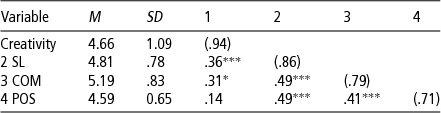
Note: N = 148 dyads. SL = Servant leadership; COM = competence; POS = perceived organisational support. Figures in parentheses are Cronbach's alphas.
*p < .05; ***p <.001.
Hypothesis Testing
Results of Mediation Test for Structural Models

Note: N = 148 dyads. SL = servant leadership; COM = cmpetence; CFI = comparative fit index; TLI = Tucker-Lewis fit index; RMSEA = root-mean square error of approximation. Model 1 is the direct effect-only model; Model 2 is the mediation model (hypothesised model).
*p < .05; **p < .01; ***p < .001.
To test Hypothesis 2, which posited that follower competence mediates the relationship between servant leadership and follower creativity, we conducted the bootstrapped indirect effect test (Preacher & Hayes, 2008). The result of the bootstrapped indirect effect test using 5,000 resamples supported Hypothesis 2 because the confidence interval did not include zero (95% bootstrap CI [.01, .19]).
In addition, we adopted the SEM method and followed the two-step process suggested by Hair, Black, Babin, and Anderson (2010). We first examined the relationships between study variables, as instructed in Step 1. According to Table 3, servant leadership was significantly related to follower creativity (r = .36, p < .001), suggesting that the direct, unmediated relationship between the two variables was significant. Servant leadership also established a significant relationship with the potential mediator, follower competence (r = .49, p < .001). Last, follower competence was found to be significantly related to follower creativity (r = .31, p < .05), indicating, together with the aforementioned results, that all the requirements in step 1 were satisfied. In step 2, we attempted to estimate the hypothesised mediation model and identify the mediation type. The results in Model 2 (i.e., the mediation model), shown in Table 4, suggested that after the mediator (i.e., follower competence) was added, the significance level of the relationship between the independent variable (i.e., servant leadership) and dependent variable (i.e., follower creativity) became weaker, that is, β = .38, t(146) = 4.60, p < .001➔ β = .29, t(145) = 2.58, p < .05, although it was still significant, suggesting a partial mediation. Taken together, the results confirmed that Hypothesis 2 was supported.
Hypothesis 3 predicted that the indirect effect of follower competence on the servant leadership-follower creativity relationship would be strengthened by a level of POS. To assess moderated mediation, we followed the procedure suggested by Preacher et al. (2007). We first tested whether there was a significant interaction between servant leadership and perceived organisational support in predicting follower competence. The result confirmed the moderating role of POS for the relationship between servant leadership and follower competence, β = .10, t(144) = 1.69, p = .04.
Results of Moderated Mediation Analysis Across Levels of POS

Note: N = 148 dyads. POS = perceived organisational support. Conditional indirect effects are standardised numbers. Results are based on 5,000 bootstrap samples.
Discussion
In this study, we examined a moderated mediation model to address literature gaps in the field of servant leadership, especially regarding follower creativity. We found a significant impact of follower competence as a mediating variable of the relationship between servant leadership and follower creativity. We also found that POS moderated the indirect effect of servant leadership on follower creativity through follower competence. These findings contributed to the theoretical and current empirical knowledge in several ways.
First, we confirmed the significantly positive relationship between servant leadership and follower creativity at the individual level in a new social context. It is undeniable that previous research studies have proven and explained this relationship, but there is still a major limitation in that the current literature on servant leadership and follower creativity is considered to be insufficient in terms of generalisability and reliability. Because our data were collected in an engineering company (i.e., a new industry of research) within the Vietnamese society (i.e., a new culture), we contributed to the improvement of the generalisability of servant leadership and follower creativity. Further, although creativity is considered to be a type of extra-role behaviour, it has received less attention than a fellow construct, organisational citizenship behaviour (Hunter et al., 2013; Neubert et al., 2008; Yoshida et al., 2014), resulting in fewer studies testing its correlation with servant leadership empirically and building the theoretical foundation for this link. Second, to the best of our knowledge, no prior studies have examined the role of follower competence in work tasks in the relationship between servant leadership and creativity. Another study (i.e., Yang et al., 2017) addressed the mediating role of self-efficacy, but it focused on follower creative self-efficacy particularly while competence in our study is regarded as self-efficacy specific to a work role (Spreitzer, 1995). The findings contribute to the current knowledge of servant leadership theory by accentuating servant leaders’ ability to promote follower competence such that followers are more likely to engage in creative behaviours.
The final and arguably most important finding of our study is the moderated mediation model, which, to our knowledge, is the first model to consider the role of POS as a potential moderator in servant leadership theory. We proposed and tested the impact of POS on the mediating mechanism, such that when follower POS is high the mediated relationship between servant leadership and follower creativity via follower competence is strengthened, but no significant conditional indirect effect was found when POS is low. This finding might result from the capability of supportive leaders, like servant leaders, to mitigate influence even when POS is low. This capability might manifest itself in the way servant leaders continue to try to create a nurturing working environment for followers as well as they can despite deficiencies in organisational policies or seemingly uncooperative management decisions (Maertz, Griffeth, Campbell, & Allen, 2007). Because followers mostly interact with leaders in the workplace and are influenced by leaders’ behaviours, the way they self-assess their competence and work outcomes depends heavily on the leaders’ attitudes. When POS is high, however, support received from other factors within the organisations may provide additional cause for followers to believe in themselves more, which will then lead to their engagement in creative behaviours.
Practical Implications
The promotion of creativity among employees has been a subject of focus for many organisations concerned with finding prompt and effective responses to a dynamic market environment (Egan, 2005). Aiming to partly address this issue, our study provides practical insights and suggestions, which may be beneficial for organisations seeking to facilitate internal creativity. The major implication for management practices in creativity-oriented organisations lies in the critical importance of creating a supportive workplace environment in which employees feel that they receive individualised care and that their work-related competence is enhanced. Therefore, it is suggested that organisations consider selecting and developing servant leaders in significant positions, such that training and recruitment methods both outside and inside organisations is conducted in alignment and mutual communication. Promoting employee competence, then, should become a consistent objective that can benefit organisations by serving as a focal point of leaders’ skill advancement and a consistent standard for the appraisal of a leadership training program's success.
Further, our findings suggest that creating a perceived supportive environment to increase employee competence should not be regarded as purely the responsibility of immediate managers, but should also be regarded as a responsibility of other seemingly more distal organisational entities, because employees also include such distal entities in their perception of the working environment. Managers can also play a pivotal role in how employees perceive organisational support (Rhoades, Eisenberger, & Armeli, 2001; Maertz et al., 2007) by tailoring such support. For example, managers can increase employees’ feeling that they are supported by the organisation by communicating to them how much the organisation cares about them and wants them to be successful (Maertz et al., 2007).
Limitations and Future Research
There were several limitations in this study, indicating areas of future research. First, the servant leadership (i.e., the independent variable), follower competence (i.e., the mediating variable), and POS (i.e., the moderating variable) responses were employees’ self-responses, gathered simultaneously. This practice could result in common source bias. Another issue is that the stability of leadership's impact on certain outcomes over time has been raised as an important issue by many scholars (e.g., Mitchell & James, 2001; Shamir, 2011). Some impacts will become stronger over time, some have their own peaks and remain unchanged, and others will probably experience a decrease after an initial increase. These changes, whether they lie inherently within the leaders or are caused by external factors, affect how we treat the effectiveness of certain leadership styles. Future studies, therefore, should employ a longitudinal design to ascertain how the durability of servant leadership impacts on employee competence and creativity, and an experimental design to examine the causality links of the variables, which would provide valuable academic knowledge and practical implications.
Third, future research could also include other leadership styles such as transformational leadership or charismatic leadership as control variables to further validate the variance in individual and organisational outcomes accounted for by servant leadership. Fourth, our data were collected from only one engineering company in Vietnam and therefore present a generalisability question for the findings. More research is needed to tackle this problem by conducting studies in other settings within and across other cultures. Fifth, we analysed servant leadership at the individual level, leading to the measurement of this construct as perceived servant leadership. Although this method is appropriate for our main focus in this study, which addresses the gap in psychological mechanisms at the individual level of the servant leadership literature, we suggest that similar research be conducted at the team/group and organisational levels so that the generalisability of the findings can be further confirmed. Sixth, POS was proposed as a potential moderator because, as one of the workplace cues (together with servant leadership), it may be critical in determining follower competence (Ford, 1996); the impact of the interactive effect between POS and follower competence on follower creativity is intuitively plausible and may be worth examining in future research.
Lastly, because recognition of servant leadership has become more popular in many areas of the world and is no longer limited to Western cultures (e.g., Hu & Liden, 2011; Walumbwa et al., 2010), there is a need for future studies to delve into more perspectives on this leadership style, especially the boundary conditions, including contextual factors and gender issues affecting the relationship between servant leadership and outcomes and the mechanism regulating this relationship. For example, culture-specific values (see Hofstede, 1984; House, Hanges, Javidan, Dorfman, & Gupta, 2004) may be important moderators that alter follower responses to servant leadership. Further, a study with a larger representation of female leaders is expected to augment the generalisability of our study results by exploring whether leaders’ genders can affect follower behaviours and attitudes. Servant leadership, with its participative and cooperative qualities, is arguably more likely to be adopted by female leaders because such leaders tend to exhibit these qualities (Eagly, Johannesen-Schmidt, & van Engen, 2003), and female leaders are regarded to be more open to unconventional leadership styles, particularly in training and developing followers (Eagly et al., 2003). However, due to stereotypes in favour of masculine qualities in many cultures (Eagly & Karau, 2002), followers of female leaders may be less likely than followers of male leaders to perform creativity.
Conclusion
In this study, we investigated the role of servant leadership regarding a desirable follower outcome: creativity. More specifically, we contributed to the current knowledge of how and under what conditions servant leaders can cultivate more creative behaviour from followers. We empirically validated follower competence as a motivational factor that affects the impact of servant leadership on follower creativity. We also found that other factors within organisations, besides leaders, are important in determining followers’ exhibition of creativity, such that when POS was high it strengthened the role of servant leadership on follower creativity by bolstering the impact of follower competence on follower creativity. This shows that the responsibility to build a supportive and nurturing environment for follower creativity to flourish should not only be held by followers’ immediate leaders but should also be fostered by consistent collaboration among policies, departments, and individuals in organisations.