






Abstract
Conceptualising foreign aid as a controversial social object, this study utilised Social Representations Theory as a social constructionist framework to understand the meanings that arise from people's social interactions in relation to foreign aid practice in a particular historical, political and social context such as the province of Sulu in Southern Philippines. Key informant interviews and group discussions with representatives of various social groups involved in the practice of foreign aid in Sulu were conducted. Research data were examined using thematic analysis. Results showed two interrelated representational systems about foreign aid in the province. First, foreign aid was understood as a valuable resource for peace and development in Sulu. Second, based on narratives of aid practice in the province, the same social object was also represented as a profiteering enterprise that operates at various levels of the aid structure. Results are discussed in terms of meaning-making in aid practice; the possible psychological, social and political consequences of the social meaning of foreign aid as a profiteering enterprise; and the potential of these social representations for reflection, critique and transformation in the practice of foreign aid.
In 2005, the United Nations Development Programme published its Human Development Report focusing on the role of foreign aid as one of the most potent tools to promote human development in poor and underdeveloped societies (United Nations Development Programme [UNDP], 2005). The significance of foreign aid in the global movement to achieve the Millennium Development Goals (MDGs) is further evidenced by the high-profile international initiatives undertaken to rally support for foreign aid, such as the International Conference on Financing for Development held in 2002 and the Paris Declaration on Aid Effectiveness in 2005 (UNDP, 2005). Indeed, it has been estimated that donor countries and organisations have already extended over $1 trillion worth of economic assistance to developing countries over the past 50 years (Arvin, 2006). However, the vast literature on foreign aid shows that the concept — its history, practice, motives, outcomes and effectiveness — has been the subject of intense debate in international development discourse (Gulrajani, 2011; McGillivray, Feeny, Hermes & Lensink, 2006; Pankaj, 2005; UNDP, 2005; Thérien, 2002).
In the Philippines, foreign aid has played a controversial role in the country's development (Ota, 2011; Tadem, 2007). Foreign aid to the Philippines has allowed for the construction of much-needed infrastructure, the provision of basic services, the transfer of technical skills, the implementation of institutional reforms, the delivery of humanitarian aid to disaster-affected communities, and the promotion of peacebuilding in conflict-affected areas such as Mindanao (Tadem, 2007). However, the Philippine foreign aid experience has also been marked with several challenges, insufficiencies and irregularities, such as the dominance of donor interests, corruption and politicking issues, and other flaws in project design, implementation and evaluation (Ota, 2011; Africa, 2009; Jones, 2009; Padilla, 2004; Landingin, 2008; Tadem, 2007). As such, foreign aid can be conceptualised as a controversial social object, with contested goals, practices and outcomes.
This research explored meaning-making in relation to foreign aid as a controversial social object. Drawing on this present conceptualisation, we utilised the theory of social representations as a social constructionist approach to surface the multiplicity and dynamism of meanings (Howarth, Foster, & Dorrer, 2004; Moscovici, 1988, 1998) that people hold about foreign aid in a specific historical, social and political context, such as the province of Sulu in Southern Philippines. Taking on a critical perspective in social representations research (Howarth, 2006a; Voelklein & Howarth, 2005), we also discussed how the meanings attached to this social object may achieve particular psychological, social and political consequences for specific social groups involved in aid practice, as well as how these social representations may provide potential spaces for reflection, critique and transformation in aid practice (Howarth, 2006a; Howarth et al., 2004). First, we provide a brief background into the history of Sulu in Southern Philippines where this research was undertaken.
Background on Sulu: History of Conflict, Violence and Underdevelopment
The province of Sulu in the region of Mindanao in Southern Philippines provides an interesting case as a recipient of foreign aid. The history of Sulu and Mindanao can be primarily understood as a history of resistance against the systematic displacement, dispossession and disenfranchisement of the Muslim people in this region, a condition that started with the intrusion of foreign colonisers and continued even under the independent Philippine republic (Lingga, 2009; Rodil, 2009). It was this experience of minoritisation and marginalisation, aggravated by events such as mass executions and military aggression against Muslims, which gave rise to Muslim liberation movements in the Philippines, such as the Moro National Liberation Front (MNLF), the Moro Islamic Liberation Front (MILF), and to some extent, the Abu Sayyaf Group (ASG) (Rodil, 2009; Taylor, 2009). Armed fighting between the Philippine government and these groups has resulted in vast human, economic, governance and developmental costs (Human Development Network [HDN], 2005; Schiavo-Campo & Judd, 2005). During the 1980s and early 1990s, the province of Sulu served as the center of the MNLF-led Muslim liberation struggle aimed towards redressing historical injustices committed by former colonisers and the Philippine government against the Muslim people in the Philippines (Taylor & Idjirani, 2006; Padilla, 2004).
The 1987 Philippine Constitution mandated the creation of the Autonomous Region in Muslim Mindanao (ARMM), which aimed to enable the Muslim people to exercise autonomy and self-determination in their homeland (Rodil, 2003). After years of negotiations, the Philippine government and the MNLF finally arrived at a peace agreement in 1996 (Bertrand, 2000; Rodil, 2000). Following this agreement, large amounts of foreign assistance were allotted to the region of Sulu and Mindanao to help facilitate peace and development (Bertrand, 2000). For instance, a year after the signing of the peace agreement, the UNDP, in partnership with the Philippine government, administered US$500 million in bilateral and multilateral aid for Sulu and Mindanao (Bertrand, 2000). Various bilateral and multilateral donor agencies also pledged to provide funding for livelihood, infrastructure and investment projects to assist in the reconstruction, rehabilitation and development efforts in the region (Abubakar, 2000). Additionally, official development assistance to the ARMM was geared towards supporting and moving the Mindanao peacebuilding process forward (Tadem, 2007).
The years after the 1996 Final Peace Agreement saw several challenges to the implementation of peace and development projects in Sulu and Mindanao. Donor-driven development approaches, corruption, clan politics, inefficiency, and mismanagement in the ARMM and the Philippine government severely hampered the ability of foreign aid to deliver the necessary improvements in the lives of the people in the region (Villanueva & Aguilar, 2008; Quimpo, 2007; Bertrand, 2000). The failure of the Philippine government to fully implement the provisions of the 1996 Final Peace Agreement also led to continued armed confrontations between the government military troops and MNLF forces, particularly in Sulu (Villanueva & Aguilar, 2008).
The September 11, 2001 terrorist attacks on the United States and the ensuing Global War on Terror had the effect of renewing donor interests in the Philippines, particularly in Sulu and Mindanao (Tujan, Gaughran, & Mollett, 2004). For instance, in 2002, US military forces were deployed in the region to provide technical and logistical support to Philippine military forces, particularly in their pursuit of the Abu Sayyaf Group, which was suspected to have links to international terrorist groups such as Al-Qaeda and Jemaah Islamiyah (Villanueva & Aguilar, 2008; Quimpo, 2007). Thus, a huge part of US foreign aid to the Philippines, particularly to Sulu and Mindanao, took the form of military assistance for counter-terrorism initiatives. In addition, US forces have also undertaken humanitarian missions and infrastructure projects in this region (Quimpo, 2007). From 1996 to 2009, the United States Agency for International Development (USAID) has extended nearly US$500 million for peacebuilding and development efforts in Sulu and Mindanao (USAID, 2011). Japan is another major foreign donor in the region of Sulu and Mindanao. In 2002, its Ministry of Foreign Affairs launched its Support and Development Package for Peace and Development in Mindanao which aimed to provide assistance for poverty-reduction and conflict-resolution initiatives in the region (Padilla, 2004). Other foreign donors in Sulu include bilateral agencies, such as the Australian Agency for International Development (AusAID) and the Canadian International Development Agency (CIDA), as well as multilateral agencies, such as the World Bank (WB) and the Asian Development Bank (ADB).
In recent years, the province of Sulu has experienced several challenges to its peace and development situation. Such challenges included high-profile kidnapping cases undertaken by the Abu Sayyaf Group (Taylor, 2009), such as the abduction of three International Committee of the Red Cross (ICRC) workers in 2009. Thus, in terms of peace and security, Sulu has continued to experience conflict and violence as a result of criminal activities, such as bombings and kidnappings undertaken by lawless groups, as well as because of armed confrontations between the Philippine military and the MNLF forces (Villanueva & Aguilar, 2008; Taylor & Idjirani, 2006). In matters related to politics and governance, political elites wield vast powers in the province through various coercive means (Taylor & Idjirani, 2006). Indeed, corruption and political violence have become the norm rather than the exception in this province (Taylor & Idjirani, 2006), a situation confounded by a feudalistic sense of governance and citizenship among its people. In terms of development, the ARMM registers the lowest levels of human development among the 16 regions in the Philippines (HDN, 2005), with the province of Sulu consistently ranking as one of the poorest and most underdeveloped in the Philippines (HDN, 2008/2009; HDN, 2005). More recently, the Philippine government has expressed its commitment to push for the full implementation of the 1996 Final Peace Agreement with the MNLF, particularly in the areas of socio-economic development, good governance, and community empowerment (Office of the Presidential Adviser on the Peace Process [OPAPP], 2012). It is within these conditions of conflict, violence and underdevelopment that the current research locates its analysis of the social representations of foreign aid in Sulu.
Research on Foreign Aid: Review of Literature
Determinants, Outcomes and Effectiveness of Aid
The research literature on foreign aid focused on two main themes: (1) the determinants or motives of aid, and (2) the outcomes, impact or effectiveness of aid (Kapoor, 2008; Alesina & Dollar, 2000). Research studies within both themes illustrate a focus on the use of state-level, structural and positivist approaches in examining foreign aid. For instance, research on aid determinants have examined various state-level variables, such as colonial linkages, foreign policy, political alliances, economic policies, and geo-strategic interests, using different statistical techniques (Fleck & Kilby, 2010; Howell & Lind, 2009; Jones, 2009; Heckelman & Knack, 2008; Padilla, 2004; Alesina & Dollar, 2000). Similarly, investigations conducted about the impact or outcomes of aid have also mainly focused on the analysis of structural variables, such as economic growth and development, delivery of basic services, the prevalence of corruption and conflict, and certain improvements in security and governance (Gulrajani, 2011; Tandon, 2009; Easterly, 2006; Radelet, 2006; Pankaj, 2005; UNDP, 2005; Hunt, 2004). Finally, research studies about aid effectiveness have also analysed the relationship of different structural variables, such as democratic governance, good economic policies, and civil and political rights, to certain developmental goals (Bearce & Tirone, 2010; Bourguignon & Sundberg, 2007; Burnside & Dollar, 2000; Svensson, 1999). More importantly, research studies on the determinants, outcomes and effectiveness of aid have yielded mixed and contested results about foreign aid, thus highlighting the controversial nature of this specific social object.
Social Psychological Researches on Aid
The social psychological literature on aid also highlights two main research strands: one that examined people's views about aid and how specific psychological factors influence these views, and another strand that investigated the multidimensional experience of aid workers. To illustrate, research findings showed the significance of factors such as attributions for poverty, stereotypes, personality traits, and particular belief and value systems in determining public attitudes towards and support for aid to developing countries (Kennedy & Hill, 2010; Paxton & Knack, 2008; Campbell, Carr, & MacLachlan, 2001; Carr & MacLachlan, 1998; Harper, 1991). The other strand of psychological research on aid highlighted the various aspects of the experiences of aid workers, such as factors that affect their psychological illbeing or wellbeing (Vergara & Gardner, 2011; Musa & Hamid, 2008), as well as the psychological and organisational impact of remuneration differences between local and expatriate workers (Carr, McWha, MacLachlan, & Furnham, 2010).
As such, most researches on the psychology of aid have taken an individual-focused approach to explaining foreign aid as a social object, using quantitative measures such as psychological scales designed to measure individual attitudes, attributions, personality traits, and other psychological constructs. In addition, several of these researches have also centred on the experience of those at the giving end of aid — the general public in donor countries as well as the development workers involved in the administration of aid in developing countries. It is these current research trends in the psychology of aid that the present research seeks to extend by adopting an alternative approach for understanding foreign aid as a controversial social object.
Foreign Aid as a Controversial Social Object
The review of related literature on foreign aid highlights its controversial nature as a social object. As a controversial social object, foreign aid evokes shared, multiple and contested meanings among different groups of people implicated in its practice. Foreign aid can mean different things for different people (Sogge, 2002; Thérien, 2002; Anderson, 2000). For those supportive of the concept, foreign aid signifies growth and development in poor countries (Radelet, 2006; Pankaj, 2005; UNDP, 2005). On the contrary, for those critical of the concept, foreign aid represents poverty and underdevelopment among local communities in recipient countries (Tandon, 2009; Easterly, 2006). The tension and conflict inherent in the concept and practice of foreign aid can be further observed from the reactions of recipient communities to this social object, ranging from acceptance, appreciation and cooperation to suspicion, disillusionment, disempowerment and disengagement (Donini, 2007; Anderson, 2000).
Furthermore, as a controversial social object, foreign aid is also embedded in relations of power and inequality among the different social actors who are involved in its practice (Gulrajani, 2011; MacLachlan, Carr, & McAuliffe, 2010; Tandon, 2009; Hinton & Groves, 2004; Sogge, 2002; Anderson, 2000). The aid chain represents a ‘system of power’ (Sogge, 2002, p. 22), composed of different social actors such as donor agencies, recipient governments, nongovernment organisations, and recipient communities. Through its mechanisms, structures and processes, foreign aid positions different social groups in ‘hierarchies’ (MacLachlan et al., 2010, p. 26), thereby reflecting relations of power and inequality among these social actors and consequently influencing the experiences of these different groups of people in relation to this particular social object.
A Social Constructionist Approach to Understanding Foreign Aid as a Controversial Social Object: Social Representations Theory
We utilised Social Representations Theory as an alternative approach to examine foreign aid as a controversial social object. In contrast to state-level, structural and positivist approaches utilised in most researches on foreign aid and as a complement to individual-focused and quantitative studies on the social psychology of aid, Social Representations Theory emphasises the significance of looking at the meaning-making processes of people involved in the practice of foreign aid. Thus, whereas traditional researches in development have focused on structural and statistical approaches to understand the concept of aid, this research adopts Social Representations Theory as a social constructionist framework (Jovchelovitch, 2001; Flick, 1994) to investigate people's narratives about social practices, everyday experiences and viewpoints in relation to foreign aid. The theory takes on a critical position towards taken-for-granted ways of understanding (Burr, 2003) and instead examines how social actors in a particular social, historical and political context, such as Sulu in Southern Philippines, make sense of foreign aid. Based on its focus on the plurality and equality of meanings, a social constructionist approach to research on foreign aid also allows for the surfacing of participant voices that may otherwise be kept silenced or concealed (Hosking & Morley, 2004). Research in social representations has also examined the meanings of other controversial social objects, such as the public meanings of a contested peace agreement in Mindanao (Montiel & de Guzman, 2011); mining conflict (Baquiano & Montiel, 2011); poverty (Ortega Rubi, 2006); and peace, war and conflict (Sarrica & Contarello, 2004).
Meaning-Making in Social Interactions
Social representations can be defined as ‘a system of values, ideas and practices’ (Moscovici, 1973, p. xiii) that fulfills communicative and practical functions (Stephens, 2007). They are ‘meaning complexes’ (Valsiner, 2003, p. 2) that people construct to be able to understand and act in their social world (Philogene & Deaux, 2001). Social representations take the form of ideas, beliefs, values, practices, feelings, images, attitudes, knowledge, understanding and explanations about a particular social object (Sotirakopoulou & Breakwell, 1992). The theory locates the creation, maintenance and contestation of meaning in people's everyday interaction and communication within a specific historical, political and social context (Jovchelovitch, 2001). Thus, social representations are produced, negotiated and contested by members of social groups in their daily talk and action (Wagner, 1995), and are embedded in the culture, politics and history of these social groups (Wagner et al., 1999).
Multiple, Diverse and Contested Meanings
Social representations theory highlights the shared, multiple and contested nature of meanings that can be attached to a single social object (Stephens, 2007; Howarth et al., 2004; Moscovici, 1998). Research within this framework has mainly focused on understanding how people construct, defend, contest and transform multiple, dynamic and competing knowledge systems about controversial social objects in everyday encounters, cultural practices and social relations (Howarth, 2006b; Howarth et al., 2004). Indeed, it is this conceptualisation of meaning as continuously produced, negotiated, contested and transformed (Howarth, 2006a; Moscovici, 1988) that made the theory highly appropriate for studying controversial social objects, such as foreign aid. The shared, multiple and contested nature of meanings that can be attached to a controversial social object can be explained by citing the socio-structural conditions — the social position — of the groups engaged in the meaning-making process (Jovchelovitch, 2001; Lorenzi-Cioldi, 2001). Thus, representations of the same social object are actively constructed, negotiated and contested by different social groups who speak from different social positions, undergo different experiences, advance different social stakes and engage in different activities in relation to this object (Wagner, 1995; Bourdieu, 1989).
A Critical Agenda for Social Representations Research
Social representations do not just reflect the meanings that people attach to particular social objects; the significance of this theory lies in how representations actually come to constitute what is real for a society (Howarth, 2001, 2006a). In the process, social representations influence the actions of people (Voelklein & Howarth, 2005) and shape the social practices and institutions that impinge on the everyday experiences of social groups (Elcheroth, Doise, & Reicher, 2011). As such, we need to adopt a critical stance in social representations research (Howarth, 2006a; Voelklein & Howarth, 2005), which entails an analysis of meaning-making and its possible psychological, social and political consequences for different groups in society (Howarth, 2006a; Voelklein & Howarth, 2005; Howarth et al., 2004). In particular, we need to examine how particular representations may impact on people's sense of wellbeing, identity and agency, how they maintain, justify or defend particular versions of reality, how they may encourage or discourage specific social practices, how they support or challenge relations of power and inequality among social groups in a society, and how they come to legitimise or delegitimise the current economic, social and political order (Howarth, 2004, 2006a, 2006b). Finally, adopting a critical agenda in social representations research also necessitates highlighting how the multiplicity, diversity and contestation in social representations may actually provide potential spaces for communication, reflection, critique, opposition and change (Howarth, 2006a; Howarth et al., 2004). The plurality and hybridity of meanings (Howarth, 2006a) inherent in this theory may also serve as a possible venue to surface the voices of marginalised groups in society. It is this critical agenda that opens up the possibility of utilising Social Representations Theory as a theory of social change (Howarth, 2006a).
Research on the Social Representations of Foreign Aid in Sulu, Southern Philippines
This research examined the social representations of foreign aid within the particular historical, political and cultural context of Sulu in Southern Philippines. Specifically, we looked into the narratives of social practices and everyday experiences of different social groups engaged in the practice of foreign aid in Sulu — donor agencies, local government officials and workers, international nongovernment organisation (NGO) workers, local development workers, members of the Philippine and US military, religious and political leaders, and members of recipient communities. Thus, we sought to answer the following question:
Method
Data Collection
Participants
Research participants came from various social groups involved in the practice of foreign aid in Sulu. Specifically, individual and group interviews were carried out with representatives from donor agencies (
In addition, we also conducted interviews and discussions with Christian and Muslim religious workers (
Procedures
For the initial recruitment phase of this research, we wrote to different donor agencies, NGOs and local government offices to ask for representatives who can be interviewed on the topic of foreign aid in Sulu. After providing some clarifications about the nature of the research, we then set appointments for interviews and discussions with the representatives who were identified by their respective organisations. It is important to note that most representatives from donor agencies oftentimes declined from participating in the interviews because most of them do not go or have never been to the province of Sulu even though their work involved the management of particular projects in the region. During the course of the fieldwork, some participants also recommended particular key informants and provided assistance in setting an appointment with them. Group discussions with members of recipient communities were scheduled through contacting people's organisations as well as through writing and talking to village leaders in the municipality of Jolo, the capital of Sulu. Although we would have wanted to invite and interview participants from other areas outside of Jolo, security advice from friends, local research partners and other participants prevented us from doing so.
Some interviews, particularly with donor agencies and international NGO workers, were held in Manila, the capital of the Philippines, and Zamboanga, another province in Southern Philippines. However, data collection was mainly undertaken in Jolo, Sulu. In conducting the data collection in Sulu, which lasted for 3 weeks, we solicited the help of a local partner from a previous research project to assist us in contacting possible respondents. Due to some time, cultural and security constraints, our local partner also assisted in conducting four key informant interviews in Tausug, the local language in Sulu. Depending on the preference of the participants, we carried out the interviews and discussions in various locations — in the local college where the first author stayed during the fieldwork, as well as in local NGO offices, government halls, community centres, health centres and military camps.
Before starting the interviews and discussions, we introduced ourselves, explained the purpose for the research, and asked the participants if they had questions or comments about the research. The areas of concern, particularly among local development workers and community members, were mostly about clarifying the purpose of the research as well as ensuring the anonymity and confidentiality of the data. After responding to the participants’ queries, we asked permission from them to record the interviews and discussions using a digital recorder. After securing their consent, we then proceeded to pose the question:
Data Analysis
In preparation for data analysis, we asked the help of some research assistants in processing the audio recordings of the interviews and group discussions. After the transcription process, we then went on to check the accuracy of transcripts. For the interviews and discussions that were undertaken in the Tausug language, our local partner assisted in translating and checking these transcripts.
In this research, focus was given to individual and group accounts about foreign aid, particularly in exploring how participants discursively constructed foreign aid in Sulu as well as in examining narratives of social practices and everyday experiences linked to this social object. Thematic analysis was used as the framework for analysing the data for this research, following the six phases proposed by Braun and Clarke (2006). Thematic analysis allows us to identify and analyse meaningful patterns within the data, called themes (Braun & Clarke). Initially, we familiarised ourselves with the data, as in reading and rereading the transcripts of the data and writing down initial ideas about the data. We then systematically coded interesting attributes of the data and collated these codes into possible themes. The following steps included reviewing, defining and labelling the themes. This involved evaluating the meaningfulness of the themes that were identified from the data, describing the content of each theme, and searching for a label that captures the essence of the theme. Finally, the last step involved the selection of vivid and compelling data excerpts to help explain and substantiate the themes that were generated from the data. Based on the themes extracted from this analysis, we then proceeded to answer the research question.
We also carried out procedures to check for reliability and validity in this research. Reliability checks included documenting the thematic analysis procedures (Silverman, 2000) that were undertaken. Similarly, guarantees for validity involved engaging the data thoroughly and conducting consultations among local partners regarding the findings of this research (Creswell, 2003).
Results
In reporting the results of our analysis, we referred to the identified themes as social representational systems and to the more specific codes as elements that comprised these representational systems. Our research findings showed two interrelated social representational systems about foreign aid in the province of Sulu in Southern Philippines. First, foreign aid was represented as a valuable resource for peace and development in a poor and underdeveloped society such as Sulu. Second, as reflected in the participants’ narratives about social practices and everyday experiences in relation to foreign aid projects in the province, the same social object was also represented as a profiteering enterprise that operates at various levels of the aid hierarchy, involving donors, local government units, intermediaries such as nongovernment organisations, and recipient communities.
Foreign Aid as a Resource for Peace and Development
Within this representational system, foreign aid was socially represented by participants from various social groups as a valuable resource for peace and development in Sulu. Specifically, participants understood foreign aid in relation to the 1996 Final Peace Agreement, citing its contributions to the implementation of the provisions in this peace pact. The social meanings of aid in relation to development were also highlighted in participants’ accounts about its role in augmenting the incapacity of the government to address the needs of the people of Sulu. Finally, people's social knowledge about foreign aid highlighted its role in uplifting the people's quality of life, particularly through the provision of basic services, infrastructure projects and capability-building programs for local communities in the province.
Foreign Aid in Sulu and the 1996 Final Peace Agreement
The history of foreign aid in Sulu was associated with the 1996 Final Peace Agreement between the Philippine government, under the leadership of then President Fidel V. Ramos, and the Moro National Liberation Front (MNLF), led by Professor Nur Misuari. As one participant, an MNLF officer, shared:
The word foreign aid became popular during the time when the MNLF and the GPH or the Philippine Government, with the active participation of the Organization of Islamic Conference had signed an agreement called the 1996 Final Peace Agreement.
Foreign Aid as a Response to Limited Government Capacity
Participants also understood foreign aid as an important resource in addressing the Philippine government's limited capacity to provide for the needs of its constituents. Indeed, the situation of the Philippines as a Third World country was cited by some participants as a significant rationale for the inflow of financial and technical assistance to the Philippines, particularly to the poorest and most underdeveloped region in the country — the Autonomous Region in Muslim Mindanao (ARMM). As a donor agency representative explained, local government officials believed in the central role of foreign aid in stimulating regional development in the ARMM. Local development workers also explained that most of the infrastructure or livelihood projects in the province did not come from the government because even at its level, it lacked the resources to provide all the programs and services for its constituents. As such, both local and national government need to secure funds from external sources, such as foreign donors, in order to address the developmental gaps in the province. As one local government official shared:
Foreign aid has a big impact because the government cannot shoulder everything, especially if you do not have much resources, you are not an industrialised province, you are very poor, you do not have local taxes . . . So the burden on the government is reduced through foreign aid.
The Role of Foreign Aid in Sulu: Uplifting People's Quality of Life
Research participants also made sense of foreign aid in Sulu in terms of its purported role — that of uplifting the quality of life of the people in the province. As an MNLF officer explained:
The role of foreign aid is to provide quality of life, to have peace and development, to have basic security . . . to protect the environment, to have good governance, quality education, quality basic services in order to uplift people's quality of life.
Foreign Aid as a Profiteering Enterprise
In contrast to the social meanings of foreign aid as an important resource for peace and development, various social groups implicated in foreign aid practice in the province also represented the said social object as a profiteering enterprise that operates at various levels of the aid structure. Thus, the narratives of participants highlighted foreign aid in Sulu as a way to earn money, to advance the interests of groups in positions of power, and to access public funds for the benefit of oneself, one's family, one's organisation or one's followers. In the following sections, we describe the social representations of foreign aid as a profiteering enterprise by highlighting the narratives, social practices and viewpoints of participants about this controversial social object.
Profiteering at the Donor Level: Donors’ Material Interests, Self-Serving Financing Practices and Donor-Centred Development
Research participants socially constructed foreign aid as a profiteering enterprise in Sulu as they described aid as a cover for the fulfillment of donors’ material interests and as a dubious exercise, given self-serving practices carried out by donors in the planning, financing and implementation of foreign aid projects in the province. Members of recipient communities and local development workers spoke of how foreign aid projects served to disguise the hidden agenda of donor countries, such as searching for treasures and sourcing natural resources from the province. As one community member narrated:
One resident saw that they (US Forces) got gold bars there. This was why they gave out bags, umbrellas and shirts, because they got something in return. That is why the people here oppose the Balikatan (a program of the US Forces) because they know that the US Forces are only here to monitor the treasures in Sulu. When they work on something, why do they secure the place such that no one can enter and no one can see what is going on inside? There are a lot of heavy equipments going in and out, we don't know what is inside, what is going in and what is going out. Like JICA, their consultant comes from Japan and they are being paid by the program. So if I give the province PhP10 million, you think the entire PhP10 million will go to Sulu? It's not the whole amount because there are foreign resource persons and consultants that are being paid, charged to your program. In reality, the main portion of that money goes to the administrative costs of donor agencies, as payment for their consultants in Manila who only engages in paperwork. So the impact of aid is not really felt at the community level. They have their menu that you have to comply with. That is what is mainly problematic. Sometimes it doesn't fit, it's like you're filling up their stomachs. They are the ones who profit, they are the ones who are satisfied, not the client. Among funders, I do not really see the sincerity because they just implement projects that they want and then that's it. Everything is based on their views or knowledge about what is needed in Sulu, about where the funds should go . . . They do not give the people the chance to decide and work as to where the funds should be placed.
Profiteering at the Recipient Government Level: Corruption and Patronage Politics in the Administration of Aid
The narratives of participants about foreign aid in Sulu were replete with stories about corruption and patronage politics in the administration of foreign aid in the province. Respondents from different social groups talked about the prevalence of incomplete, substandard, overpriced and nonoperational projects that were funded through foreign aid in Sulu. For example, local development workers shared how the approved designs of some infrastructure projects were often changed upon implementation. An international NGO worker shared a vivid example of the pervasiveness of corruption in foreign aid projects:
There was this foreign-funded water system project, it was like a hand-pump. There was no water coming out of it because it was not really connected to a water source. So what they did during the inauguration, they poured water into the pump. It was actually the mayor who told us this story. They poured water, pumped the water from the water pump and then took pictures that they included in their report to the funders . . . In other cases, there were projects wherein the approved designs were concrete buildings but what we saw in the communities were nipa huts without walls . . . There were a lot of situations like these that happened in foreign aid projects in Sulu.
Apart from corruption in the practice of foreign aid in Sulu, members of recipient communities also shared about the fraudulent diversion of funds and other benefits from foreign aid projects to the relatives and supporters of local politicians through the manipulation of these politicians. As a member of a recipient community lamented:
Like that foreign-funded program, it's supposed to be a big help for the poor. But those who will receive the benefits of that program are not poor people . . . They are those who are closest to the people who are in power, they are the ones who can avail of those benefits. That should have been for the poor! How can we become developed if this is what happens?
Participants from various social groups cited the role of the local government in the widespread corruption and patronage politics that have plagued foreign aid projects in the region. As such, local politicians were understood as playing a significant role in turning foreign aid projects into profiteering opportunities designed to benefit themselves, their families, and their followers. One member of a recipient community expressed the following sentiment:
We witnessed how a lot of aid from other countries was given to Sulu but because of the local leaders in Sulu, they do not give what is due for the people. They just make sure that they have something from the aid but they do not care about the people in their communities. To be frank, a lot of the funds that go through the government from the other countries are pocketed by government officials. Like Misuari when he was governor of ARMM, a lot of money was given to him but development did not happen. If you look at the government officials, the mayors and even the governor himself, their houses and lifestyles cannot be justified by their salary from the government. That is where the funds from foreign aid go. A lot of foreign aid already came here but they do not monitor the outcomes of their (donors) programs. They just pour money but they have no idea whether the pouring of funds was worth it. They are no longer concerned if the project really benefitted or aggravated the conditions in the community.
Profiteering at the Intermediary (NGO) Level: Money-Making NGOs and Excessive NGO Administrative and Operating Expenses
The social representations of foreign aid as a profiteering enterprise at the level of aid intermediaries such as NGOs were observed in participants’ accounts about money-making NGOs and excessive expenses incurred by these organisations. One aspect of the social representation of foreign aid as a money-making opportunity among intermediary groups was observed in narratives about the creation of some NGOs for the purpose of obtaining foreign funding for the organisation's own benefit. As one local development worker shared:
There are NGOs that are there only for the money and they are there for the money at expense of the people. This is why the community also suffers. They are not responsive to the needs of the community, they are not there to really journey with the community. They are just there and when the fund dries up, they will also go. There are a lot of NGOs like that in Sulu.
According to some participants, another way through which some NGOs take advantage of foreign aid as a means to make money for their own profit involves the excessive administrative and operating expenses incurred by these organisations as they implement foreign aid projects in Sulu. As an MNLF officer expressed:
Some people who implement foreign-assisted projects, these NGOs, their compensation is oftentimes higher than the budget that they implement for the aid projects . . . So at times, they are just making money out of the foreign aid assistance. There are some programs that are effective but there are also those that I feel have been put to waste. Because if you will compute the program expenses, you will see that a big amount goes to operating expenses of NGOs, sometimes much bigger than the benefits that the masses actually receive.
Profiteering at the Community Level: Profit-Driven Grassroots Involvement in Foreign Aid Projects and Entrepreneurial Violence Against Foreign-Funded Projects and Workers
The social representation of foreign aid as a profiteering enterprise can also be linked to the profit-driven involvement of local communities in foreign aid projects and the practice of committing entrepreneurial violence against foreign aid projects and workers in the province. According to local development workers, community members understand foreign aid in terms of the huge sums of money that are made available for various projects in the communities. In connection to this understanding of foreign aid as an opportunity to access money, participants also shared about the development of profit-driven involvement among recipient communities in relation to foreign-funded endeavors. As one local development worker shared:
They (recipient communities) appreciate it when a lot of foreign aid or foreign NGOs come in because the community knows that there is a lot of money involved . . . And when they know that there is funding, they now expect that they will receive something, that they will get money, so they participate. So they will now try their best to be active and involved because they know that they will get something. But after that, the interest and participation will die down as soon as the funding dries up.
In connection to people's social knowledge about foreign aid as a way to earn money, acts of entrepreneurial violence have also been committed against foreign aid projects and workers by some groups in the province. As local government officials, development workers and members of recipient communities shared, the monetary value placed on foreign aid has led to threats of extortion and kidnapping against activities and people related to this social object. To illustrate, some participants shared stories about community members demanding fees from implementers of foreign aid projects to permit the installation of water pipes in their locality or to allow the construction of roads in their communities. As a local government official shared about a water system project that they implemented:
We wanted deep-well water tanks, not the ones that installed pipes along the road. Because some people will ask for revenues or fees if the pipes pass through their vicinity. If you don't pay them, then they chop the pipes. Some aid agencies might think that they are neutral because they carry the cross or the crescent but on the ground, some people look at them and just see money. We don't use logos for our security . . . People might look at us and think that we are rich because we work with foreigners, even if we are locals. That is why there is the threat of kidnapping among aid workers in Sulu.
Profiteering From the Community's Point of View: Sense of Mistrust, Resentment and Helplessness in Relation to Money-Making Practices in Foreign Aid Projects
The narratives of development workers from both local and international organisations about some of their engagements with local communities reveal a picture of mistrust, resentment and helplessness among recipient communities arising from previous experiences with profiteering in foreign aid practice in Sulu. In some instances, members of recipient communities refused to participate in foreign aid projects as they believed that the people who implemented these projects just used them to earn money for themselves. In another instance, feelings of suspicion were expressed by local community members based on an understanding of foreign aid as a way for some groups in Sulu to profit at their expense. As one international NGO worker shared:
In the middle of a community meeting for a foreign aid project, one community member stood up and asked ‘Will we earn from that project? Because if we will not earn, then that is a different issue. If we will not get some money from this project, maybe someone else is earning from this?’ So that was the reality and history, they knew that someone always profited at their expense. So what is really happening here is that they are really just making fools out of us. The national government will ask money from foreign donors based on survey reports about the ARMM area where education and health indicators are low, that will be the basis of the national government to ask for foreign aid. And then the donors, taking pity on us, will give aid to the government. So the government is just making a business out of us here, they are just out to make a profit! They will implement these projects but they are not sincere! Even though they know that the project was not implemented properly, it is okay with them. This is because they are all part of this business. What we believe here in Jolo, we think that whatever happens, whatever foreign aid comes or goes, nothing will really happen because we cannot do anything about it. What else can we hope for? Among communities, there is this feeling that given the massive amount of aid that came to Sulu, there is still that question, that sense that there is no way out of poverty, out of this kind of situation. It is because when you think about it, a lot of help came but nothing really happened. Social Representational Systems and Elements of Representational Systems About Foreign Aid According to Various Social Groups Involved In Aid Practice In Sulu, Southern Philippines Note: The ticked boxes in the table indicate the presence of particular social representational elements in the narratives of specific social groups interviewed.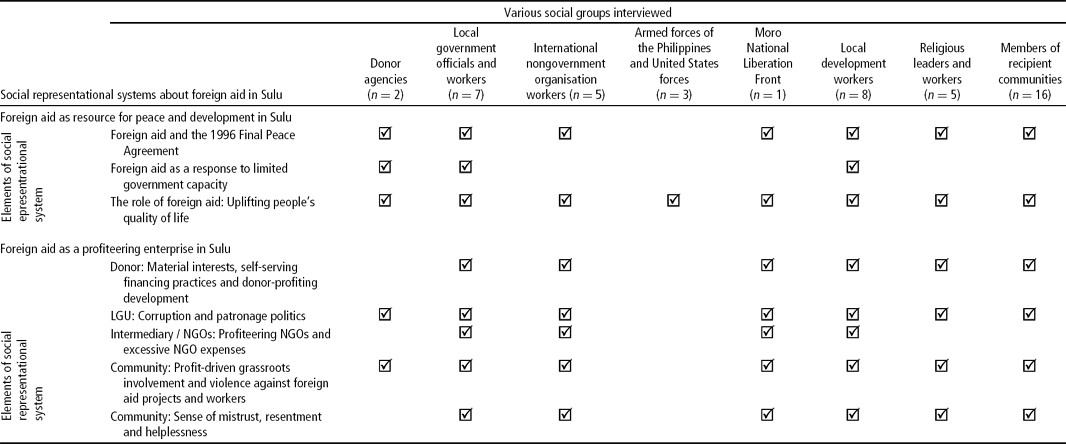
Table 1 also illustrates some interesting observations about the social representations of foreign aid according to various social groups implicated in aid practice in Sulu. First, all social groups highlighted the meaning of foreign aid in relation to its role in uplifting the people's quality of life. Thus, it appears that this particular representation constitutes the shared meaning of foreign aid across all social groups involved in aid practice in Sulu. Second, the Philippine and US military forces’ social representation of foreign aid in Sulu only highlighted its role in uplifting the quality of life of the people in Sulu. Thus, their narratives did not exhibit the social meanings of foreign aid as a profiteering enterprise in the province. Third, with the exception of representatives from the Philippine and US military, all social groups socially represented foreign aid in Sulu in relation to the 1996 Final Peace Agreement and to the practice of corruption and patronage politics in the administration of foreign aid in the province. Fourth, it is interesting to note that the narratives of participants from the local government as well as local development workers reflected the two social representational systems and all the representational elements within these two systems. Fifth, only participants from donor agencies, local government units and local development workers spoke of foreign aid as a response to the limited capacity of the government to provide for the needs of its constituents. Finally, it is also interesting to note the seeming absence of particular representational elements in the narratives of some social groups. Specifically, participants from donor agencies underlined the meanings of foreign aid in relation to its role as a resource for peace and development in Sulu but were mainly silent about the meanings of this social object as a profiteering enterprise, particularly on the issues of donor material interests, questionable financing practices, and donor-driven development.
Discussion
Exploring Meaning-Making in Aid Practice in Sulu, Southern Philippines
Participants’ narratives about foreign aid in Sulu revealed two social representational systems about this controversial social object. First, foreign aid was understood as a valuable resource for peace and development in the province of Sulu. This meaning system corresponds to the abstract and ideal representations of foreign aid articulated in participants’ accounts about its purported developmental goals in the region. It is the social representation of foreign aid espoused in international development discourse, one that highlighted communal interests for the benefit of the majority. However, as foreign-funded development projects came to be implemented in the province, another representational system about foreign aid took shape — one that surfaced its social meanings as a profiteering enterprise that operates at various levels of the aid hierarchy. Thus, foreign aid was seen as a means to earn money, a route to advance the economic interests of powerful groups, and an opportunity to access funds for the benefit of oneself, one's family, one's organisation or one's followers. It is this meaning system that stands for the hidden yet powerful narratives about material interests, power and wealth inequalities, corruption, profiteering, violence, and helplessness that permeate people's social knowledge about the goals of foreign aid projects, how these projects operate, what type of impact these projects have, and who ultimately benefits from these initiatives. Additionally, this meaning system also highlights subjective dimensions in aid practice, particularly reflected in feelings of mistrust, resentment and helplessness among community members. Manifested in aid practices undertaken by various social groups occupying different levels of the aid structure, it is this representational system that needs to be further examined to achieve a more grounded understanding of the meaning-making processes involved in foreign aid practice in poor and underdeveloped societies.
Psychological, Social and Political Consequences of the Social Representations of Foreign Aid as a Profiteering Enterprise
Psychological consequences of the social representations of foreign aid as a profiteering enterprise in Sulu were most articulated among grassroots communities, the social group at the lowest level of the aid structure in terms of material, political and institutional power. The narratives of local recipient communities about their everyday aid-related experiences highlight the development of cognitions, emotions and behaviors that reflect mistrust, resentment and helplessness among the members of this group. As powerful groups utilise foreign aid projects to gain profit at the expense of local communities, aid recipients may experience a sense of victimisation and exploitation. In turn, this may undermine people's sense of identity and agency and negatively impact on any meaningful involvement in future development initiatives. But how do we make sense of community practices, such as profit-driven participation in foreign aid projects and entrepreneurial violence against aid projects and workers? Such profiteering practices at the grassroots level may be explained as a reaction to more blatant and systemic profiteering practices at higher levels of the aid structure. Indeed, this reaction may be indicative of a diminished sense of identity and agency; local recipient communities may resort to self-interested and antisocial behaviors as they understand these as their only means of survival. However, the same reaction may be a re-assertion of identity and agency, as grassroots communities attempt to negotiate and improve their position in the aid structure and the benefits that they derive from this position. Nevertheless, in both ways, the achievement of developmental gains from foreign aid is adversely affected and conditions of poverty, violence and underdevelopment are reinforced.
The social consequences of this representation of foreign aid as a profiteering enterprise include aid-related behaviors and social practices that negatively impact on the ability of foreign-funded projects to achieve their developmental goals. First, this particular social representation may encourage the participation of different social groups in foreign aid initiatives but only as long as funding is available, which may present a serious challenge to the sustainability of foreign-funded development interventions. Second, this particular representation may also promote certain antisocial behaviors, as seen in entrepreneurial violence committed against foreign aid projects and workers. Finally, people's social knowledge about the utilisation of foreign aid to advance the material and political interests of specific social groups implicated in aid practice may sustain and reinforce the vicious cycle of profiteering and exploitation at different levels of the aid structure. As profiteering practices are regarded as the norm rather than the exception in aid initiatives, the credibility and legitimacy of foreign aid as a resource for peace and development are put into question. Thus, any initiative undertaken in relation to foreign aid may be met with scepticism, indifference or even opposition at different levels of the aid structure and thus may lead to failure in achieving development.
Lastly, political consequences of the social representation of foreign aid as a profiteering practice include the legitimisation of aid mechanisms, institutions, structures and processes that support the exploitation of foreign aid resources for the self-centred benefit of powerful groups involved in the practice of aid. In effect, as self-interest become more important than communal interests and as profiteering takes precedence over peace and development, this social representation serves to naturalise the existing unequal relationships among the different social groups in terms of power, authority and control over foreign aid resources — in the advancement of the self-serving interests of different social groups in the aid structure, in the asymmetrical nature of aid financing practices, in the corruption and patronage politics that permeates the administration of aid, and in the exploitation and helplessness experienced by those at the receiving end of aid. Indeed, this highlights the critical issue of how aid, which is aimed towards benefiting the poorest and most vulnerable sectors in society, is actually appropriated by powerful individuals and groups for themselves. In the process, the status quo is reinforced, structural transformation is inhibited, the vertical structure of aid is fossilised, and existing conditions of poverty, violence and underdevelopment are maintained.
Possible Spaces for Reflection, Critique and Transformation in Foreign Aid Practice
The present study showed that apart from the ideal and articulated representation of foreign aid as a valuable resource for peace and development, a related representational system may be observed in how the participants’ narratives surfaced the social meanings of foreign aid as a profiteering enterprise. In the process, research participants highlighted possible spaces for reflection, critique and transformation in foreign aid practice. For instance, the social meanings of foreign aid as a profiteering enterprise reflect a critique of current aid practices that lack relevance, transparency, accountability and sustainability. Based on this critique, various social groups, most especially project donors and implementers, need to ask critical questions about how foreign aid projects operate, how the benefits of these initiatives are distributed to different social actors, and how these efforts yield significant consequences on people's lives. To illustrate, we need to ask how involvement in aid projects may exploit rather than empower recipient communities as well as how existing frameworks, procedures and systems that operate in these projects may function to intensify rather than alleviate conditions of poverty, violence and underdevelopment in a poor society. More importantly, rather than treating the ‘profiteering’ representation of foreign aid as a shadow in development discourse, there may be a need to make this particular meaning system more manifest in order to effectively manage its psychological, social and political consequences as well as in view of crafting effective policies and strategies to transform the mechanisms, institutions, structures and procedures that produce, justify and reinforce this social representation.
To illustrate, this research suggests that bilateral and multilateral agencies operating in Sulu may need to review certain practices related to the financing, identification, design, implementation, and evaluation of development projects. This includes ensuring that genuine consultations are undertaken with various stakeholders involved in aid projects, that the financing practices of donors and implementers are made more socially just, and that projects are implemented in a manner that is transparent, sensitive, and accountable. Additionally, this involves ensuring that monitoring and evaluation procedures are carried out conscientiously even in the face of security threats, in view of deterring profiteering, corruption, and patronage politics in the administration of aid. Finally, the importance of building relationships with local recipient communities lies at the core of these reforms, in order to address subjective meanings of aid linked to mistrust, resentment and helplessness. These are very important issues that must be tackled if the goal is to manage the ‘profiteering’ representation of foreign aid and redirect attention to its ‘peace and development’ meaning.
On Reflexivity
We acknowledge our position as peace and development researchers and advocates and how this vantage point may have framed our reading and analysis of the data in this research. Moreover, we hold that alternative interpretations of the data are possible and that the present research only highlights one aspect of these meanings. In line with standards of reliability and validity in qualitative research (Creswell, 2003; Silverman, 2000), we constantly engaged the data through several rounds of reading, coding, and analysis. We also conducted consultations with local research partners to ensure the authenticity and meaningfulness of our research findings. Our hope is that our findings may contribute to calls for reforms in foreign aid practices not only in Sulu, Southern Philippines, but also in other societies experiencing poverty, violence and underdevelopment, in view of moving towards the achievement of the Millennium Development Goals.