






Abstract
Avalanches have caused injuries and deaths in mountain areas throughout history. We have examined the historical effects of avalanches on communities in the eastern Spanish Pyrenees. Surviving written records began in the year 1444 when an avalanche destroyed the village of Gessa. Many other avalanches since then have destroyed houses and other buildings and have caused injuries and deaths. In the 20th and 21st centuries, many villages evolved from agrarian areas to destinations for winter sports. The first known deaths during winter recreation likely occurred in 1930. Because of avalanche mitigation efforts, including relocating settlements, physical barriers, avalanche control measures, efforts to increase avalanche awareness, and avalanche warnings, avalanches now seldom affect inhabited areas in the eastern Spanish Pyrenees. Avalanche injuries and fatalities are now mainly limited to backcountry skiers and others traveling out of bounds near avalanche-controlled ski resorts.
Introduction
Avalanches have caused injuries and deaths throughout history. 1 As science and technology have evolved, many developed countries have taken steps to mitigate the effects of avalanches, especially in Europe over the last 100 y. Protecting the population against natural hazards became necessary because of increased human presence in mountain areas.
Historical Avalanches
The history of avalanches and the human toll they have taken in the eastern Spanish Pyrenees are not well known. Historical knowledge may be inaccurate or incomplete because it is based on transcriptions of stories and word-of-mouth reports that are often centuries old. The first recorded avalanche with consequences for the inhabitants of the eastern Spanish Pyrenees occurred during the winter of 1444. 2 -7 An avalanche struck the village of Gessa (1232 m) in the Val d’Aran in Catalonia, Spain. According to these ancient reports, the avalanche came from the mountain as a punishment from God. The amount of snow was enough to divert the natural course of the La Garona River. The village had to be rebuilt from scratch. Most of the inhabitants died, but it is not clear whether most of the deaths were a direct result of the avalanche or if they were caused by the massive destruction and the contemporaneous bubonic plague. Another giant avalanche destroyed half of Gessa on February 11, 1600. An unknown number of inhabitants perished. On the same day, another catastrophic avalanche occurred in the nearby village of Unha (1280 m). The entire village was destroyed. A group of 15 people had taken refuge in a house in a supposedly safe location in the village. Unfortunately, the avalanche swept away the house, killing the entire group.
The village of Gessa is threatened by several avalanche zones (Figures 1 and 2). 8 One of the largest avalanche zones is in “Pales de Corilha,” a large, grassy, steep, southeastern-facing slope, towering 900 m above the village. A second avalanche zone is the gully “Barranc de Corilha,” with several starting zones from which avalanches can coalesce to reach the village. The slopes of this gully are grassy and very steep and have eastern, southern, and western aspects. The current location of the village is much safer than the original location.
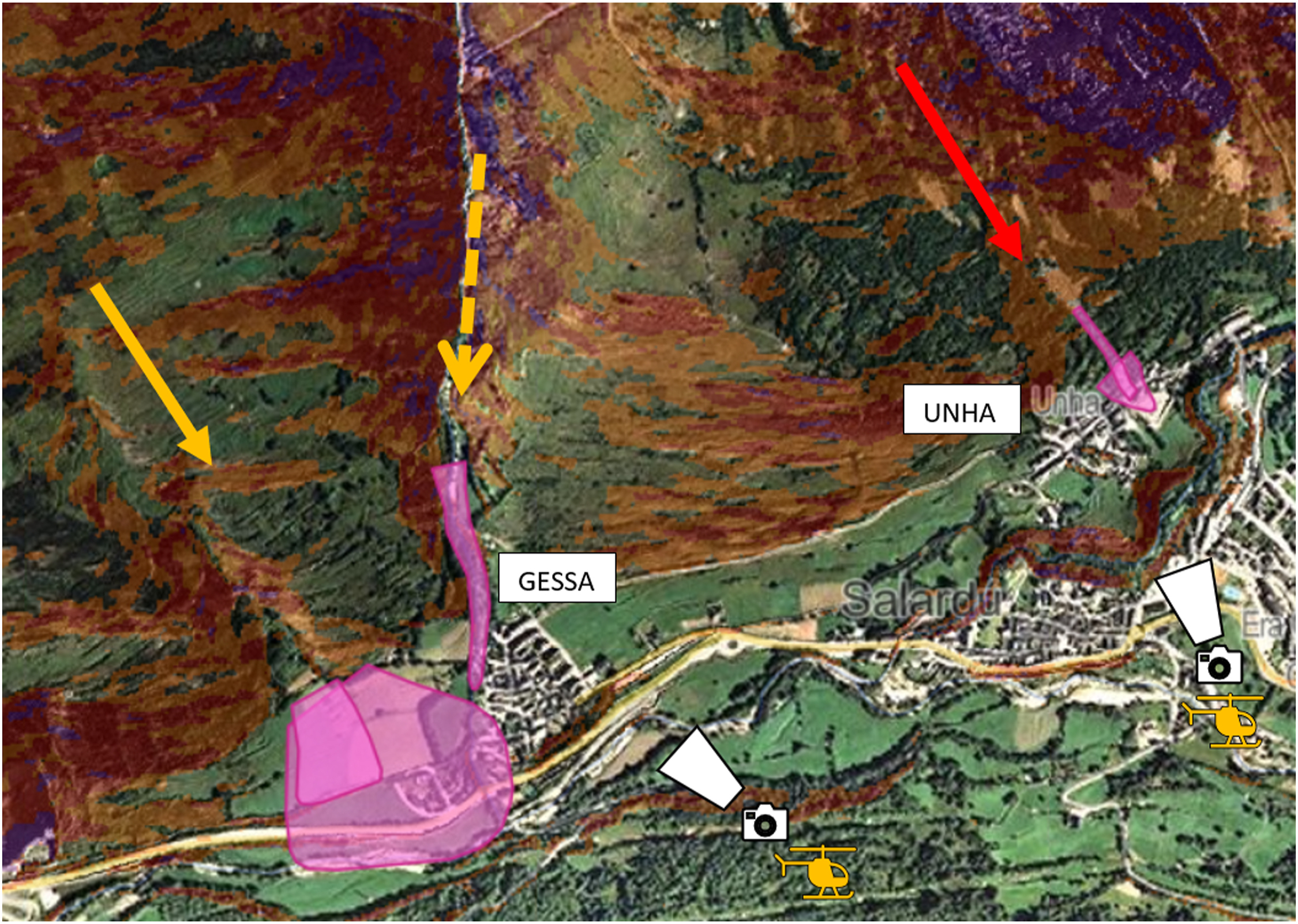
The map shows the most probable direction of the avalanches in the villages of Gessa and Unha. 9 Yellow arrows indicate the common avalanche paths affecting Gessa. The red arrow shows the avalanche path affecting Unha. The pink area shows the deposition zone of historical avalanches in Gessa. Symbols of helicopters with cameras show the locations and directions from which images were obtained (Figures 2 and 3).
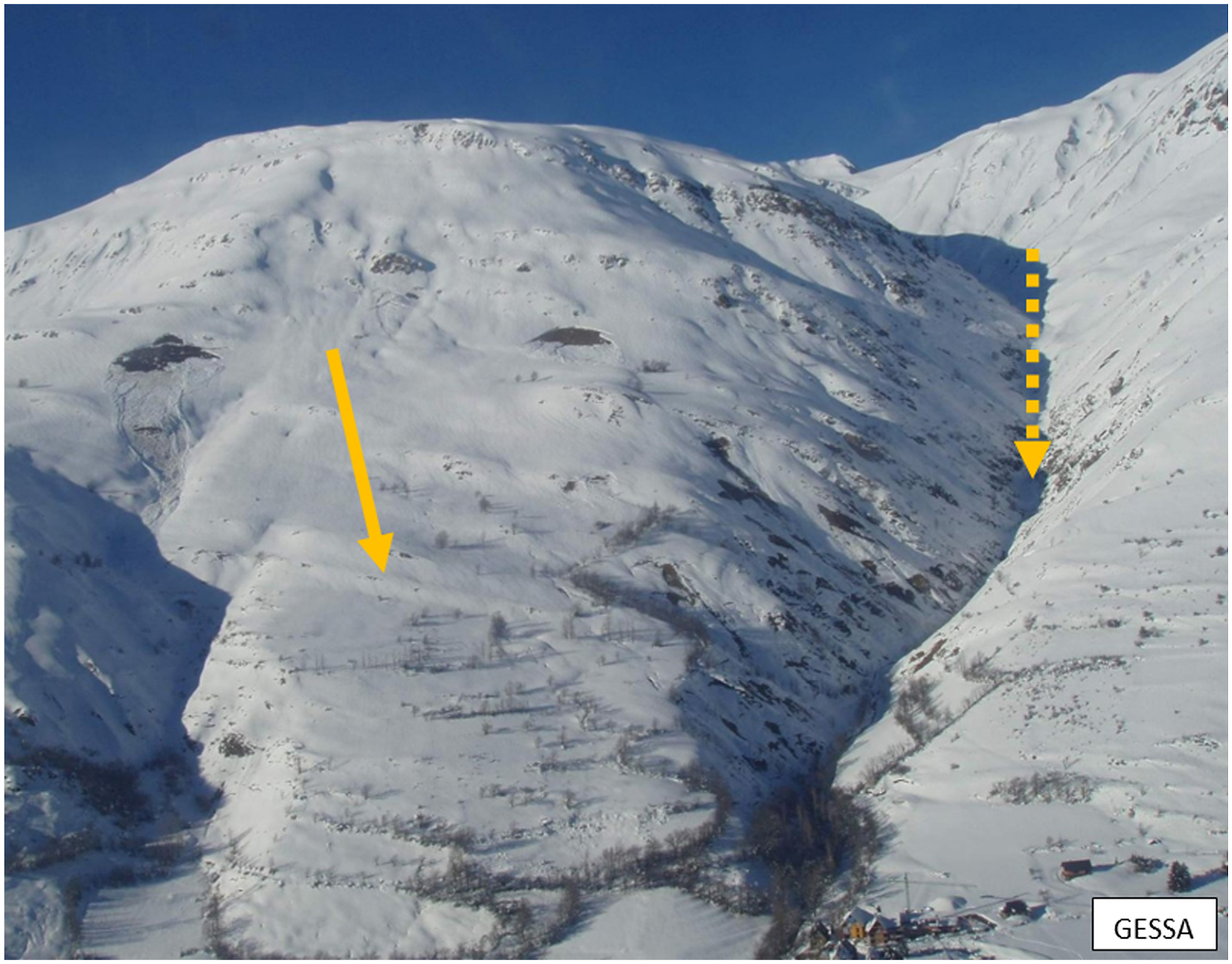
This aerial photo shows the slopes above the village of Gessa. The arrows mark the most common avalanche paths. The solid arrow indicates the “Pales de Corilha.” The dashed arrow indicates the “Barranc de Corilha.”
The avalanche zone above Unha is a large, very steep south-facing slope (Figures 1 and 3). Avalanches start just below the rocky peak “Poi d’Unha” 1000 m above Unha and the Garona River. Sometime before 1736, the village of Unha was hit by another massive avalanche. Most of the village was then moved to a small nearby hill, leaving only the village square in the main avalanche path. To increase forest cover and protect the village, logging was forbidden.
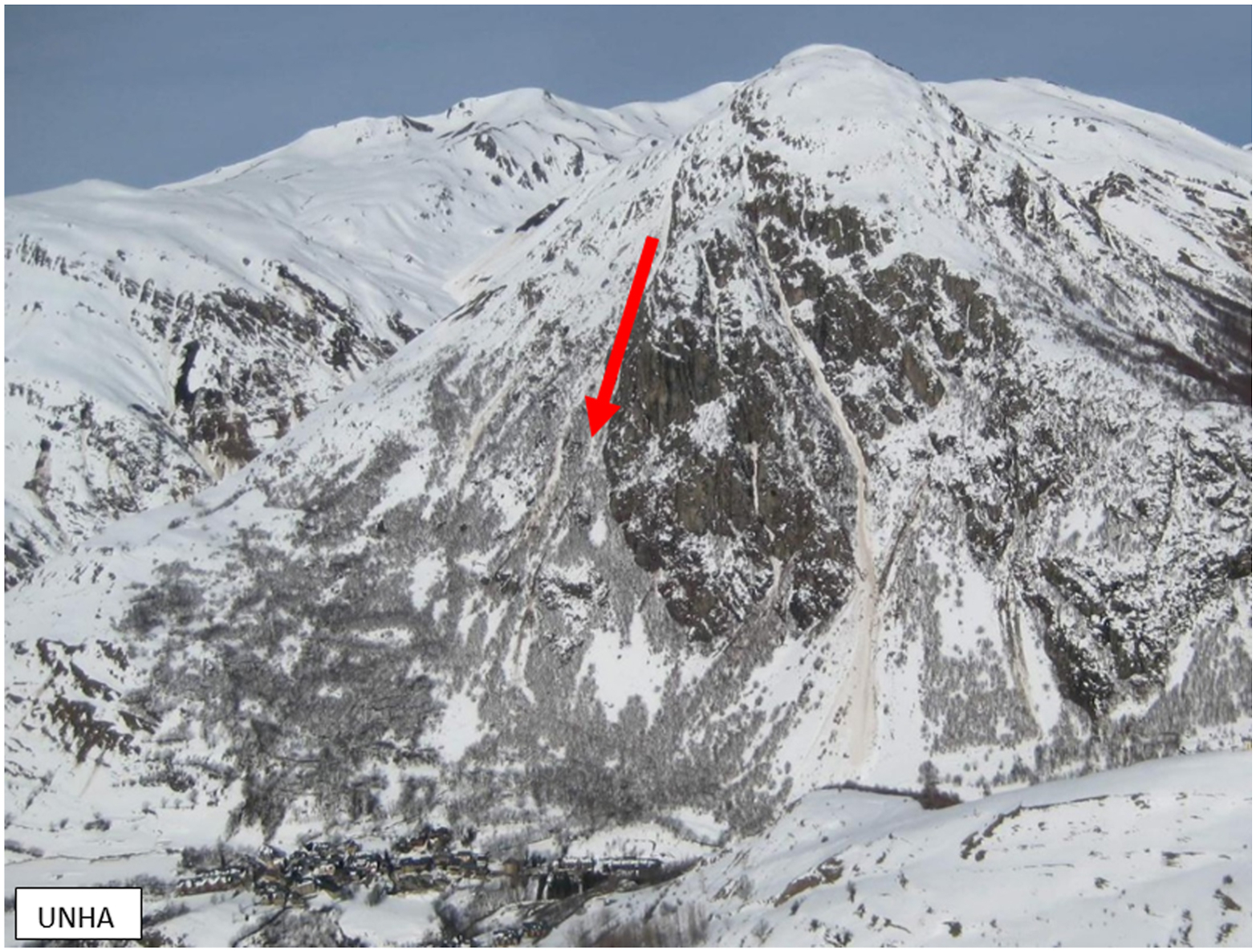
This aerial view shows the steep slopes above the village of Unha. The red arrow indicates the most common avalanche path.
Other avalanches affected these villages in the 20th century, between 1930 and 1950 and in 1963, without significant damage. The avalanche that caused the greatest number of deaths in the Pyrenees occurred in 1855 in Val de Toran, a secondary valley in the northwestern Aran valley. It destroyed as many as 58 houses and caused about 60 fatalities. 9
In the eastern Spanish Pyrenees, weather records including snow depth from automated weather stations are scarce. The oldest station is located in Ransol (1645 m), a village in Andorra, where records have been collected since 1934. Major avalanche cycles in modern times have been reconstructed or verified from written archives or photographs using both models and dendrochronological techniques.10,11 The major avalanche seasons during the last 40 y were 1971–72, 1995–96, and 2002–03. 10 Despite the dangers, the local population has benefited from avalanches over several centuries. After an avalanche impacts forested areas, wood is more easily available for the locals, avoiding the costs and risks of logging on mountain slopes. Avalanche paths also create meadows, facilitating hunting.
Twentieth- and 21st-Century Avalanches
The development of snow sports in the 20th century has modified the geography and economies of the mountain valleys in the Pyrenees. Many villages have evolved from agrarian areas to locations for winter sports and second homes. Unlike in the past, when interactions between people and snow were unavoidable, the paradigm has changed so that people are exposed to the greatest avalanche risks during winter sports.
As far as we know, the first death during winter sports in the eastern Spanish Pyrenees occurred on March 17, 1930. 12 -14 Two mountaineers set out that morning to climb Tossa d’Alp peak in La Cerdanya, Catalonia, Spain. One was English and the other was Italian. At about 1115 in the morning, they were surprised by an avalanche after reaching the top of the Torrent de Set-Fonts (Figure 4).
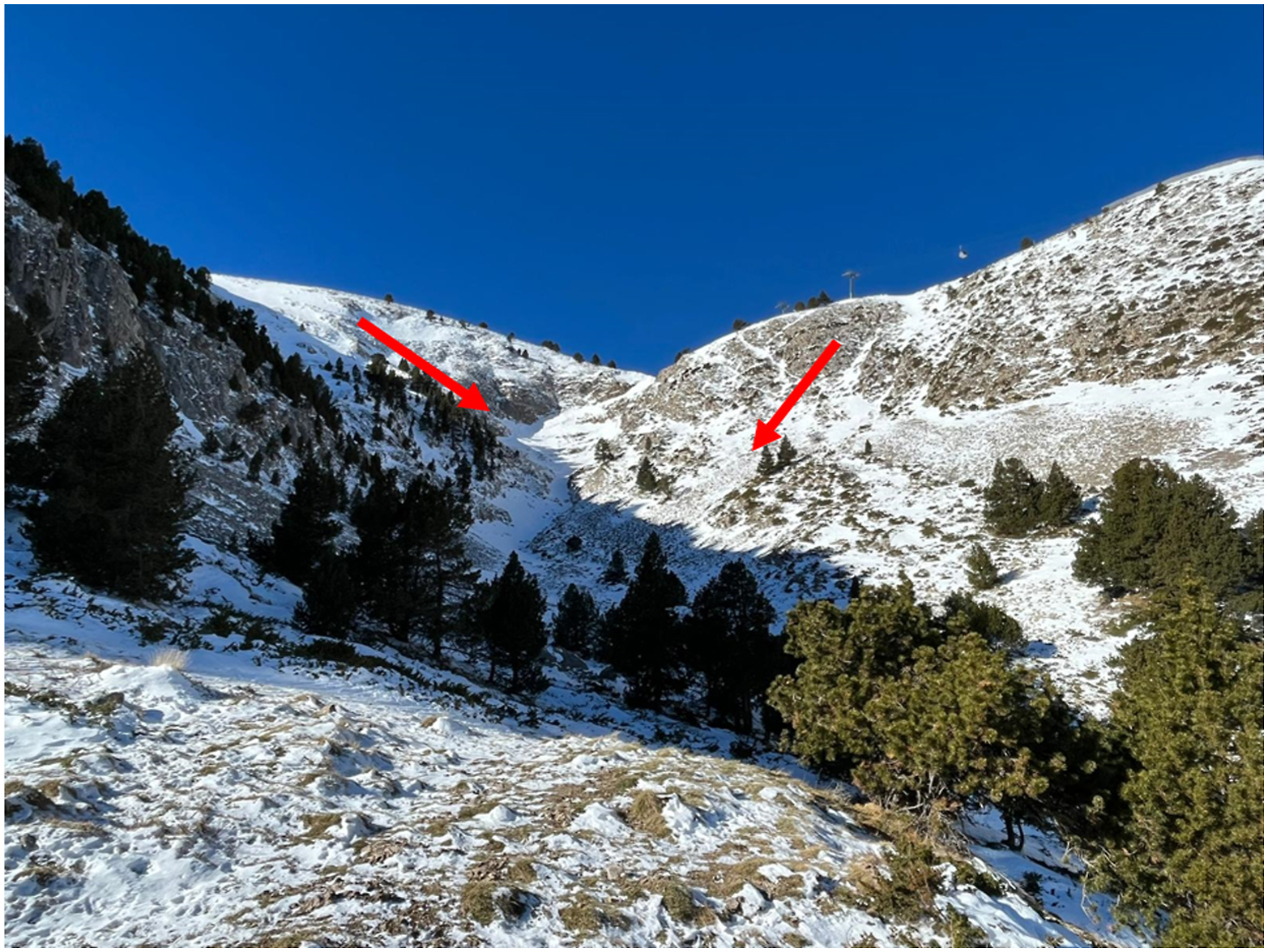
The photo shows Set-Fonts. The arrows indicate avalanche paths.
The avalanche carried them down about 200 m vertically. 7 The Torrent de Set-Fonts is an open bowl with several starting zones facing northeast to southeast and converging in a gully. Most avalanches recorded in the last 30 y in this area were triggered by skiers and released in an area at about 2225 m with an abrupt change of slope angle, where the steepest slope meets rocky ground. The Englishman survived unscathed and went for help after he was unable to find his comrade, who was buried in the avalanche. On descent, he encountered 5 other skiers, who accompanied him to the site of the slide to find the victim. The group arrived between 1500 and 1600 in the afternoon in difficult snow conditions with deep snow. They started the search immediately. In the meantime, a notice was sent to the nearest mountain hut, El Xalet de la Molina, about 2.5 h travel from the incident site. There, a team of 7 people with rescue gear and food was organized. By the time this team arrived, the first group had found the victim’s body in a state that precluded resuscitation. They moved the body to the village of Alp, where they buried the victim. 8 In 2003 and 2008, there were 2 more slides with injuries in the same avalanche path, with 1 fatality.
Modern Avalanche Epidemiology and Hazard Mitigation
Until the second half of the 20th century, in developed countries, avalanches mainly affected people in settlements and on roads. With the institution of preventive measures, the risk of avalanches dwindled in inhabited areas. Now, in developed countries, including Spain, most victims of avalanches are recreationists in unprotected and uncontrolled mountain areas. In the eastern Spanish Pyrenees, the number of avalanche victims has been relatively stable for the last 34 y at an average of 1.3 fatalities per year. 15 Fatalities are mainly caused by accidentally triggered slab avalanches. Men in the age range of 26 to 50 y (median 38, IQR 12) are the most frequent victims. March is the most common month for fatal avalanches. Most avalanche victims are backcountry skiers. The most common cause of death is asphyxia (57%), followed by trauma (33%) and hypothermia (10%). The most frequent anatomical location of trauma is the head. The median Injury Severity Score for trauma victims is 48. Only half of the victims carry avalanche transceivers. 16
Awareness of avalanche hazards has increased over the last several decades because of public service announcements, avalanche advisories, information on social networks, and signs at ski resorts that mark off-piste ski routes. Avalanche injuries and fatalities are now mainly limited to backcountry skiers and others traveling out of bounds near avalanche-controlled ski resorts. As in most areas worldwide, the majority of recreational avalanche fatalities in the eastern Pyrenees (70%) occur when avalanche danger is considerable (North American Avalanche Danger Scale level 3) but not high (level 4) or extreme (level 5). 15 Programs for preventing and forecasting avalanches have been developed in the eastern Spanish Pyrenees. The local network provides snow and weather monitoring, with remote sensing and construction of passive defensive structures. In 2003, an avalanche damaged a group of houses in the Aran valley, although there were no injuries or deaths. Since this incident, there have been additional improvements in avalanche forecasting and avalanche control to protect roads and settlements. Other measures that have been implemented are daily public avalanche danger bulletins, avalanche awareness training, and avalanche danger signs at ski resort boundaries.
Conclusion
A historical perspective on avalanches can help explain the current geography of the eastern Pyrenees. Preventive measures have evolved from word of mouth, stories about past hazards, local tales and myths, and churches with mystical protective properties built in historical avalanche paths to scientific programs developed specifically for avalanche prevention and protection from avalanche hazards. The Aran valley has been transformed from an isolated valley of mountain farmers to a tourist destination with a large ski resort. As is the case worldwide, climate change will likely produce further changes in avalanche hazards in the eastern Spanish Pyrenees. 17
Footnotes
Acknowledgments
We thank Dr Enric Subirats for supporting the local investigation, Centre de Lauegi d’Aran–Conselh Generau d’Aran for providing the helicopter statistics, and the Institut Cartogràfic i Geològic de Catalunya for providing maps and technical support.