






Abstract
Objective
The immediate medical management of buried avalanche victims will to some extent be dictated by the victim’s body positioning in the snow. Medical personnel are trained to assess and manage victims in a supine body position. Furthermore, avalanche first responders are trained to handle extricated avalanche victims carefully out of concerns for causing hemodynamic instability or for aggravating spinal injury. Thus, locating and extricating avalanche victims in positions other than supine has the potential to complicate immediate medical management. To our knowledge, the current medical literature does not detail the body positioning of buried victims.
Methods
In order to ascertain the most common body positioning of buried avalanche victims we reviewed the avalanche incident database of the Colorado Avalanche Information Center (CAIC). This comprehensive database strives to track over 160 fields of information for each avalanche victim, including the body and head positioning of buried victims.
Results
Head positioning was recorded for 159 buried victims. We found that 65% of buried avalanche victims were found with their heads in a downhill position, 23% with their heads uphill and 11% with their heads in the same level as the rest of their bodies. Body positioning was recorded in 253 victims. 45% of victims were found lying prone, 24% supine, 16% were sitting or standing and 15% were found lying on their sides. We identified 135 victims where both head and body position was registered. 40% of victims were found prone with their heads in a downhill position
Conclusions
The majority of victims will be extricated with their heads in a downhill position. Moreover, almost half of victims will be found prone. We believe this will have significant impact on the immediate medical management. We believe current training in avalanche medical rescue should emphasize managing victims in non-supine positions. Finally, our findings may represent another benefit of modern extrication techniques.
Keywords
Introduction
Buried avalanche victims experience a mortality rate of almost 50% where the vast majority die of asphyxia, trauma, and hypothermia. 1 The survival rate for buried victims drops precipitously the first half hour as the majority of victims succumb to asphyxia from having their upper airways or breathing obstructed by avalanche debris. After 35 minutes of complete avalanche burial, roughly 35% of victims remain alive.1,2 Survival beyond this initial “asphyxia phase” requires the presence of a patent away and the ability to ventilate.
Buried victims who survive the asphyxia phase succumb to gradually increasing hypercapnia, hypoxia, and hypothermia. 2 It follows that avalanche rescue is a desperate race as rescuers attempt to locate and extricate the victims within their time window of survival. Companion rescue, appropriate equipment as well as efficient extrication methods will improve outcomes by reducing search and extrication times. Buried victims are ideally located by immediate bystanders using a combination of visual estimation and avalanche transceivers, often followed by pinpointing their position using avalanche probes. Without functioning transceivers, victims may face prolonged burial times and may have to rely on extrication by organized avalanche rescue. 3 Medical management starts the moment the rescuers or clinicians gain access to the face and chest. Rescuers must immediately re-establish airway patency as well as restore oxygenation. Rescuers may face victims who are critically ill or in cardiac arrest and must also be prepared to manage a wide range of traumatic injury as well as hypothermia. 4
Consequently, the medical rescue of avalanche victims may involve a wide variety of interventions including airway management, providing basic or advanced life support, monitoring, cannulation, surgical interventions, and spinal immobilization as well as providing protection from environmental exposure. 4 How clinicians perform these interventions will to some extent be dictated by the victims body position upon extrication. Medical providers normally manage victims who are lying supine. In addition, medical scenario training is commonly performed with the mannequin or marker in a supine position. Thus, buried avalanche victims who are extricated in body positions other than supine may pose a challenge as they force care providers to perform potentially life-saving interventions working in ways they are not accustomed to nor frequently practice for. Obviously, some victims could simply be pulled out of the snow and turned supine to facilitate management. Unfortunately, that is often not the case. Settled avalanche debris is often of high density and of low compliance, sometimes described as of a concrete quality, meaning extrication efforts may be protracted, forcing clinicians to provide emergent medical management under awkward conditions for extended periods of time.5,6
To our knowledge, the current medical literature does not report on which body positions are common in buried avalanche victims. In order to address this, we performed a retrospective review of a large avalanche incident database that for some incidents provide information on the body positioning of buried avalanche victims.
Methods
In order to determine the body positions of buried avalanche victims we approached the Colorado Avalanche Information Centre (CAIC). CAIC is a program within the Colorado Department of Natural Resources tasked with providing avalanche forecasting and observations as well as promoting avalanche information and education. 7 The CAIC maintains databases of avalanche victims and accidents in the United States. The archive grew out of data compiled in the 1960s and 1970s by the US Forest Service and has been used by many researchers since. 8 –10 Data abstraction is carried out retrospectively by CAIC avalanche forecasters and relies on primary sources such as witness statements and reports from Search and Rescue organizations, coroners, and the US Forest Service. Most sources are public records, but these are often supplemented by additional data from interviews of victims, witnesses, or rescuers. The current database strives to track over 160 fields of information per avalanche victim, including the body and head positioning of buried victims.
In this database we identified data entries describing the characteristics of completely buried victims. Complete burial was defined as to occur when the victim was buried completely beneath the snow surface with no body part or attached equipment visible. We then further isolated the entries where body positioning was detailed in accordance with an established classification system. 9 The database describes head and body positioning. Head position was classified as uphill or downhill in relation to the rest of the body or as lying sideways with the head in the same level as the rest of the body. Body positions upon localization were classified as prone, supine, the victim lying on his/her side, or as sitting/standing.
Results
The database consists of data entries for 1989 avalanche victims from incidents occurring between April 1951 and March 2014. After excluding non- or partially buried victims as well as entries that did not state the degree of burial, we identified 1085 victims who had experienced complete burial. Twenty-nine percent of victims experienced avalanche burial in Colorado, 12% in Washington state, 12% in Alaska, 11% in Montana, and 10% in Utah, while the remaining 26% were buried in incidents in other states. Only 2 victims were recorded to have successfully deployed avalanche airbags, of which 1 experienced complete burial.
Head positioning was recorded for 159 buried victims. Sixty-five percent were found with their heads in a downhill position, 23% had their heads uphill, and 11% were found with their heads across the slope (Table 1). Mode of travel at avalanche impact was known for 114 of these victims. Eighty-two percent (n = 94) were skiers including backcountry, sidecountry, and inbounds skiers. The remainder were snowboarders (n = 8) and those travelling on foot (n = 9) or on snowshoes (n = 3). In order to better describe the most common type of avalanche victims, we charted the head positioning of skiers and found that 66% were found with their heads in a downhill position, 24% had their heads uphill, and 10% were found with their heads across slope (Table 1). We did not proceed to detail the other groups because there were too little data to produce a meaningful comparison.
Head positioning of buried avalanche victims
Body positioning was recorded in 253 victims. Forty-five percent were found face down in a prone position, 24% were supine, 16% were sitting, and 15% were found lying on their sides. Mode of travel was recorded in 173 patients, of which 83% (n = 143) were skiers (Table 2). Finally, we identified 135 victims where both head and body position was registered. Forty percent (n = 54) of victims were found prone with their heads in a downhill position (Table 3).
Body positioning of buried avalanche victims
Combined head and body positioning of 135 buried avalanche victims
Discussion
Our limited data sample indicates that 65% of victims are found with their heads in a downhill position. Furthermore, roughly 45% of victims will be found in a prone position. Of the 12 possible combinations of head and body positioning, victims found prone with their heads downhill stood out as the dominant combination, accounting for 40% of victims where both head and body position was recorded.
Immediate management will depend on what part of the body is accessed first. Unfortunately, our data sample does not record this. One could, however, approach this with reference to common extrication techniques. After locating the victim with an avalanche probe, untrained rescuers tend to dig straight down along the probe line, creating an almost vertical and cone-shaped hole expanding toward the victim. Such nonsystematic digging has been proven to be inexpedient. Clearing snow out of a vertical hole involves lifting the snow out of the hole, and as snow tends to collapse or fall back, this technique becomes even more ineffective. Furthermore, as rescuers get closer to the victim they risk standing on the victim, which could compromise the victim’s air pocket, airway, or breathing and could aggravate traumatic injuries. When access is finally achieved, a small diameter vertical access hole often makes extrication and management of the victim difficult or even impossible.
To address these shortcomings, novel extrication techniques have been developed. 11 These techniques, collectively known as “strategic shoveling techniques,” emphasize that digging should start somewhat downhill of the patient and then to dig laterally toward the victim. This way, snow is removed downhill, reducing rescuer fatigue and rescuers avoid standing on the victim. In field tests, modern strategic digging techniques, such as Manuel Genswein’s widely taught “V-shaped conveyor belt,” have proven to achieve extrication significantly faster than unstructured digging. 12 Thus, if the majority of victims are positioned with their heads in a downhill position, rescuers digging laterally toward the victim from downhill will, in the majority of cases, access the victim’s head and thorax before the rest of the body. One could argue that this is another benefit of modern digging strategies. It is not only the most efficient and safest way to access victims, in the majority of cases the head and chest will be extricated first and the all-important management of airways and ventilation can be initiated before complete extrication (Figure 1).
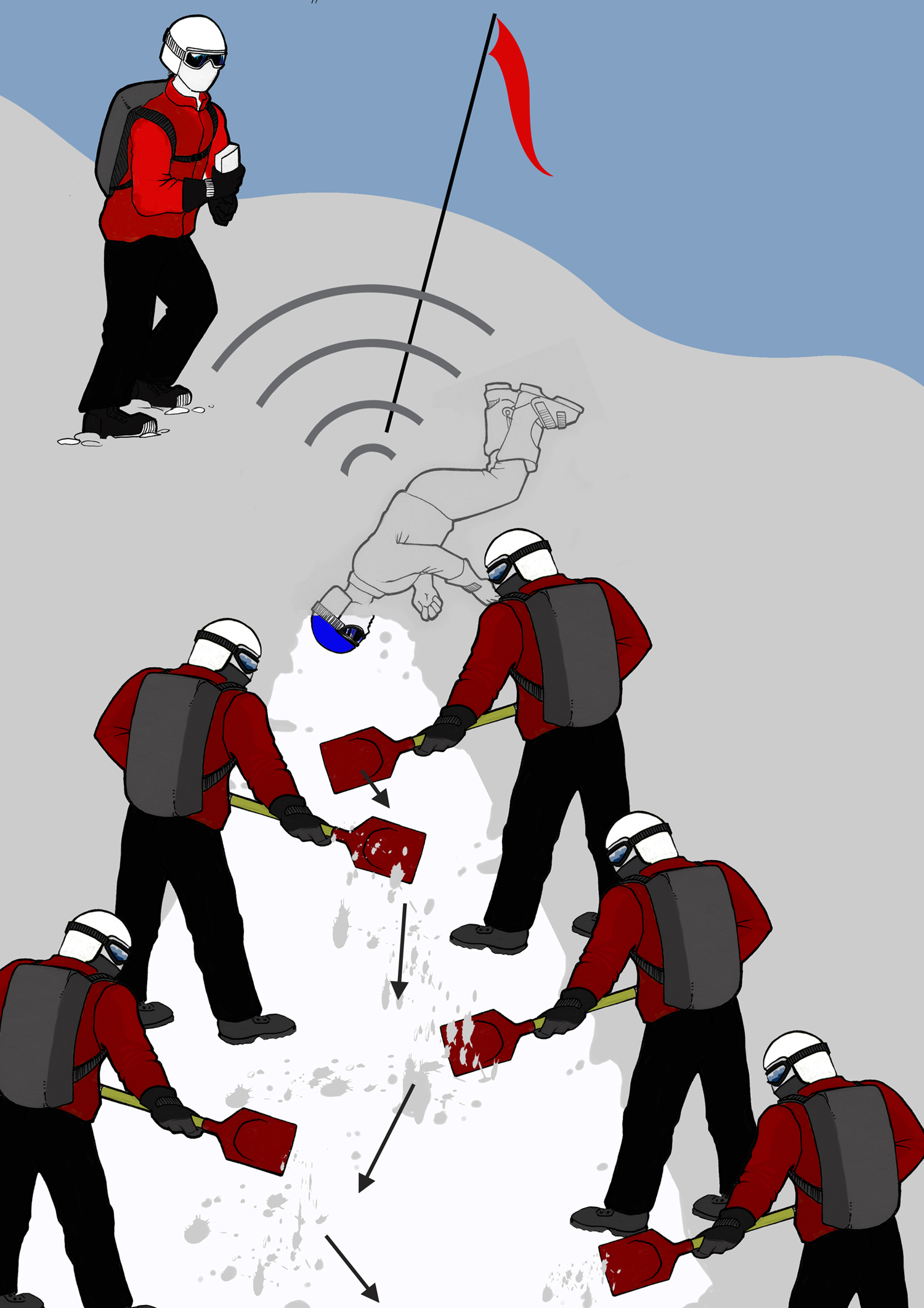
Modern digging techniques such as the V-shaped conveyor belt method emphasize starting to dig somewhat downhill and then laterally toward the victim. If the majority of victims are positioned with their heads in a downhill position then the rescuers will be digging toward the head and thorax. Thus, airway management, monitoring and other medical treatment could start with complete extrication still ongoing.
According to our results, immediate medical management will be initiated in nonsupine body positions for the majority of patients. In the unresponsive patient with an occluded or obstructed airway or who is hypoventilating, establishing airway patency and oxygenation is of immediate concern, starting the moment the rescuers gain access to the face and upper airway. If the victim cannot readily be extricated, clinicians may have to clear the airway, provide basic or advanced airway management, and provide oxygen in a victim who is prone, lying on his side, or who is sitting or standing. Although advanced airway management occasionally is performed in alternative patient body positions, it is uncommon and is associated with increased difficulty.13,14 Other specific life-saving interventions may be also be made complicated by body positioning other than supine. Hypothermic avalanche victims are prone to experience circulatory collapse secondary to arrhythmia or cardiac failure that may be triggered by mechanical stimuli such as extrication and evacuation. 15 An attempt at turning the patient supine to facilitate management could be sufficient to trigger collapse. Cardiac arrest in buried avalanche victims is associated with extremely poor outcomes. 16 Despite that, and despite being of a lower priority than achieving oxygenation, chest compressions should be initiated. 4 To provide chest compressions effectively, the majority of victims will have to be turned over on their back. If this requires further extrication, it may preclude effective cardiopulmonary resuscitation. The incidence of spinal injury in avalanche victims is low. 17 Nevertheless, current guidelines emphasize maintaining spinal precautions throughout extrication as well as during evacuation. 4 In victims who have to be turned or otherwise moved to be able to provide treatment or evacuation, we risk causing further spinal injury.
Our study comes with several limitations and should be interpreted carefully. Our review is of a retrospective nature. Although the database is fairly comprehensive, there are considerable amounts of missing data, and our sample of victims where body positioning was recorded is small. Our data is collected over a time period of more than 60 years. During that time, equipment, types of activity, awareness, forecasting and rescue strategies, among other factors, have changed dramatically. For example, the database identifies only 2 victims who successfully deployed avalanche airbags, of which 1 was completely buried. As our sample includes incidents from many decades before avalanche airbags entered mainstream use, our sample may not accurately represent the current situation.
Conclusions
Our limited data sample suggests that the majority of buried avalanche victims (65%) will be found with their heads in a downhill position. Moreover, almost half of buried avalanche victims (45%) will, upon extrication, be found in a prone position. We believe this will have significant impact on the immediate medical management. We believe current training in avalanche rescue should prepare rescuers for the eventuality of having to manage victims in nonsupine positions. Finally, we suggest this may be another benefit of modern avalanche extrication techniques. As these emphasize digging towards the victim from a somewhat downhill position, in the majority of cases the victim’s head and thorax will be accessed before the rest of the body.