






Abstract
Mushroom poisoning is increasing worldwide, as well as the incidence of fatal mushroom poisoning. Several new syndromes associated with mushroom poisoning have been described in the literature. Notably, 1 of the newly identified mushroom poisonings is Russula subnigricans poisoning. R subnigricans can be classified as causing a delayed-onset rhabdomyolytic syndrome as patients with this severe poisoning present with severe rhabdomyolysis, acute kidney injury, and cardiomyopathy. However, there are only a few reports on the toxicity of R subnigricans. We recently treated 6 patients with R subnigricans mushroom poisoning, of whom 2 died. The 2 patients showed severe rhabdomyolysis, metabolic acidosis, acute renal failure, electrolyte imbalance, and irreversible shock, which caused their deaths. Mushroom poisoning should be considered in the evaluation of rhabdomyolysis of unknown origin. In addition, in cases of mushroom poisoning with severe rhabdomyolysis, R subnigricans poisoning should be promptly identified.
Introduction
Although >2000 species of mushrooms are safe to consume, there are also many poisonous mushrooms in the wild. Because there are no easily recognizable differences between edible and toxic mushrooms, amateur mushroom foragers commonly confuse toxic mushrooms with edible ones.1,2
Most mushroom poisoning cases have benign outcomes, but the proportion of fatal mushroom poisoning cases also seems to be increasing. 3 -5 Since the 1990s, several toxic mushroom species have been reported, and new mushroom syndromes have been recently described.3,6,7
Among these syndromes, Russula subnigricans poisoning can be classified as a delayed-onset rhabdomyolytic syndrome. R subnigricans is mainly found in East Asia and was first found in Japan in 1955. 8 This mushroom toxidrome is characterized by subacute myopathy with subsequent rhabdomyolysis. 9 Although the clinical manifestations vary, most cases present with rhabdomyolysis, and there have been a few cases of death due to R subnigricans poisoning.
Herein, we report 2 cases of mortality associated with R subnigricans poisoning. We recently treated 6 patients with R subnigricans mushroom poisoning; 2 of these patients tragically died.
Case Report
Patient 1
A 63-y-old man presented to the emergency department (ED) with complaints of nausea, vomiting, and dyspnea that lasted for 6 h. He usually consumed wild mushrooms; 8 h before his presentation, he had a dinner containing wild mushrooms. These mushrooms were collected from the forest of Yangsan-si (Gyeongsannam-do, Republic of Korea) in August 2021 (coordinates: 35° N, 128° E). The patient was healthy prior to admission. He had no history of trauma, infection, or other known underlying diseases and was not taking any medications. His vital signs were normal. The most significantly abnormal results were elevated creatine kinase (CK; 2441 U/L) and myoglobin levels (>3909 ng/mL), indicative of rhabdomyolysis; his chest x-ray results were also normal (Table 1).
Laboratory findings of Patient 1
CK-MB, creatine kinase-myoglobin binding; HCO3, bicarbonate; IU, international unit.
The patient’s consciousness deteriorated gradually, and arterial blood gas analysis performed 5 h later showed severe acidosis. Therefore, the patient was intubated and provided with mechanical ventilator support. However, follow-up laboratory investigations revealed severe rhabdomyolysis and acute kidney injury (AKI) (Table 1). However, electrocardiography and bedside echocardiography findings were normal (ejection fraction [EF], 50%). He underwent continuous venovenous hemodiafiltration (CRRT) due to severe rhabdomyolysis, acidosis, and AKI. Despite CRRT and ventilator support, the metabolic acidosis and rhabdomyolysis did not resolve; his blood pressure decreased gradually even though we administered intravenous fluids and inotropes 29 h after mushroom ingestion (Table 1). Eventually, he died 53 h after ingestion.
The remaining mushroom sample (Figure 1) was sent to the Forensic Toxicology Department of the National Forensic Service, Wonju-si, Gangwon-do, Korea. This sample was from the mushrooms picked by the patient and was brought to us on the day of consumption. The mushrooms were identified as R subnigricans based on gross morphology and cyclopropylacetyl-(R)-carnitine, an indicator component of R subnigricans.
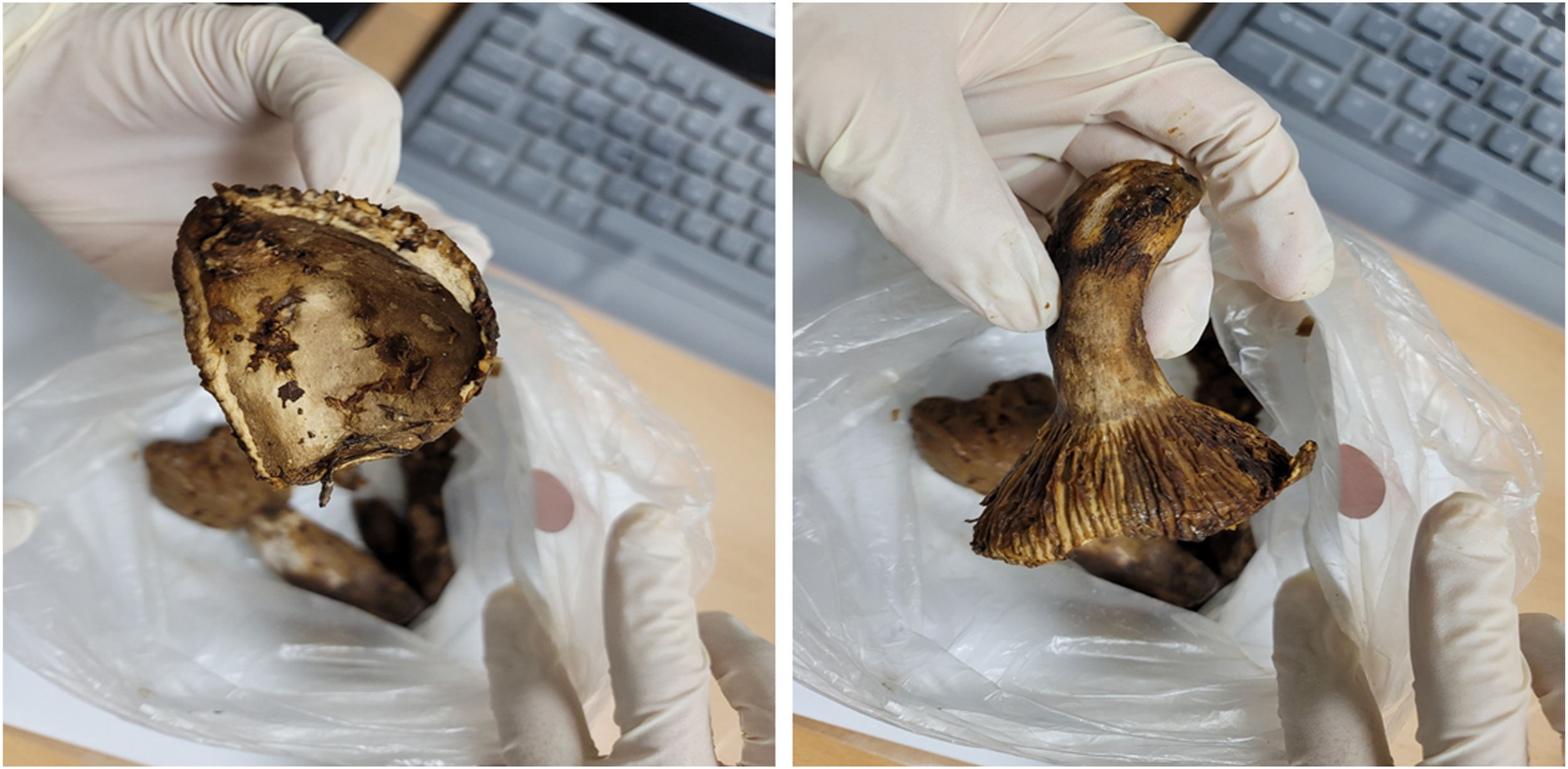
A sample of Russula subnigricans ingested by the patients.
Patient 2
A 70-y-old man presented to the ED with nausea and abdominal discomfort 2 d after Patient 1’s visit. At that time, Patient 2 did not report mushroom intake, and there were no specific findings other than a slight increase in the levels of aspartate aminotransferase and alanine aminotransferase (147 and 52 IU/L, respectively). The patient underwent hepatic resection for hepatocellular carcinoma 12 y ago. Cancer recurred 2 y ago, and he followed up every 3 mo after transarterial chemoembolization; his symptoms improved, and he was discharged.
The next day, he returned to the ED after hearing that Patient 1 (with whom he had eaten the wild mushrooms) had died. On admission, he complained of diarrhea, vomiting, dyspnea, and general weakness. His vital signs were as follows: blood pressure, 110/80 mm Hg; pulse rate, 110 beats/min; respiratory rate, 25 breaths/min; oxygen saturation, 92%. The most significantly abnormal results were as follows: CK, 32,399 U/L; creatine kinase-myoglobin binding, >600 ng/mL; high-sensitivity troponin I, 3615.61 pg/mL; myoglobin >20,000 ng/mL; brain natriuretic peptide, 1671 pg/mL (Table 2). The tests revealed rhabdomyolysis. Electrocardiography revealed sinus tachycardia, and chest radiography revealed cardiomegaly with mild pulmonary edema. Particularly, severe systolic dysfunction (EF<30%) of the left ventricle and akinesia of the mid-to-apex wall of the left ventricle (suggesting stress-induced cardiomyopathy [SICMP]) were noted using bedside echocardiography. His consciousness, oxygen saturation, and blood pressure deteriorated gradually. Oliguria was noted, with no response to intravenous fluid or furosemide. As a result, he was placed on ventilator support and received CRRT and inotrope infusion. Six days after the ingestion of the mushrooms (ie, 3 d after admission), on follow-up echocardiography, EF improved slightly but was <40%. In addition, severe rhabdomyolysis, hypocalcemia, metabolic acidosis, and unresolved SICMP were observed (Table 2). Eventually, he died of cardiogenic shock 6 d after ingesting the mushrooms.
Laboratory findings of Patient 2
CK-MB, creatine kinase-myoglobin binding; HCO3, bicarbonate; IU, international unit.
Discussion
Picking and eating wild, uncultivated, or foraged mushrooms have become popular in recent years.4,5
Several new syndromes of mushroom poisoning have been described since the early 1990s.3,9 However, another novel type of poisoning, not covered by the syndromes listed, has been identified in recent years. 10 Furthermore, the demarcation between edible and inedible mushrooms is obscure; while cultivated species have potential health benefits, they may also contain toxic compounds.11,19 This emphasizes the inherent serious risk of wild mushroom foraging.
Russula spp are found worldwide, and in particular, Russula eccentric, Russula nigricans, and R subnigricans have been spotted during summer and fall in Korea. 12 Poisonous R subnigricans can be mistaken for nonpoisonous, edible R eccentric and R nigricans. 13
Several case series of R subnigricans poisoning, with rhabdomyolysis, have been reported in China, Japan, and Korea.8,14,15 Typical symptoms of R subnigricans poisoning include vomiting and diarrhea, followed by rhabdomyolysis. In most severe cases, patients present with rhabdomyolysis, severe electrolyte disturbances (hyperkalemia and hypocalcemia), respiratory failure, AKI, cardiomyopathy, and circulatory shock.
In the present report, Patient 1 developed symptoms 2 h after ingestion of R subnigricans. The laboratory tests conducted on him after admission (8 h after ingestion) revealed that he had rhabdomyolysis. As the rhabdomyolysis worsened, AKI, metabolic acidosis, and cardiomyopathy occurred, leading to his death. The initial EF was normal on bedside echocardiography, but based on the clinical features and elevated troponin levels, cardiogenic shock induced by SICMP may have been present. It is worth noting that the clinical course of Patient 1 progressed faster than that of R subnigricans poisoning.
However, Patient 2 showed the delayed-onset rhabdomyolytic syndrome typical of R subnigricans poisoning. He complained of symptoms 3 d after ingestion, and rhabdomyolysis started to develop on the fourth day after ingestion. Bedside echocardiogram on admission (fourth day after ingestion) revealed a low EF (approximately 20%) and a finding indicative of SICMP. However, as the rhabdomyolysis did not resolve, AKI, metabolic acidosis, hypocalcemia, and cardiomyopathy occurred, leading to his death. Considering the clinical features of Patient 2, if echocardiography had been performed for Patient 1 on the second and third days of admission, we believed that the findings indicative of SICMP would have been shown. The symptoms of mushroom poisoning depend on the toxin content of the mushroom, age of the poisoned patients, intake amount, and repeated consumption.11,16 The differences in the clinical features between the 2 patients may be attributed to the consumption amount and repeated consumption. The hepatic resection performed on Patient 2 may have affected the metabolism of putative toxins and clinical features.
Elevated cardiac troponin I levels are common in rhabdomyolysis. Even though the exact mechanism has not been elucidated, free radicals, cytokines, cardiotoxicity due to ion fluxes, hypotension, etc., can cause microdamage to the myocardium, and direct myocardial damage by mycotoxins is also possible. 17
Recently, cycloprop-2-ene carboxylic acid was isolated and identified as the fatal toxin in R subnigricans.16,18 However, this compound is unstable for detection, and cyclopropylacetyl-(R)-carnitine can be used instead as the unique chemical marker for identifying R subnigricans. In our case, we sent a picture of the mushrooms eaten by the patient to a mycologist via a mobile phone, who immediately identified the mushrooms as R subnigricans. Later, we identified cyclopropylacetyl-(R)-carnitine in the mushroom sample.
Conclusions
Mushroom poisoning should be considered in the evaluation of rhabdomyolysis of unknown etiology. In cases of mushroom poisoning with severe rhabdomyolysis, R subnigricans poisoning should be promptly identified. However, as various mushroom species cause toxicity, it is difficult to diagnose and treat patients with mushroom poisoning in the ED. 11 Therefore, a sample and photo of ingested mushrooms along with samples of the patient’s blood and urine should be sent to mycologists for accurate diagnosis and identification of mushrooms.
Footnotes
Acknowledgements
Author Contributions: All authors made substantial contributions to the acquisition, analysis, or interpretation of data for the work. All authors have read and approved the final version of the submitted manuscripts.
Financial/Material Support: This study was supported by a 2023 research grant from Pusun National University Yangsan Hospital.
Disclosures: None.