






Abstract
Introduction
Search and rescue (SAR) is vital for visitor safety in US national parks, which are popular destinations for tourists. Previous studies have described SAR and seasonal visitation patterns, but not in the context of overall visitation. In addition, studies on the association between SAR and developed park areas remain limited. Concurrently, social media can be valuable for sharing information about conservation awareness and the joy of being outdoors. However, social media can potentially be an avenue for users to share risky and dangerous behaviors performed during attempts to obtain photos and videos. The associations between SAR and social media have not been discussed in existing literature.
Methods
Variables included recreational visits, developed site stay visits, backcountry visits, SAR incidents, and tweets. Data from 2017 were obtained from National Park Service visitor use statistics, the SAR incident dashboard, and the University of California, Irvine, Cloudberry application. Correlation analysis was performed using nonparametric Kendall rank correlation coefficients.
Results
Recreational visits were correlated with SAR incidents (rτ=0.415, P<0.001). Developed site stays were similarly correlated with SAR incidents (rτ=0.447, P<0.001), as were backcountry visits (rτ=0.428, P<0.001). Backcountry visits had a stronger correlation with fatalities (rτ=0.380, P<0.001) compared to developed site stays (rτ=0.304, P<0.001). Tweets were correlated with SAR incidents (rτ=0.468, P<0.001), recreational visits (rτ=0.403, P<0.001), and fatalities (rτ=0.367, P<0.001).
Conclusions
Our findings demonstrate associations between national park visitation, SAR incidents, fatalities, and Twitter use and provides a concept framework for future prospective studies to further investigate the relationships between visitation, SAR, and social media.
Introduction
Search and rescue (SAR) in US national parks is vital for visitor safety. Public safety in national parks is subject to a changing visitation landscape, with the National Park Service reporting over 300,000,000 visits to parks every year since 2015 (National Park Service, 2020). SAR and seasonal visitation patterns have been previously studied, but associations between SAR and overall park visitation remain limited. 1 -4 In addition, few studies discuss the associations between SAR and developed park areas.5,6
At a time of marked national park popularity, social media use has become a common avenue for sharing outdoor experiences. Associations between social media posts and visitation to public lands have been well documented. 7 -10 In contrast, the literature surrounding social media use and public safety in national parks is limited, although there have been many reports of outdoor injuries related to social media, such as falls from cliffs while taking selfies.11,12 We sought to research the associations between national park visitation, accessibility, SAR incidents, and social media use. Our study used Twitter, a social media platform that enables users to share their experiences through 280-character “tweets” with attached photos and videos, to investigate the associations between social media and public safety in national parks. We hypothesized that recreational visits are associated with SAR incidents, developed site stays are more strongly associated with SAR incidents compared to backcountry visits, backcountry visits are more strongly associated with fatalities than are developed site stays, and tweets are associated with SAR incidents.
Methods
Our study was considered exempt research by the University of California, Irvine institutional review board given that it does not involve human subjects research. For simplicity, the term “national park” in our study includes all individual units managed by the US National Park Service, including national parks, recreation areas, seashores, and lakeshores. Visitation data were obtained from the National Park Service visitor use database using the query builder for public use statistics tool. Search variables included 2017 calendar year recreational visits, concessioner lodging, concessioner camping, tent campers, recreational vehicle campers, and backcountry campers. Backcountry is defined as primitive or wilderness areas that are reached primarily by hiking, boating, or horseback. Developed site stays in our study are defined as the sum of tent campers, recreational vehicle campers, concessioner lodging, and concessioner camping. We made the assumption that developed site stays occurred in more easily reached areas of parks, and backcountry visits occurred in more remote areas.
SAR data were obtained from the US National Park Service SAR Incidents 2017 Dashboard, which provided a comma-separated-value dataset that includes reporting national park units compiled by the law enforcement, security, and emergency services department of the National Park Service. Our study used the number of SAR incidents and fatalities from this dataset. Our inclusion criteria required a park to have a sum of total dollars spent for SAR operations, SAR hours, and SAR costs greater than 0. The assumption was made that parks with 0 SAR costs, 0 operational hours, and 0 SAR incidents did not have their own dedicated SAR unit; these were excluded in the study. Of the 176 national park units included in the SAR dataset, 127 met the inclusion criteria for our study. Four of those parks included did not report fatalities and were excluded from the fatality analysis.
Twitter data were compiled on October 11, 2020 from the University of California, Irvine, department of information and computer sciences Cloudberry application, which collects Twitter post counts based on keyword, hashtag, and geographic data. For 99 parks, the keyword used was the official name of the national park unit, excluding the “national” unit (eg, “Yosemite” and “Grand Canyon” vs. Yosemite National Park and Grand Canyon National Park), which yielded an application-generated list of related keywords that were included in the total tweet count. For the remaining 28 parks, we made the decision to retain the full name of the park because excluding the national park appendage would yield too broad a search term (eg, “Glacier National Park” was searched instead of “Glacier”). The parks that retained the national park unit designation in the search query are listed in Table 1. Tweets were included from January 1, 2017 through December 31, 2017 in the United States.
Selected national park units that retained the “national park” appendage for Twitter search keywords
Independent variables were recreational visits, developed site stays, backcountry visits, and tweets. Dependent variables were SAR incidents and fatalities. Because the data were not normally distributed, the associations were analyzed using the Kendall tau correlation coefficient. A correlation was considered statistically significant if P<0.05. Kendall tau value interpretations were defined as the following: 0 to 0.10 suggests a weak correlation, 0.11 to 0.30 suggests a weak to moderate correlation, 0.31 to 0.49 suggests a moderate to strong correlation, and 0.50 or higher suggests a strong correlation. SPSS Statistics version 26 (IBM SPSS Statistics for Windows, Version 26.0. Armonk, NY) was used for the analysis.
Results
We analyzed the correlations between 180,216,375 recreational visits, 10,452,835 developed site stays, 1,956,935 backcountry visits, 183,744 tweets, 3,433 SAR incidents, and 181 fatalities that occurred in national parks during 2017. Recreational visits were correlated with SAR incidents (rτ=0.415, P<0.001). Developed site stays and backcountry visits both were correlated with SAR incidents (rτ=0.447, P<0.001 and rτ=0.428, P<0.001, respectively). Backcountry visits had a stronger correlation with fatalities than did developed site stays (rτ=0.380, P<0.001 vs rτ=0.304, P<0.001). Tweets were correlated with SAR incidents (rτ=0.468, P<0.001), recreational visits (rτ=0.403, P<0.001), and fatalities (rτ=0.367, P<0.001) (Table 2).
Correlations of recreational visits, developed site stays, backcountry visits, and tweets with search and rescue incidents and fatalities
SAR, search and rescue; rτ, Kendall’s tau correlation coefficient.
Discussion
Our large database study found that recreational visits, developed site stays, and backcountry visits were correlated with SAR incidents and fatalities. In addition, developed site stays and backcountry visits had a similar correlation strength with SAR incidents. However, backcountry visits had a stronger correlation with fatalities than did developed site stays. Lastly, we found that tweets were correlated with SAR incidents, recreational visits, and fatalities.
There was a moderate to strong association between recreational visits and SAR incidents. Previous studies have identified an increased number of SAR incidents during peak visitation times such as the summer season and weekend days. 1 -3,13 In regard to park popularity and SAR incidents, 4 popular national parks in California accounted for 83% of the state’s national park emergency medical services workload. 14 Our results and the existing literature show that visitation may be a helpful marker for park officials to predict SAR demand. Future studies can benefit from focusing on specific popular attractions within parks and SAR incidents associated with these attractions.
Relative ease of access to park areas also has the potential to be associated with safety. We proposed that developed site stays take place in more easily reached areas of parks compared to backcountry visits and hypothesized that developed site stays would be more strongly associated with SAR incidents. Surprisingly, we found that visits to developed and remote areas of parks were similarly associated with SAR incidents. Our original hypothesis was based on a study in Sequoia National Park showing that 81% of 704 rescue incidents occurred within 1 mile of a paved road. 5 In comparison, another study demonstrated that the highest number of medical and trauma events in the national park system occurred in the Intermountain Region and suggested that the higher prevalence of calls for rescue in this region was related to the dangers posed by challenging terrain and minimal shelter from the elements. 6 Backcountry visits inherently carry more risks to safety related to environmental unpredictability and topographic extremes. 15 -17 The implications of experience, judgment, and preparedness are extensively documented in the SAR literature. 18 -21 The increased dangers of backcountry excursions require a higher level of knowledge and preparedness that may attract the more adept outdoorsperson, who may be less likely to call for rescue in the event of minor setbacks or deviations from plans. In contrast, developed areas of parks may have a higher proportion of inexperienced visitors, who may be more likely to call for rescue in less urgent or unnecessary circumstances. This observation was demonstrated in multiple SAR studies that found a lack of preparation and errors in judgment to be associated with SAR burden.18,19 Regarding life-threatening cases, we expectedly found that backcountry visits were more strongly correlated with fatalities compared to developed site stays. A potential mechanism for our finding may be related to both the inherent dangers of the backcountry and the possibility that calls for rescue in the backcountry are made by more experienced and critically injured visitors. Notably, our study did not account for the possibility of less experienced visitors engaging in backcountry activities or more experienced visitors engaging in activities in developed areas. SAR can benefit from future studies that specifically examine and compare the experience levels of those who call for rescue in the front and backcountry.
Tweets were found to have a moderate to strong association with recreational visits. This finding is consistent with the existing literature on social media and outdoor space popularity. 7 -10 A study that included outdoor recreational spaces from around the world found strong associations between social media posts and recreational space popularity. 8 Correlations between social media and visits to national forests have also been identified. 22 Regarding public safety, the strongest correlation in our study was between tweets and SAR incidents (Figure 1). There are likely several mediators that contribute to this association, such as an increased number of visitors posting to social media and increased visitation overall being related to SAR incidents, as identified in our study. However, we suggest that social media may be associated with SAR incidents via users motivating others to obtain photos or videos through risky or dangerous means. Existing studies have demonstrated the dangers associated with social media–influenced trends in the outdoors. For example, one study described many cases of selfie-related injuries, including wild animal attacks. 12 A study of similar photo-taking behaviors associated with injury found that the most preferred site of photography was on cliff edges, and the most frequently reported injury was falling from heights. 11 Furthermore, injury, risk-taking behavior, and social media have been described in other contexts. One study found that motivations behind engaging in risky driving demonstrated in videos shared on YouTube, a popular social media video-sharing platform, included factors such as financial reward for garnering higher view counts and peer pressure. 23 We hope that this initial finding of a moderate association between tweets and SAR incidents may be explored in future studies and is useful for park administrators seeking an easily trackable proxy to predict SAR need.
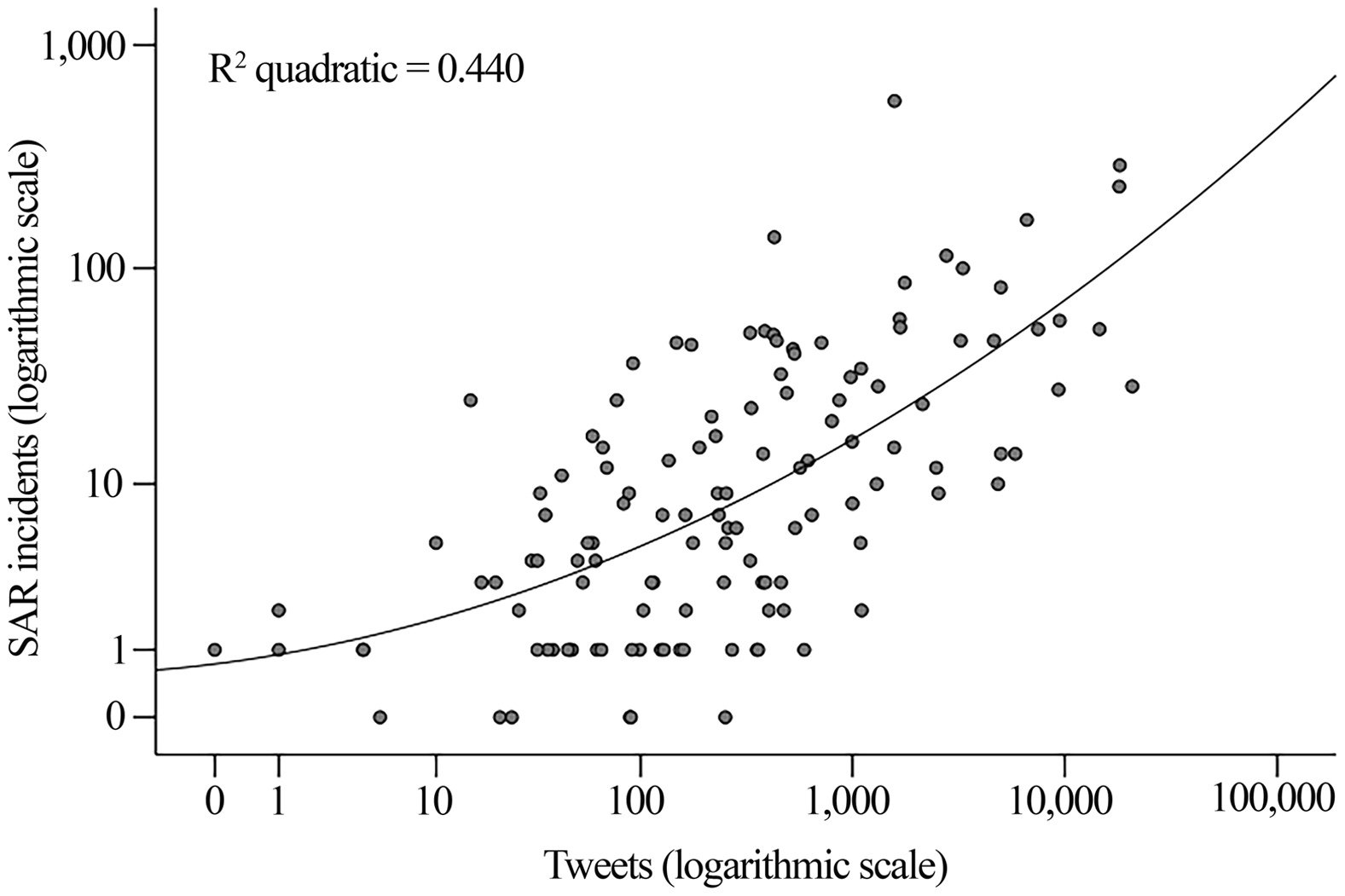
Correlation between tweets and search and rescue incidents.
Limitations
The retrospective design of our study prevents assumptions of causality between the studied variables. Potential confounders such as weather, geography, and cell phone reception were not accounted for in our analysis. Furthermore, our results are shown as nonparametric correlation coefficients because the data were not normally distributed. This limited our ability to yield valid results from a multivariate analysis given that the assumptions required for such analysis, including normal distribution of data and linear relationships, were not met. In addition, we have identified that variables such as tweets and recreational visits may be collinear, and results from a multivariate analysis would potentially be inflated. Because we used databases, the data used to obtain results may be subject to input errors and may not include the entirety of available data. We recognize the potential for bias in the selection of national parks that retained the full national park appendage in the keywords used for tweet searches. Demographic data of users posting to Twitter were not included in the study, and social media use in the context of outdoor recreation may be skewed toward certain populations. Furthermore, we used only Twitter as a measure for social media use, and other social media platforms such as Instagram and Facebook may yield different results in comparing correlations with park visitation and SAR.
Conclusions
Our study found that visitation was associated with SAR incidents, developed and backcountry areas had similar associations with SAR incidents, backcountry areas had a stronger association with fatalities compared to developed areas, and tweets were associated with visitation and SAR incidents. The evolving visitation and social media landscape in national parks warrants further prospective investigation. It is paramount to continue adapting to both the physical and digital landscape of outdoor recreation to ensure the safety of all who take part in the enriching experiences of the great outdoors.
Footnotes
Acknowledgements
Author Contributions: Study concept and design (ZL); acquisition of the data (ZL); analysis of the data (SS); drafting of the manuscript (ZL, AB); revision of the manuscript (ZL, AB, IAG); and approval of final manuscript (ZL, AB, SS, IAG).
Financial/Material Support: None.
Disclosures: None.