






Abstract
Introduction
Although bear attacks on humans are uncommon, the incidence has slowly risen as human populations increasingly encroach on wilderness habitat. In the Kingdom of Bhutan, Himalayan black bear attacks occur regularly. Bears preferentially attack the face, often causing injuries that require surgical airway management. We sought to determine how often patients injured by Himalayan black bears required airway management during initial resuscitation.
Methods
We conducted a retrospective review of emergency department and admission records of the 3 referral hospitals in Bhutan. We identified all victims of bear attacks in Bhutan who received emergency airway management, including surgical airway management during the period from August 2013 to December 2017.
Results
There were 21 patients who were treated for injuries from bear attacks during the study period. Of these, 12 required emergency airway management. Three patients who required emergency airways (2 intubations, 1 surgical airway) were attacked near a regional referral hospital and received care at that hospital. The remaining 9 patients received care from the helicopter emergency medical services (HEMS) retrieval team (1 intubation, 8 surgical airways).
Conclusions
The use of highly trained HEMS critical care retrieval teams may improve outcomes in critically injured patients who require time-critical airway management in remote areas. Countries such as Bhutan with populations far from emergency and critical care might benefit from the establishment of HEMS critical care retrieval services. HEMS teams providing care while retrieving patients from austere environments should be expert in emergency airway management.
Introduction
Although bear attacks on humans are uncommon, the expansion of human populations to encroach on wilderness habitat has made attacks more likely. 1 In the Kingdom of Bhutan, Himalayan black bear attacks occur regularly and seem to be increasing in frequency, a trend also noted elsewhere in the region. 2 The Himalayan black bear (Ursus thibetanus, also colloquially known as the Asiatic black bear) is a bear with a predominantly black coat with a characteristic white or cream-yellow crescent moon chevron on the chest (Figure 1). Adult bears measure 70 to 100 cm at the shoulder and 120 to 190 cm in length. Males weigh an average of 135 kg, and adult females weigh between 40 and 125 kg. As the name suggests, Himalayan black bears live in the Himalayas, but they have a wide range that encompasses the northern part of the Indian subcontinent, Korea, northeastern China, and the Russian far east, as well as parts of Japan and Taiwan. 3
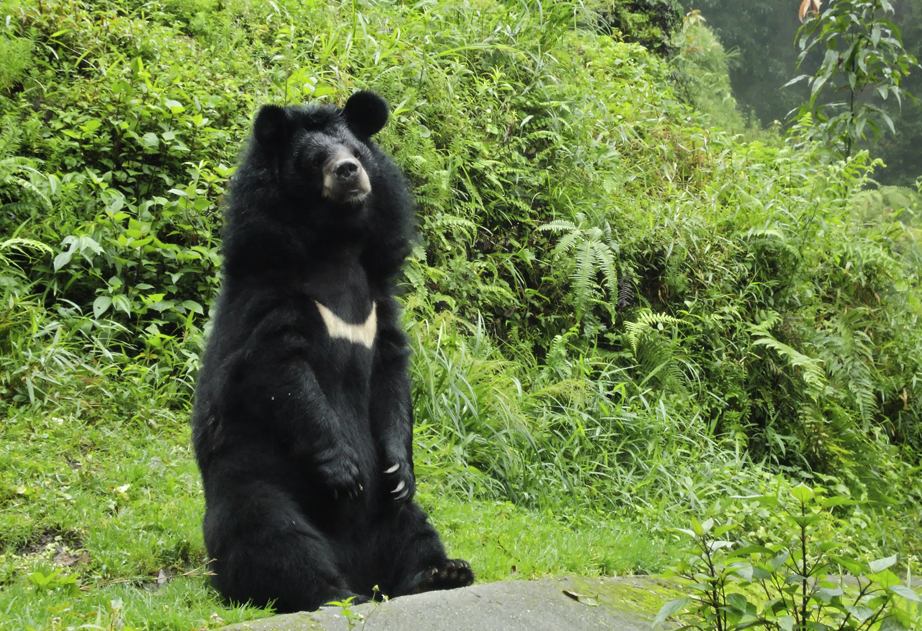
Himalayan black bear. The Himalayan Black Bear is the only bear found in Bhutan.
Himalayan black bears preferentially attack the face, often causing injuries that require surgical airway management. Increasing numbers of people in Bhutan venture into forests to forage for mushrooms and other foods. Himalayan black bears, the only bear species found in Bhutan, are generally shy but can also be aggressive. They sometimes attack people, causing devastating injuries (Figure 2). 4
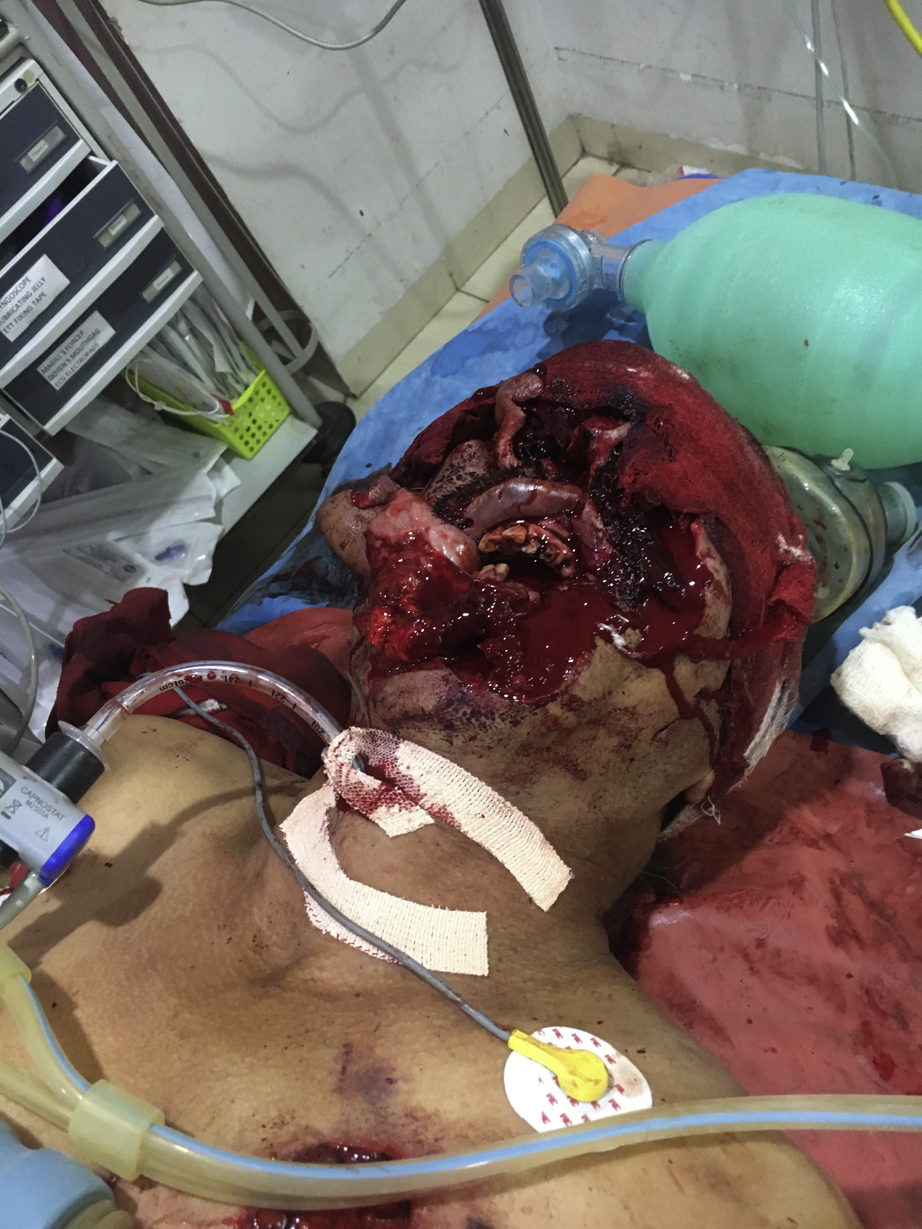
Facial injuries after Himalayan black bear attack. Severe facial injuries after Himalayan bear attack are common.
Emergency physicians who work at Jigme Dorji Wangchuck National Referral Hospital and crews of Bhutan Emergency Aeromedical Retrieval, the kingdom’s critical care helicopter retrieval team, have treated many patients injured by bear mauling and have observed that a large proportion require emergency airway management. A small number of studies have attempted to determine the pattern of injuries common to bear attacks, but, to our knowledge, no studies have mentioned injuries that require emergency airway management. 5 –8 The scant literature suggests that many patients do not receive adequate critical care, especially in less developed countries such as Bhutan. In Bhutan, serious injury and illness can occur far from any healthcare facility or trained healthcare provider, rendering timely critical care, necessary to treat life-threatening conditions, impossible without use of a critical care retrieval team. We sought to determine how often patients injured by Himalayan black bears require emergency airway management during initial resuscitation.
Methods
We first obtained formal ethical clearance from the institutional review board of Bhutan, the research ethics board of health, which oversees all research involving human subjects. The board waived the requirement for individual patient consent and granted approval for publication.
We reviewed the emergency department and admission records of Jigme Dorji Wangchuck National Referral Hospital, the only tertiary referral hospital in the Kingdom of Bhutan and the headquarters for the nation’s critical care retrieval team. We also reviewed the emergency department and admission records of Bhutan’s 2 other referral hospitals, the Mongar Regional Referral Hospital and Gelephu Regional Referral Hospital. We identified patients seen and treated for bear attacks during the period of August 2013 to December 2017. We reviewed individual records of each patient, noting the need for emergency airway management and whether surgical airway management was necessary. The databases were paper binders that included all admissions to the emergency department, operating room, and surgical ward, including transfers from district hospitals and smaller healthcare facilities. The admissions registry often cataloged all injuries and patient condition, including airway status, at time of admission. When we found a case in the admissions registry, we then searched the files of the surgical ward or intensive care unit for the same case to confirm injuries and interventions. We included all cases of bear attacks. When a surgical airway is necessary after a Himalayan black bear attack, it is usually because facial trauma is so extensive and the distortion to the anatomy so severe as to render orotracheal intubation impossible. We considered the need for facial reconstructive surgery after the establishment of a surgical airway as evidence that the airway was necessary.
Results
There were 21 patients who were treated for injuries from bear attacks during the study period. Of these, 12 required emergency airway management. Three patients who required emergency airways (2 intubations, 1 surgical airway) were attacked near a regional referral hospital and received care at that hospital. The remaining 9 patients received care from the helicopter emergency medical services (HEMS) retrieval team (1 intubation, 8 surgical airways). All 9 would likely have died from asphyxiation had an HEMS critical care team not been available because there were no other healthcare providers able to secure these challenging airways. The HEMS team successfully performed all surgical airways using the scalpel-finger-tube method, 9 with the use of a gum-elastic bougie (next to the finger), over which the tube was inserted.
Table 1 shows injuries and airway management of each of the 21 patients who were treated for injuries due to bear attacks.
Bear mauling patients, injuries, airway management, and survival
Discussion
In this study of airway management after Himalayan black bear attacks, we found that almost half of patients required surgical airways. Our research suggested that bears preferentially attack the face. Bear attacks are often severe enough to cause life-threatening airway injuries associated with facial injuries that require surgical reconstruction. A case report describing the management of facial wounds after a Himalayan black bear attack in Arunachal Pradesh, a part of India immediately bordering Bhutan, describes injuries similar to those found in our review: facial fractures, loss of an eye, and extensive lacerations to the face and scalp. 10 The patient’s airway was not involved and did not require emergency airway management. A study of fatal Himalayan black bear attacks in Japan found that all 5 patients who died after being attacked died as a consequence of head injuries. 11
We believe that the public health system of Bhutan and the system of referral allowed us to identify all patients mauled by bears who were treated at a referral hospital during the study period, but we also knew that there might have been victims with injuries so minor that they did not require transfer to a referral hospital or so severe that death occurred shortly after the attack.
We excluded district hospitals and basic health units because all of these facilities transfer any patient with a significant injury to 1 of the 3 referral hospitals. Basic health units are staffed by either a nurse or a general physician with a single year of postgraduate training. Although district hospitals have more experienced physicians and, on occasion, have a physician with postgraduate training in internal medicine, they are not staffed by specialist physicians in emergency medicine, intensive care, surgery, or anesthesia, and they lack the staff and equipment to provide critical care or to perform surgery. Critically injured patients in these facilities are cared for by the critical care retrieval team on site and during transport.
The critical care HEMS team includes a physician with postgraduate training in emergency medicine and prehospital medicine (an emergency medicine specialist) and a nurse with at least 2 y of emergency department or intensive care unit experience and extra training in flight medicine. The team placed surgical airways with excellent success in this small series.
After the study, we learned of 1 victim mauled early in our study period, prior to the initiation of HEMS retrieval. He died of wounds to his face and neck at a basic health unit while awaiting ground ambulance transfer to a referral hospital. This case emphasizes that patients with critical airway injuries are likely to die before reaching medical care in the absence of timely resuscitation. The only patient in our series who died succumbed to airway injuries during a long ground journey to a regional referral hospital to access definitive care. It is possible that timely intervention would have saved that patient’s life. A critical care retrieval team allows the provision of emergency and critical care medicine soon after a patient becomes injured, when there remains an opportunity to intervene.
Limitations
Our work is subject to the limitations inherent to case series. The paper-based recording of cases in Bhutan is scattered among different hospitals and is not standardized, limiting the completeness of data in some cases and making it possible that we may have missed cases. A prospective study of bear mauling cases and their prehospital management would allow a stronger conclusion to be made as to the mortality benefit afforded by a critical care retrieval team. An international registry of Himalayan black bear attacks, their injuries, treatments, and outcomes would not only afford better data to study the true incidence of these attacks but also would allow development of strategies to manage the often-devastating injuries.
Conclusions
The use of highly trained HEMS critical care retrieval teams may improve outcomes in critically injured patients who require time-critical airway management in remote areas. Countries such as Bhutan with populations far from emergency and critical care might benefit from the establishment of HEMS critical care retrieval services. HEMS teams providing care while retrieving patients from austere environments should be expert in emergency airway management.
Footnotes
Acknowledgements
Acknowledgments: The authors thank Dasho Lhab Dorji, president of the Jigme Dorji Wangchuck National Referral Hospital, for his continued support of prehospital critical care.
Author Contributions: Study concept (CM); data acquisition (CM, LD); analysis of data (CM, KZ); drafting of the manuscript (CM); critical revision of the manuscript (CM, KZ).
Financial/Material Support: None.
Disclosures: The authors have no conflicts of interest to declare.