






Abstract
Many UK medical curricula lack dedicated prehospital education other than first aid courses and basic life support training. In contrast, nonmedical mountain rescue team members receive advanced prehospital training addressing scene management and various clinical interventions. This article reports a condensed mountain rescue casualty care course designed for medical students by a mountain rescue team. The course was offered as part of a student-selected module during phase 3A at the University of Sheffield Medical School. Within the module, students also learned the relevant biomedical sciences and clinical skills to construct their knowledge of mountain rescue casualty care.
Introduction
Within the UK, voluntary teams provide organized mountain rescue services.1,2 Data from England and Wales for 2017 record 2115 mountain rescue deployments with 73 fatalities 3 ; of these, Edale mountain rescue team responded to 107 incidents including 1 fatality. At a national level, Mountain Rescue (England and Wales) serves as a coordinating body representing mountain rescue services to the government and statutory bodies. It also coordinates national casualty care training, assessment, and standards. For clarity throughout this article, casualty care is used to describe the care of patients in the prehospital setting. This is a mountain rescue term synonymous with wilderness first aid, wilderness medicine, and prehospital emergency medicine.
Casualty care tuition is guided by the CABCDE principles (treat catastrophic hemorrhage; then assess/treat airway, breathing, circulation, disability [head and spinal injuries]; protect from the environment). The training equips each team member to identify scene dangers, request further appropriate resources, perform a primary survey,4,5 and present a working diagnosis. This clinical assessment then influences strategies for patient packaging and evacuation. The course assessment comprises 60 single-best-answer questions requiring a pass mark of 70% and 2 practical scenarios (1 medical and 1 trauma) requiring a pass grade of at least 20 of 30.
Holders of the nationally recognized casualty care qualification can perform various extended care skills (Table 1) and administer certain prescription medications, including opioid analgesia, not usually associated with standard first aid courses (Table 2).2,4 Remote incidents often present mountain rescue teams with context-specific challenges, including difficulties accessing patients, limited resources, and inclement conditions. Therefore, team members must also be competent mountaineers.
Primary survey skills
Midazolam is now replacing rectal diazepam.
MREW drug formulary used by Edale mountain rescue team
Lack of formal training in prehospital care leaves medical students ill prepared to act in a prehospital emergency in which anything beyond basic life support is required. 6 –13 Therefore, Sheffield medical students approached the local mountain rescue team (Edale) requesting an elective attachment to learn prehospital care skills. In response, the Edale mountain rescue team devised an elective placement focused on casualty care provision and its associated challenges (Supplementary Information Table 1).
Placement design
The teaching group comprised serving members of Edale mountain rescue team, including a medical school academic as the module leader, responsible for the day-to-day educational organization of the program; 3 anesthetists (consultant and specialist registrar, both air ambulance physicians, and 1 further specialist registrar); an emergency nurse practitioner with polar medicine expertise; and a mountaineering instructor with broad Alpine and Himalayan guiding experience.
Student selection
Being comfortable in a mountaineering environment was important (mountaineer first, doctor second), and students enquiring about the module already engaged in remote-area hobbies (eg, hiking, climbing). We interviewed all prospective students stipulating placement requirements. Professional behaviors, including integrity and respecting patient confidentiality, were monitored as required by the University of Sheffield (Supplementary Information Table 2).
Insurance
The UK mountain rescue service always operates under delegated authority of the police, with team members being covered by the appropriate regional police service's personal accident insurance policy. This policy extended to civilians, including medical students, training with the team. The University of Sheffield always provides comprehensive travel and personal liability insurance for its students undertaking placements away from the main campus, and students were advised to use this (Supplementary Information Table 3). Given these provisions, Edale mountain rescue team did not need to implement a specific health or personal liability policy for students. In this placement, although students would not be providing clinical care, all had medical malpractice insurance. Medical students were also required to complete a health and safety questionnaire to ensure the placement provider had appropriate governance procedures (Supplementary Information Table 3).
Phase 3A student-selected component placement learning objectives
Module delivery and engagement
Students received 2 full days per working week of contact time with various instructors over a 6-wk period. This provided focused tuition in the clinical aspects of mountain rescue casualty care. Within the remaining 3 d students completed self-directed learning to develop their critical analysis skills through journal clubs, production of prehospital literature reviews, and data collection for audit or research. 14 We also introduced the 3-min thesis presentation. 15 Essentially, in this presentation format, one needs to translate experimental data into a jargon-free lay narrative and present that in 3 min. An example study was the advanced trauma life support classification of hypovolemic shock. 16 All instructors provided regular feedback to students to facilitate their learning. Table 3 lists the placement learning objectives that were delivered in 3 overarching themes:
Teaching on each aspect of the primary survey examination covered the relevant biomedical sciences and clinical considerations. This tuition was reinforced with practical demonstrations of various skills (eg, airway maneuvers or preparing bag-valve masks). The pharmacology of the drugs listed in Table 2 was also introduced at this stage, giving students an opportunity to develop their knowledge of these common medications and appreciate the clinical manifestations of potential adverse effects of such drugs. Presentations focusing on common medical illnesses seen by mountain rescue teams, including severe acute asthma and chest pain, were also delivered.
The senior prehospital clinicians and emergency nurse practitioner were keen to provide an overview of more advanced interventions, including prehospital sedation and anesthesia (including the use of ketamine for limb fracture reduction) as well as cold-induced injuries and polar medicine. Students enjoyed learning the theory around these extended clinical skills.
Within the primary survey teaching, students were sometimes challenged by apparently conflicting medical needs. This was reinforced by the evidence for casualty care interventions often being based on consensus expert opinion 17 –19 rather than empirical experimental data. Consequently, students were encouraged to appraise the risks and benefits of interventions and come to a balanced decision using suitable case studies. This is illustrated in the case of an unconscious patient with a potentially unstable cervical spine injury and the concomitant need to secure the airway. 20 Care was taken to emphasize 2 salient points: 1) the need to open the airway as a priority while giving consideration to spinal care and 2) that spinal care should not take priority over the airway. This approach was in keeping with the appropriate prehospital consensus statements 17 –19 and helped students address uncertainty in their own clinical decision making.
Casualty care skills are best taught in the appropriate wilderness environment, 21 and in keeping with this notion, once students were comfortable completing an “indoor” primary survey, practical teaching was extended to remote moorland areas regardless of the prevailing weather conditions. This was important for students’ learning: undertaking a primary survey in a warm, dry hospital environment is in stark contrast to completing the same examination at a remote location, be it training (Figure 1A–C) or at a live incident (Figure 1D) where poor site access and inclement weather can compound the casualty's condition and affect equipment functionality. For example, pulse oximetry may be ineffective in a cold patient because of peripheral vasoconstriction. Importantly, if students attended a live call-out, a full postincident debrief assessed their well-being and identified learning points they wished to discuss.
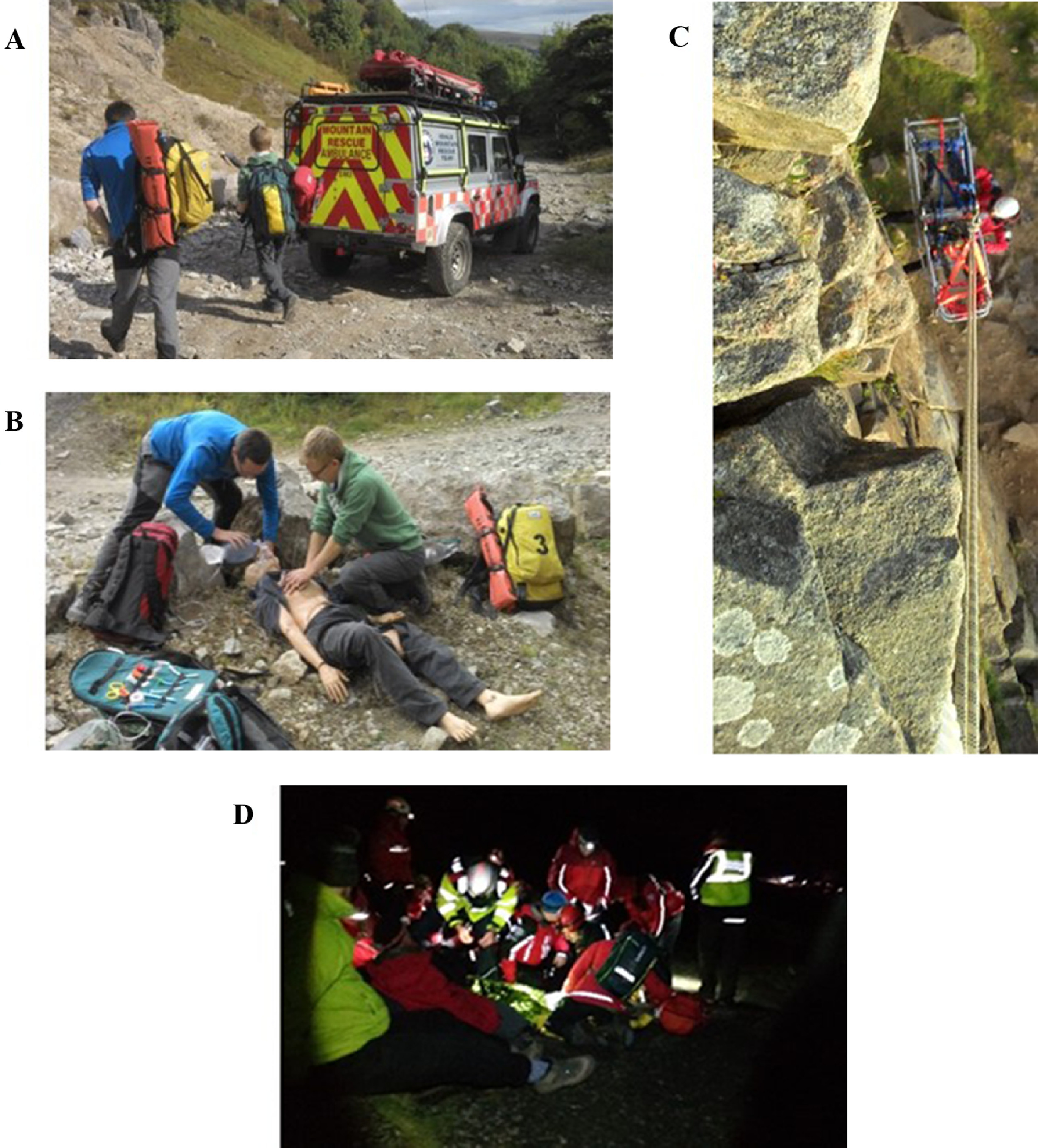
Medical students undertaking an elective placement with Edale mountain rescue team. A and B, Students learning to complete a prehospital primary survey—these skills can be readily employed in many acute clinical settings. C, Team training—learning vertical rescue and stretcher handling techniques. D, Members of Edale mountain rescue team reducing a fractured lower limb to re-establish neurovascular function. Those seated members are preventing the storm from blowing equipment away.
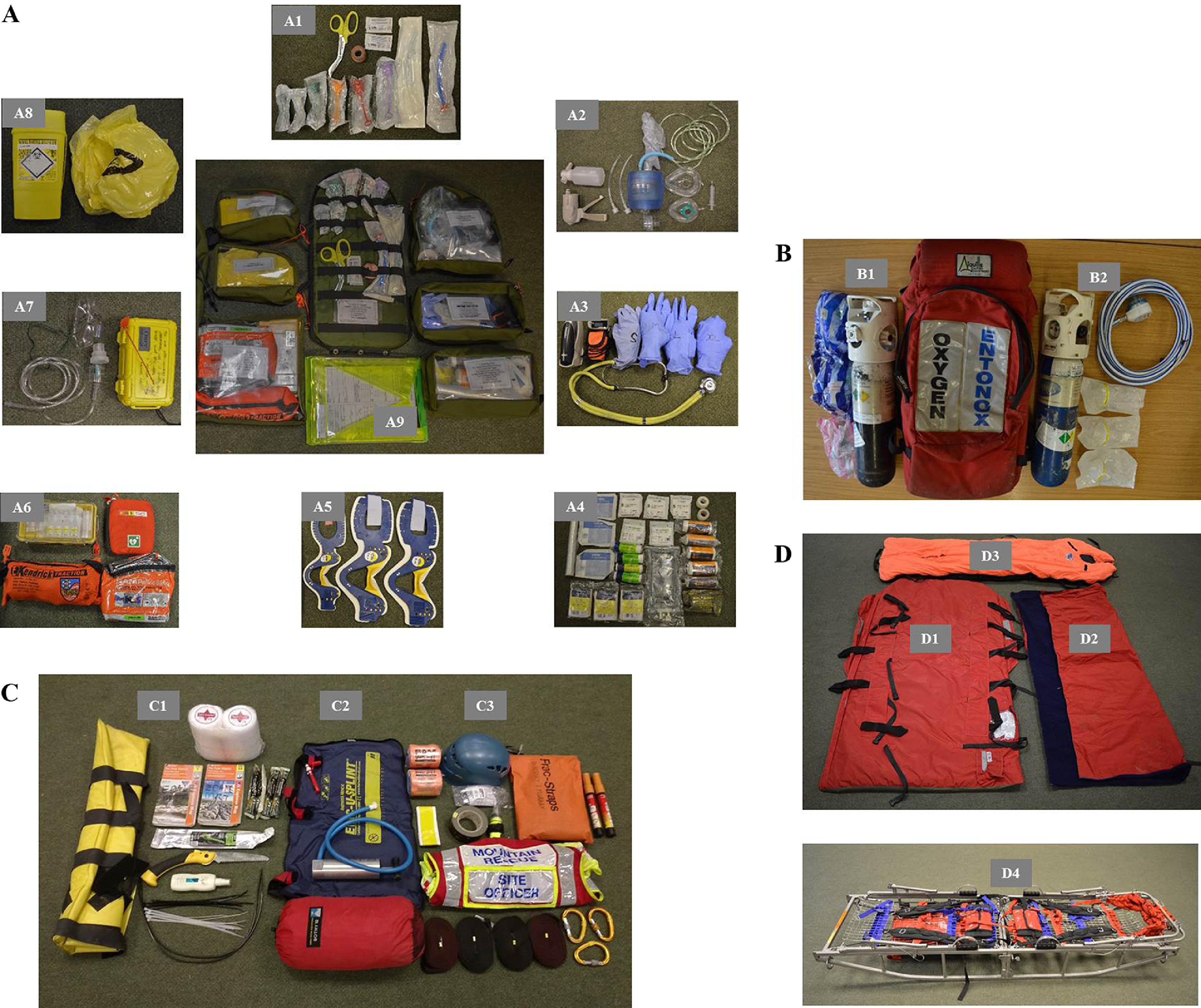
Equipment used by Edale mountain rescue team. Team medical bag and contents: A1, nasopharyngeal and oropharyngeal airway adjuncts; A2, bag valve mask and suction device; A3, pulse oximeter and gloves; A4, sterile dressings including Celox hemostatic agent and cling film (for burns); A5, cervical collars; A6, automated external defibrillator, pelvic binder, femoral (Kendrick) traction splint, advanced life support drugs; A7, nebulizer mask and other team drugs; A8, sharps bin and biohazard bags; A9, patient record forms. The team also carries oxygen and delivery masks (B1) and analgesia (Entonox) with patient demand valve giving set (B2). C1, Various tools, disposable head blocks, glow sticks, and maps; C2, vacuum splints, malleable (SAM) splints, and shelter tent, along with (C3) a helmet, fracture straps, smoke flares, tape, site vest, slings, and HMS karabiners are carried. The vacuum mattress (D1) and Pertex blanket (D2) provide adequate patient insulation for most seasons being supplemented in winter with the Wiggy bag (D314). D4, Patient transport is by the Bell mountain rescue stretcher.
Discussion
This module commenced in 2008 as a response to increasing requests by Sheffield medical students for training in mountain rescue casualty care. This was in keeping with an increased interest in undergraduate teaching of prehospital emergency care. 7 –13 Despite demand from students from surrounding areas, only 8 students were taken per year. It was found the elective was most affordable and accessible for Sheffield students who already lived locally, approximately 25 min from Edale mountain rescue team headquarters. This was an important financial consideration.
It was important to manage student expectations of the module because some students initially believed mountain rescue was, in the words of one student, “all blue lights and helicopters.” Without any clear explanation, the reality could prove disappointing, and it was important to emphasize that students would not attend callouts unless an instructor was present; students accepted this openly, and those who did observe a live rescue evolve found it a valuable learning exercise.
All UK mountain rescue teams are charities and, with the exception of those in Scotland, do not receive central government funding. Consequently, many weekends and evenings are spent fundraising and undertaking public engagement work, so students were included in those activities. Equally, mountain rescue team training typically occurs during evening hours and at weekends, and student schedules needed to accommodate this. The training students engaged in varied depending on placement timing, but examples included vertical rescue techniques (Figure 1C) and “bodying” (essentially hide-and-seek with a dog on the hillside) to train the search dogs and their handlers.23,24 This combined package of activities complemented the clinical training, giving students a more realistic view of mountain rescue work and an appreciation of the significant time commitment required to be a member of a voluntary rescue service.
Good communication skills are vital for clinical jobs, and the students valued learning to give a good 3 min thesis presentation because it developed their ability to translate complex terminology into a concise lay narrative. The small group teaching with academic staff also facilitated this because students more willing to ask questions and highlight their own uncertainty with particular topics.
Assisting at a mountain rescue emergency is challenging even for professional responders. 20 The mountain rescue casualty care skills taught in this module are immediately transferable to any environment, urban or otherwise, 5 and coupled with knowledge of how mountain rescue teams function, they will provide a strong foundation for students wishing to follow a career in emergency and wilderness medicine. 25 Therefore, we were keen to instill in our students that, as a specialty replete with shades of gray, mountain rescue casualty care has few axioms because a pragmatic approach is essential: Keep it simple, keep it safe.
Footnotes
Acknowledgments
To those individuals who took time to provide the constructive anonymous peer review of this article, your collective insight has been very much appreciated. We are also grateful to the following individuals: Mike Chapman, James Crossley, Mark Fenwick, Gaynor Miller, Mike Pierson, and Sarah Waite for critical appraisal of the final manuscript; John Coombs, national training officer for the search and rescue dog association (SARDA England), for allowing students to train with search dogs; and Ian Bunting, chairman and past team leader of Edale mountain rescue team, for his support of this project. Edale Mountain Rescue Team Ltd is a registered charity in England and Wales, Charity Number 1138626.
Author Contributions: Devised the module and prepared the teaching objectives (NC, CP); prepared the initial teaching slides as part of her SSC work on this module (JL); provided teaching for this SSC (NC, CP, HB, NS, BC, CA, ML, CW); prepared the manuscript (NC); read and provided critical comment on the final version (NC, CP, HB, NS, BC, CA, ML, CW, JL).
Financial/Material Support: None.
Disclosures: None.
Supplementary materials
Supplementary material associated with this article can be found in the online version at doi:
References
Supplementary Material
Please find the following supplemental material available below.
For Open Access articles published under a Creative Commons License, all supplemental material carries the same license as the article it is associated with.
For non-Open Access articles published, all supplemental material carries a non-exclusive license, and permission requests for re-use of supplemental material or any part of supplemental material shall be sent directly to the copyright owner as specified in the copyright notice associated with the article.
